

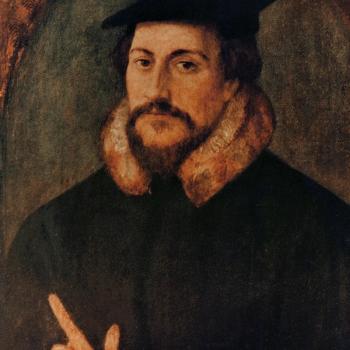
Have you ever read something about history that stopped you in your tracks? That shook up your assumptions about the past? It happens to me all the time. I still remember reading the epilogue of Ward Holder’s Calvin and the Christian Tradition (Cambridge University Press, 2022) on a plane ride a few years back, when I was stunned to read about John Calvin’s interpretation of 1 Corinthians 11:13-15. The passage in question comes in the context of Paul arguing that men must pray or prophesy with their heads uncovered, while women must do the same with their heads covered. Observing this tradition will, in Paul’s argument, rightly symbolize the gender hierarchy of husbandly authority and wifely submission. Holder highlighted the scripture, and Calvin’s grappling with it, to make a larger point about how we all, even—especially!—biblicists don’t just come to the Bible and read it afresh. We all read within traditions. These reading traditions tell us what to pick up to bring on the journey and what to leave on the floor, as it were. In Ward’s words, “My argument here is not that biblical literalism is wrong, but that the idea of a biblically literal community is in itself a tradition. Every ‘biblically literal’ community of faith decides subconsciously that certain passages are not meant literally, or that they should be glossed over or not considered.” Holder illustrates this by dialoguing with Tim Keller’s work supporting the withholding women’s ordination. Keller argued from 1 Corinthians 11:3-8, which states the husband is the head of the wife. As Holder writes, Keller argues specifically from the created order, from nature. But, Holder asks, why stop at verse 8? Beginning in verse 13, Paul appeals specifically to nature:
Judge for yourselves: is it proper for a woman to pray to God with her head unveiled? Does not nature itself teach you that if a man wears long hair, it is degrading to him, but if a woman has long hair, it is her glory? For her hair is given to her for a covering (1 Cor. 11:13-15).
 Holder then turns to Calvin’s commentary on the passage. This is the part that surprised me. Holder offers his own translation, but I’ll provide the translation from CCEL so interested readers can find it in context. Calvin writes of the passage,
[Paul] again sets forth nature as the mistress of decorum, and what was at that time in common use by universal consent and custom — even among the Greeks — he speaks of as being natural, for it was not always reckoned a disgrace for men to have long hair. Historical records bear, that in all countries in ancient times, that is, in the first ages, men wore long hair. Hence also the poets, in speaking of the ancients, are accustomed to apply to them the common epithet of unshorn. It was not until a late period that barbers began to be employed at Rome — about the time of Africanus the elder. And at the time when Paul wrote these things, the practice of having the hair shorn had not yet come into use in the provinces of Gaul or in Germany. Nay more, it would have been reckoned an unseemly thing for men, no less than for women, to be shorn or shaven; but as in Greece it was reckoned all unbecoming thing for a man to allow his hair to grow long, so that those who did so were remarked as effeminate, he reckons as nature a custom that had come to be confirmed.
Did you catch that? Calvin writes that Paul was, strictly speaking, incorrect about the “universally understood” teaching that men should have short hair and women long. Paul was limited, as are we all, by his cultural context, and Calvin pointed this out. Holder writes, “Calvin was also clear that this was not the order of nature—not something decreed by God.” To be sure, most conservative churches have followed Calvin’s conclusion by effectively ignoring Paul’s teaching on nature, long hair, short hair, and veils even as they loudly proclaim Paul’s teaching on nature, male authority, and female submission.
I thought of Ward’s dialogue with Tim Keller again this week in the shadow of another looming vote to restrict women’s ordination or public teaching in the Southern Baptist Convention. And I returned to Calvin’s commentary on 1 Corinthians 11. The obvious take on Calvin is that he denied the ordination of women, and that he generally saw women as inferior to men. Yes, this is true. And it’s important context. Calvin was a 16th century man of some influence and learning—thus, he was patriarchal in his outlook.
What’s more interesting to me is the way that the Bible pushes on Calvin’s and others’ patriarchal assumptions in real time and that, because Calvin took the Bible very seriously, he was often very obviously forced to grapple with a text that didn’t behave as expected. There is no “complementarian” synthesis or evangelical reading tradition from which Calvin can draw to help him decide how to go on any given passage. He’s using different maps to chart new paths. This leads to fascinating and often competing through-lines or values in Calvin’s exegesis. It also elevates Calvin’s dependence on hermeneutical strategies like divine condescension and culturally contextual readings. This is clear in his commentary on 1 Corinthians 11.
To begin with, Calvin views much of this passage as dealing not with eternal decrees, but with order and custom. The beginning of 1 Cor. 11 begins with Paul praising the church in Corinth for “maintaining the traditions just as I handed them on to you.” What traditions? Calvin writes, these are unrecorded traditions having to do with mitigating scandal and promoting dignity: “all actions are set off to advantage by decorum, and are vitiated by the want of it…Hence he prescribes some things that are connected with public order, by which sacred assemblies are rendered honorable.” And later, he writes that these things related to decorum and church government are not rigid. “For we know that every Church has liberty to frame for itself a form of government that is suitable and profitable for it, because the Lord has not prescribed anything definite.” The prevailing motif for Calvin is found in 1 Cor. 14:40, that “all things should be done decently and in order.”
The emphasis on custom and propriety, culturally defined, is carried through Calvin’s interpretation of 1 Cor. 11:3: “But I want you to understand that Christ is the head of every man, and the husband is the head of his wife, and God is the head of Christ.” Calvin writes this seems to conflict with Paul’s teaching elsewhere in Galatians 3:28, that in Christ there is no “male and female.” Calvin’s rhetorical question: “Why then does he make a distinction here, which in that passage he does away with?” His answer:
The solution of this depends on the connection in which the passages occur. When he says that there is no difference between the man and the woman, he is treating of Christ’s spiritual kingdom, in which individual distinctions are not regarded, or made any account of; for it has nothing to do with the body, and has nothing to do with the outward relationships of mankind, but has to do solely with the mind — on which account he declares that there is no difference, even between bond and free. In the meantime, however, he does not disturb civil order or honorary distinctions, which cannot be dispensed with in ordinary life. Here, on the other hand, he reasons respecting outward propriety and decorum — which is a part of ecclesiastical polity. Hence, as regards spiritual connection in the sight of God, and inwardly in the conscience, Christ is the head of the man and of the woman without any distinction, because, as to that, there is no regard paid to male or female; but as regards external arrangement and political decorum, the man follows Christ and the woman the man, so that they are not upon the same footing, but, on the contrary, this inequality exists.
Notice that Calvin doesn’t make the evangelical complementarian move: to underline spiritual equality but highlight divinely ordained and eternally decreed differentiation in roles. Calvin does something quite different. He affirms the spiritual equality of men and women, but then places the headship of men under a different category, that of standing: his concerns orbit around civil order, honorary distinctions, or social decorum. These are all fluid and localized categories. Calvin’s culturally conservative interpretation of Paul nevertheless opens the possibility of something different, precisely because Calvin’s reading of Paul respects its contextuality. If indeed external arrangement and political decorum are prevailing concerns in the churches, the kinds of arrangements and decorum that are to be observed are open to change. At other points, Calvin is unable to imagine the world as other than it is, and thus is forced into an uncomfortable corner, like in his reading of vv. 4-5. The scripture reads: “Any man who prays or prophesies with something on his head disgraces his head, but any woman who prays or prophesies with her head unveiled disgraces her head.”
Naturally Calvin asks, what’s all this about women praying and prophesying? This creates problems for Calvin, especially since he views prophesying and praying as authoritative public acts. Of prophecy, he says it means “declaring the mysteries of God for the edification of the hearers,” while praying means “preparing a form of prayer, and taking the lead, as it were, of all the people—which is the part of the public teacher.” So if prophecy and prayer are public and authoritative, what gives, Paul? Calvin essentially argues that Paul isn’t reneging on his teaching in 1 Timothy 2 or 1 Cor. 14, that women should be silent, but rather is condemning uncovered prophecy without commending covered prophecy.
Elsewhere, in his commentary on 1 Timothy, Calvin anticipates objections to his interpretation by those who bring up women prophets and leaders in scripture—Miriam, Deborah, Huldah, Anna, and others. “The answer is easy,” he says (a delightful glimpse into Calvin’s style, I might add). “Extraordinary acts done by God do not overturn the ordinary rules of government, by which he intended that we should be bound. Accordingly, if women at one time held the office of prophets and teachers, and that too when they were supernaturally called to it by the Spirit of God, He who is above the law might do this; but, being a peculiar case, this not opposed to the constant and ordinary system of government.”
We might turn Calvin’s treatment of Paul on him. Where he seems to argue from the state of normalcy, the status quo, even what seems “natural,” we can from our vantage point see that Calvin’s own patriarchal perspective—what he must have assumed to be universal and natural—was a product of custom, decorum, and discrete exercises of power. The world as he saw it was not inevitable, whatever he might have thought.
It’s worth noting, too, that Calvin wasn’t the only early modern commentator who took this tack. Peter Martyr Vermigli, the Italian reformer, wrote of women and prophecy in 1 Corinthians that although the “ordinary and general” pattern was male leadership in the churches, “since occasionally the Spirit of the Lord has come upon them [women], it was not completely forbidden them to say something.” Similarly, French reformer Wolfgang Musculus wrote in his commentary that while “Paul is restraining female rashness, for women are frequently very talkative and, forgetting their place as women, burst forth with teaching and prophesying…Nevertheless, Paul did not quench the spirit whereby some women, inspired to predict the future, were prophesying.”
Patriarchal? Yes. But Calvin and others were certainly not attempting an internally consistent or coherent, systematic approach to the question. In this, they are less than complementarian, more restrictive than nearly all modern churches, and at the same time perhaps more honest with themselves about the tensions inherent in the scriptural witness, and more open to the possibility–at least rhetorically–of the Spirit exploding social categories. If not open, they were at least observant.
Calvin ended his commentary on this section of 1 Cor. 11 with Paul’s admonition against contentious people. “Of this description,” Calvin writes, “are all who, without any necessity, abolish good and useful customs, raise disputes respecting matters that are not doubtful, who do not yield to reasonings, who cannot endure that any one should be above them.” A number of live questions result. How do we know what customs are good and useful, and for whom? What constitutes a custom being necessarily abolished? How do we know if a matter is in doubt?
Calvin does not leave us an example of a church leader who strove for liberative readings of scripture. In many ways, he was far from it. But because he was strenuously concerned to deal with the text as both historical and authoritative, his exegesis unfolded in some surprising ways. Calvin’s exegesis of 1 Cor. 11 placed Paul’s teachings in the context of the local church in Corinth, thus detaching their creation from the realm of smooth eternality and locating them in the rough and foreign terrain of antiquity. The principles of universal application were, for Calvin, the necessity of churches to provide workable and meaningful structure and to attend to questions of dignity, propriety, and decorum. In focusing the application here, Calvin began to chisel at the ageless tradition of the Latin Church, but he also opened the possibility for a world in which propriety, order, and dignity demand the recognition that the Spirit’s call upon women is not irregular, extraordinary, or at odds with the natural world. Calvin’s culturally contextual, patriarchal exegesis offers a vision of equality, mutuality, and the honoring of women’s authority as a gift to the churches, even if it was a vision he couldn’t himself fully see.











 Ad-Free & Subscriber Log-In