2016-01-27T21:55:41-05:00

https://www.youtube.com/watch?v=b_gREw_7xIQ This was an All Star tribute to Led Zeppelin. This is why they call it ‘classic rock’. Real musicians were writing and performing their own music on real instruments producing memorable tunes that stick in your head for generations. And notice that Plant and Page et al. were in the audience and thought the recreation was awesome. This was the vox populi in the 60s, 70s, and into the 80s when technologically produced music replaced actually playing instruments. Read more

2016-02-01T15:05:12-05:00

https://www.youtube.com/watch?v=BQmllwTKtqU ‘The Finest Hours’ starring Chris Pine and Casey Affleck, is certainly one of the finest ‘rescue’ movies ever made. It tells the true story of a dramatic rescue of more than twenty men hanging on for dear life to the second half of a tanker that split, in gale force winter winds and thundering tides on Feb. 18, 1952 off the coast of Chatham And Wellfleet Massachusetts. The movie is one hour and 57 minutes long, but it seems... Read more

2016-01-19T19:24:23-05:00

Kudos to my friend Ed Paxton who found this on the internet. Read more

2016-01-18T11:00:31-05:00

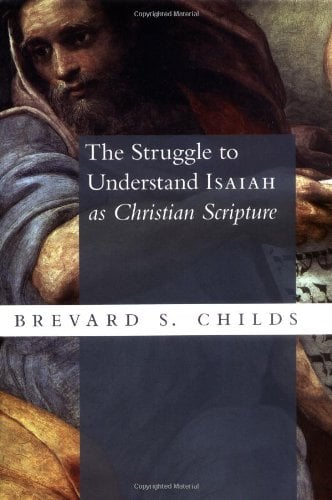
Strangely, Child’s jumps nearly 900 years to his next major interpreter, Aquinas. How is it even possible that there is no real discussion of Augustine’s voluminous dealings with the Biblical text, including Isaiah? Or even someone like Bede? And why include a minor figure like Nicholas of Lyra who really adds little to the discussion? However we answer these questions, there can be no cavil with giving good treatment to Aquinas. The influence of Thomas Aquinas (ca. 1225-74 A.D.) compared... Read more

2016-01-18T10:59:05-05:00

The Antiochian school of interpretation (Theodore, Julian, Chrysostom, Theodoret) has frequently been misunderstood, and as a result, misinterpreted. They were not simply interested in the literal or historical meaning of the text as oppose to the spiritual and allegorical interests of the Alexandrians. Childs outlines the approach of this school to theoria (theory): 1) the Antiochian theoria presupposes the historical reality of the events described by the Biblical author. These events function something like a mirror imaging forth a different... Read more

2016-01-18T10:57:45-05:00

Cyril of Alexandria (ca. 378-44 A.D.) before he became embroiled in controversy with Nestorius and others in about 430 A.D., Cyril wrote some major commentaries on the Bible, including on Isaiah and John. He stood, not surprisingly, entirely in the Alexandrian tradition of interpreting the Scriptural text, and being of a polemic turn of spirit, he often took serious issue with the Antiochean approaches. He has a good deal to say about the literal and spiritual senses of the Biblical... Read more

2016-01-18T10:56:34-05:00

Sadly, we do not have much from John Chrysostom (ca. 349-407 A.D.) on Isaiah. This is a great pity because in my view he was the greatest exegete of the early church. We do have five or six Homilies on Isaiah but they are not focused on the exegesis of the text of Isaiah but rather presuppose that work Chrysostom had done earlier, and instead concentrate on the moral application of the material to a Christian audience. Yes, an Armenian... Read more

2016-01-18T10:54:41-05:00

It would be hard to over estimate the significance of Jerome (345-420 A.D.) when it comes to the establishing of Christian commentating on the Bible, including on Isaiah. Ironically, despite all his erudition and thorough knowledge of Hebrew and Greek, it is his translation of the Bible into Latin, the so-called Vulgate (done between 391 and 404 and largely based on the Hebrew text of the OT), which is to say a move away from any of the Biblical languages,... Read more

2016-01-18T10:53:20-05:00

Eusebius (ca. 260-340 A.D.), is of course best known for his work Ecclesiastical History for which he came to be dubbed the ‘father of church history’. It is only in more recent decades that research has focused more on Eusebius as a Biblical commentator, and still more recently his Isaiah commentary has been unearthed, analyzed and made available (1999). It is clear enough that Eusebius is cognizant of earlier approaches to interpreting the Bible in the Christian tradition, but his... Read more

2016-01-18T10:51:56-05:00

The next member of the Alexandrian school could hardly be more different in some respects than Clement. I am referring to Origen (ca. 185-254 A.D.). Unlike Clement, Origen was indeed first and foremost a Bible scholar, an exegete. Nevertheless, his go to method was allegorizing of the Biblical text, sometimes in service of reconciling the Biblical tradition with the Greek philosophical one. One of the methods used in the Alexandrian approach to Scripture is what we would call the ‘word... Read more

Follow Us!


TAKE THE
Religious Wisdom Quiz

Which Christian denomination believes in seven sacraments?

Select your answer to see how you score.


Browse Our Archives