

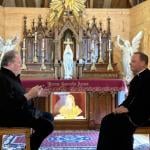
Recently a clip of an interview between Pope Leo XIV and Elise Ann Allen was been making the rounds. It took place as part of a wide-ranging and deeply personal biography titled León XIV: ciudadano del mundo, misionero del siglo XXI (Leo XIV: Citizen of the World, Missionary of the 21st Century), published in Spanish by Penguin Peru on today (September 18, 2025).
One segment of the interview in particular is getting attention. Here Pope Leo Responds to Elise Ann Allen’s question about how his tone will be different than Francis on issues related to LGBTQ+ issues.
Here’s the quote:
What I’m trying to say is what Francis said very clearly when he would say, “todos, todos, todos.” Everyone’s invited in, but I don’t invite a person in because they are or are not of any specific identity. I invite a person in because they are a son or daughter of God. You’re all welcome, and let’s get to know one another and respect one another. At some point, when specific questions will come up… People want the church doctrine to change, want attitudes to change. I think we have to change attitudes before we even think about changing what the Church says about any given question. I find it highly unlikely, certainly in the near future, that the church’s doctrine in terms of what the church teaches about sexuality, what the Church teaches about marriage, [will change].
—Pope Leo XIV to Elise Allen
I find the phrase “in the near future,” to be perhaps the most significant statement in the entire exchange.
This phrase could be interpreted in several ways, each carrying weighty implications. On one hand, it may function as a delay tactic, offering a kind of false hope to groups seeking reform of the Church’s moral teachings.
On the other, it might signal an openness to doctrinal development that stretches beyond what John Henry Newman envisioned (a development not as a rupture, but as a preservation of truth through adaptation, remaining faithful amid a rapidly shifting cultural zeitgeist) instead suggesting the introduction of a discontinuity or reversal of long-held moral teachings – a new Praevalet cura pastoralis hermetic in the execution of the role of the Magisterium.

Both possibilities are troubling if true.
There is, however, a third and more charitable interpretation: that Pope Leo is expressing a form of epistemic humility. That is, while he cannot currently envision a path by which the Church’s teaching on this topic might change, he nonetheless leaves room for the movement of the Holy Spirit—acknowledging that divine wisdom may unfold in ways beyond his own understanding.
Yet Pope Leo XIV, both in this quote and elsewhere in his interview, rightly reminds us that our focus on sin must never be divorced from the identity of the person: beloved by God, created with innate dignity, and destined for communion with Him. This is not sentimentality—it is theological realism. Every person is more than their choices, and every soul is called to transformation.
Given that the Church’s stance is that moral truths are meant to guide souls toward holiness and eternal life, the tension we face today must be taken seriously. Sin wounds us—deeply. To ignore it, minimize it, or smooth it over is to risk an enormous spiritual cost, both personally and communally.
We should indeed cry out “todos, todos, todos”—but we must also be clear that the invitation is to a new identity. One in which God’s love is not merely comforting, but consuming. Mercy is not cheap grace. It is a righteousness that gives no quarter to any area of our lives where we choose a path other than that of being transformed in mind and heart.
The obsession of our age with sex—and it is an obsession—is not the Church’s doing. The Church has not elevated sexuality as the supreme moral concern; rather, it has responded to a culture that has enthroned pleasure-centered utilitarianism. This cultural fixation owes more to Jeremy Bentham than to Casti Connubii, Humanae Vitae, or Persona Humana. Bentham’s principle of utility, which elevates the maximization of pleasure and minimization of pain as the highest good, has shaped a worldview where sexual satisfaction is seen as the pinnacle of human fulfillment.
In contrast, the Church’s teachings are not repressive—they are redemptive. They are a response to a culture that has placed individual autonomy above all else, even above truth, goodness, and communion. This is fundamentally antithetical to the Gospel, which calls us not to self-sovereignty, but to self-gift.












 Ad-Free & Subscriber Log-In