

Most of us don’t think much about peace until we realize how badly we need it. What if “Peace” is another name for God?

It’s the relief you feel after a sleepless night when the doctor finally says, “It’s treatable.” Or the sound of the door closing late at night, when you can finally rest because “they’re home.” It’s the calm after the storm. Peace arrives in the margins of real life. You know what it feels like, without needing to define it. I’ve come to believe something bold: peace isn’t just something God gives—Peace is one of the names of God.
More Than a Greeting
Around the world, Jewish people greet one another with the word shalom. What a beautiful blessing! But I want to go further than simply admiring the greeting; I’m about to make the audacious claim that Peace is one of the names of God. Today I want to talk about God not just as someone who gives peace, but as the God who is Peace—God as Shalom itself.
Gideon’s Revelation: God Is Peace
In Judges 6, Gideon is terrified of the Midianites and hides in a winepress, doing everything he can to stay unnoticed. Yet after an encounter God, he builds an altar and names it YHWH Shalom—“the Lord is Peace.” Gideon understood something profound. He wanted peace for his people and peace for his own troubled heart. He understood that peace wasn’t something achieved through force of arms, nor was it simply the absence of conflict. By naming God “Peace,” Gideon declared that Peace wasn’t just a divine gift but a divine identity.
Gideon could have said, “The Lord gives peace,” or “The Lord inspires peace.” But he didn’t. He said, “The Lord is Peace (with a capital P).”
Shalom: Nothing Missing, Nothing Broken
Shalom is more than quiet or lack of conflict. It means wholeness, well-being, “nothing missing, nothing broken.” Shalom is everything as it should be—a picture of life put back together, a vision of cosmic order fulfilled. This Peace is love in action, not mere sentiment but embodied reality. This kind of peace lifts up the brokenhearted, sets prisoners free, feeds the hungry, strengthens the afflicted, protects the vulnerable, and lights up the darkness.
Where Shalom Breaks Into Real Life
If God is Shalom, then we should be able to spot that kind of wholeness showing up in real, everyday life. Divine Peace can and should arrive in places that don’t look religious at all—hospital rooms, parking lots, kitchens, shelters, and living rooms where bitter conflict turns to understanding.
Some years ago, I wrote about a man I’ll call Nick, who had been living in his vehicle for years—medically fragile, cold, and one bad night away from disaster. After we finally moved him into his new apartment—a place with heat, a bathroom, and a bed that doesn’t recline in front of a steering wheel—I asked him how he felt. His eyes went wide and Nick said, “I think I might not die now.”
What a statement. Those five words carried the weight of a lifetime. Something as simple as a roof over his head gave him the kind of peace that assured him all is well. That’s what Shalom sounds like everyday language—not perfect circumstances, but a tight chest that can finally allow itself to breathe. A life with hope for tomorrow.
God’s Identity Statements: Love, Light, Peace
Why do I claim it’s okay to rename God? Because our favorite Bible characters do it over and over again. God shows up in the way that they need—and God gets a new name.
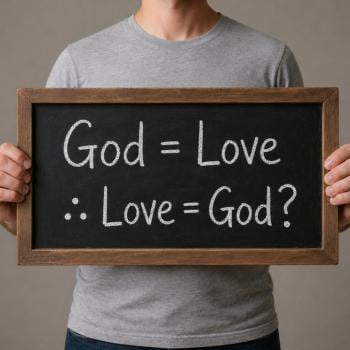
Scripture offers us a series of identity statements that rename God with titles we might mistake for mere attributes. God is Love. God is Light. The Lord is Peace. These are more than metaphors. They’re equivalencies. They’re mathematical equations. Since 5+5=10, we know that “10” is just another way of saying “5+5.” They are the same thing. And, the equations can be reversed. We can also say 10=5+5.
The word “is” means “equals.” Just like a math equation, the two words on either side of “equals” can be reversed. Thus, God=Love, and Love=God. God=Light, and Light=God. God=Peace, and Peace=God. This doesn’t diminish the meaning of “God.” It elevates Love, Light, and Peace. Wherever love, light, and Shalom appear, God is breaking through, widening the cracks in human experience into places of blessing.
What Real Peace Looks Like
If God is Shalom, then real peace can’t just be thoughts and prayers. Societally, Shalom looks like housing, food, healthcare, rides, casseroles, and policies that help people actually live. It looks like cities planning for the vulnerable instead of reacting to or discriminating against them. It looks like neighbors checking in and meeting needs. It means churches opening their doors instead of worrying about their carpets, and communities deciding that survival shouldn’t depend on luck. Politically, peace is more than ceasefires and accords; it means finding the divine in one another and seeking wholeness, healing of relationships, restoration, and reconciliation. Spiritually, Shalom means that you can be content in all circumstances because you know who you are and Whose you are.
Shalom in Our Skin
Shalom is more than a concept. It is God wearing our skin—God choosing nearness instead of distance, compassion instead of detachment, incarnation instead of remote worship.
Just as Hagar named God “the God who sees me,” and Gideon named God “the Lord is Peace,” we rename God every time we say “the God who held me together” or “the God who didn’t give up on me.” When we name the God of our understanding, we join those in Scripture who did the same. Renaming God isn’t arrogance—it’s testimony. It’s our attempt to articulate what divine love has felt like in our own skin.
The Fingerprints of Shalom
Wherever fractured people move from “I don’t know if I’ll make it” to “I think I might not die now,” I hear this name of God. Wherever someone’s life shifts from terror to relief, I see the fingerprint of the God who is Shalom. Divine Peace is deeply invested in our wholeness. Peace is the name of the God who keeps showing up in the broken parts of the world, lovingly stitching the world back together, one Nick-sized story at a time.
















 Ad-Free & Subscriber Log-In