

Maybe your grandpa used to say, “If it ain’t broke, don’t fix it.” What if that wisdom applies to people, too—and people aren’t projects?

Sometimes, tinkering with something that isn’t defective breaks its balance and creates problems you didn’t have before. Similarly, starting with the assumption that others are defective could actually prevent any positive influence you might want to have.
What if Your Neighbors Aren’t Projects?
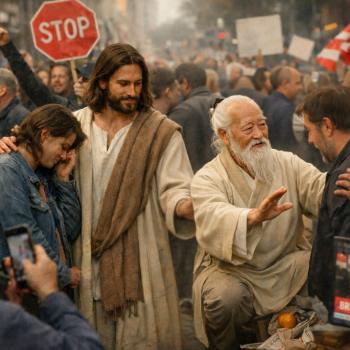
Of course, whenever you try to fix something, you’re saying that there’s something wrong with it. Some people love a good DIY project and find fault with things that are doing just fine on their own, just so they can get their hands dirty with some home improvement. What if the world isn’t broken—and what if your neighbors aren’t projects at all? Lao Tzu and Jesus weigh in on our tendency to tamper instead of trust.
Lao Tzu’s Tao Te Ching, Verse 29
Stephen Mitchell Version
Verse twenty-nine of the Tao Te Ching says:
Do you want to improve the world?
I don’t think it can be done.
The world is sacred.
It can’t be improved.
If you tamper with it, you’ll ruin it.
If you treat it like an object, you’ll lose it.
There is a time for being ahead,
a time for being behind;
a time for being in motion,
a time for being at rest;
a time for being vigorous,
a time for being exhausted;
a time for being safe,
a time for being in danger.
The Master sees things as they are,
without trying to control them.
She lets them go their own way,
and resides at the center of the circle.[1]
On Mission, “As You Go…”
Many Christians emphasize a call to missions. The conservative denomination in which I grew up made missions work the ultimate job anyone could do. Sermons kept returning to the Great Commission, where Jesus said,
Our church’s mission was all about a commandment from God to go out and improve the world. Preachers emphasized the imperative to “Go!” like generals giving orders. They ignored the fact that the Greek can reasonably be heard with a “going” sense: “As you go, therefore, disciple all the nations…” This shifts the posture.
There’s a difference between a command to go and an acknowledgement that Jesus’ disciples would be going anyway. There’s also a difference between an imperative to “make disciples” of the nations and to “disciple” those from every nation. Calling this scripture the Great Commission can sound like an injunction to change the world, conquer it, and convert it. But, read through that “as-you-go” lens, the charge becomes humbler and truer: “As I happen along through the world, I will do what I can to make a faithful, loving difference.”
If mission is “as-you-go” presence, then Lao Tzu’s first lines sound less like a rebuke and more like a theological guardrail. “Do you want to improve the world? I don’t think it can be done. The world is sacred. It can’t be improved.” This guardrail warns against making a project out of changing other people.
The Problem with Missions Through Relationship
When I was a child, my church impressed upon me the importance of converting those who were not Christians. “The best way to do this is through relationship,” they said. “Therefore, it’s important to make friends with nonbelievers so that you can influence them subtly. By forming friendships, you can learn people’s needs. By meeting their needs, it becomes easier to convert them.” Yet, this reduces friendship to coercion. It isn’t a true bond at all if the reason you befriend someone is so you can change them.
The Tao Te Ching says “The world is sacred. It can’t be improved. If you tamper with it, you’ll ruin it. If you treat it like an object, you’ll lose it.” Instead of approaching people as if they are a territory to be won, try greeting them with an open heart, which recognizes that they are already sacred. They don’t need your improvement to be worthy. Instead of looking at people as a project or something to be fixed, try developing relationships that honor them for who they already are. Friendships become sacred presence, not selfish pressure.
A Time for Everything
The next stanza in Lao Tzu’s verse reminds the reader of the Bible’s book of Ecclesiastes. Qoheleth the teacher writes:
For everything there is a season and a time for every matter under heaven:
a time to be born and a time to die;
a time to plant and a time to pluck up what is planted;
a time to kill and a time to heal;
a time to break down and a time to build up;
a time to weep and a time to laugh;
a time to mourn and a time to dance;
a time to throw away stones and a time to gather stones together;
a time to embrace and a time to refrain from embracing;
a time to seek and a time to lose;
a time to keep and a time to throw away;
a time to tear and a time to sew;
a time to keep silent and a time to speak;
a time to love and a time to hate;
a time for war and a time for peace.
Both Lao Tzu and Qoheleth insist on seasons—times to move, times to wait. That rhythm frustrates our fix-it reflex. It draws us toward trust and away from tampering.
This philosophy of letting things be as they are without trying to change them is an exercise in acknowledging that God knows what God is doing. It can be difficult to trust that the movement of Tao throughout the universe is wise and loving enough to bring about the best. Not everyone finds it easy to believe that Heaven’s love will prevail in all things. But, if you can manage it, this trust allows the person of faith to move serenely upon the Earth. They can thrive in all circumstances without imposing their will upon the sacred world.
From “Go!” to “While Going…”
Lao writes, “The Master sees things as they are, without trying to control them. She lets them go their own way, and resides at the center of the circle.” Taoists call this wu wei: unforced action that cooperates with reality. This kind of understanding reframes the Great Commission from “Go!” to “While going…”
As you go, you can’t help but leave your mark or influence upon the world around you. As you go, following the Way, things around you will naturally thrive. But you don’t have to control them to improve them. When you simply reside at the center of the circle, keeping your own balance and living your own truth, blessings will grow up around you. Treat the world as sacred, resist the urge to control, and let love do the persuading. This is the mission, the great commission, of Christ.
Practice…
If the world is sacred and people are not projects, then mission begins with attention. Before we try to act, we practice seeing—so any action that follows comes from presence with the world, not pressure to change it.
The following practice is called Sacred Seeing. Drawing from Lao Tzu’s idea that everything in the world is sacred as it is, and from Qoheleth’s assertion that God has made everything beautiful in its time, Sacred Seeing strives to appreciate rather than enhance. Here’s how you do it:
Pick a person, place, or thing that you regularly experience. This could be your spouse, a body of water, a flower, or anything else you choose. Position yourself before it. Instead of considering how it could be improved, used as a resource, or repaired, simply experience it as it is.
Affirm its inherent holiness. Inwardly say something like, “This, too, is blessed. It doesn’t need to be improved. It is already beloved of God and a bearer of God’s image.” Resist the urge to shape, control, or intervene in the hallowed being before you. Just remain with it, affirming its beauty.
Hear the words of Jesus, “And remember, I am with you always, to the end of the age.” Consider that Jesus is with you now, embodied in the sacred one in your presence. Notice what shifts in you when you recognize God’s presence in the sacred Other. Consider your mission not to change this thing, but to honor it. Then ask: What faithful action, if any, belongs here—without force?
Check out my related articles:
- How Taoism Made Me a Better Christian
- Jesus & Lao Tzu: How to Embody the Way of Love Completely
- Jesus & Lao Tzu: When Good Intentions Go Awry
















 Ad-Free & Subscriber Log-In