

James Hollis is a Jungian analyst based in Washington, D.C., and the author of more than twenty books. I have read over half of them 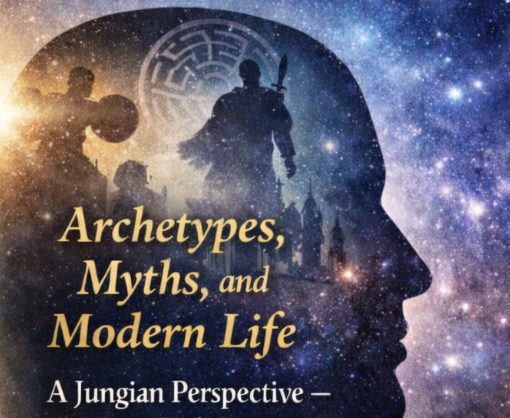 and have found each one illuminating. Over the years, I have woven some of his insights into my sermons, and I suspect I will eventually make my way through the rest of his work.
While reading a book he published last year, I was struck by a passing remark about a much earlier volume he wrote in 1995, Tracking the Gods: The Place of Myth in Modern Life. He says it may be the most important book he has ever written.
But then he added something else. It is also one of his least-read books — likely, he suggests, because the word myth can scare off modern readers. And at that point, I couldn’t resist: Challenge accepted. I ordered it immediately.
Why does the word myth make some of us wary? And why does it matter? What is lost when a culture abandons its myths?
To explore those questions, I want to invite us on a journey — not backward into nostalgia, but inward and forward — through three stages in our relationship to myth. For myths, rightly understood, are not childish fantasies but living containers of meaning.
And that is why, when we adopted Jaylen, one of the books I bought him was a copy of D’Aulaires’ Book of Greek Myths. At two years old, he is not quite ready for it. But one day soon, I look forward to reading those stories to him — and revisiting them myself — because they carry something enduring about what it means to be human — stories that speak to deep psychological and spiritual truths.
So to understand why myth matters so deeply, let’s trace how our relationship to myth has changed over time.
First, there was mythology — the great stories our ancestors told and retold, carrying them across generations as vessels of meaning, seeking to make sense of the human condition in which we all find ourselves — its joys and sorrows, its chaos and order, its beginnings and endings. Though they spoke of gods on mountains and forces in the sky, they were also — even if not always consciously — speaking about the depths of the human soul (8).
Then came the rise of modern science and the long process of what we nerdy academics call demythologization. Through the scientific method, the world became more measurable, predictable, explainable. And in the process, myth was often dismissed as superstition — a relic of a less enlightened age, fit perhaps for children, but not for serious adults.
And yet even as science advanced, many voices attuned to the human spirit — poets, artists, psychologists — began to sense that something essential had been lost (9).
And now we find ourselves at a threshold. A third stage.
The potential for remythologization — not a retreat from science, but a recognition that meaning cannot be reduced to data.
Perhaps that is why a renowned psychoanalyst like Hollis would say that a book on myth is the most important of his many books. Without myth, we may gain information — but lose wisdom, depth, and our felt connection to a larger order of meaning beyond ourselves (53).
Consider just one brief example of the power and insight that myths still hold — if we approach them not literally, but as metaphors, symbols, and archetypes (8).
As you have heard the news this past week about our country’s war of choice against Iran, can you feel how Mars, the god of war, has seized the wheel of history once again?
War not as a sober last resort, but as impulsive, vainglorious force. Not Athena’s disciplined strategy in the service of defense, but Ares’ chaotic fury, intoxicated with his own power.
This is myth — not in the sense of literal gods in the sky, but in the sense of stories that reveal enduring truths — truths we ignore at our peril (107).
Our Constitution, the U.N. Charter, and international law represent our collective attempt to bind the war-god — to fasten chains around Mars, forged in centuries of bloodshed. They embody the accumulated wisdom of our forebears, who learned at terrible cost that unrestrained power will eventually devour the very civilization it claims to defend.
When leaders launch strikes that many experts say are neither lawful self-defense nor clearly justified, it is as though the chains begin to fall away.
And whenever Mars runs free, it is never the powerful who suffer most.
It is the children.
The elders.
The poor.
The ordinary people in Iran, in Israel and Palestine, and across the region — those who did not choose this war, yet will bear its consequences.
This is why myth matters.
It names the archetypal forces that move beneath our policies and press releases. It reminds us that the god of war is not only a figure in ancient stories, but a pattern in the human psyche — one that, when unrestrained, always sacrifices the vulnerable.
And we could trace similar patterns elsewhere. We might look to Narcissus and the perils of self-absorption for those in the highest echelons of power. Or recall Cassandra — cursed to speak the truth and never be believed — and ask ourselves where urgent warnings are dismissed in our own time.
Can you feel the power these ancient myths still carry — and still awaken?
The anthropologist Claude Lévi-Strauss once expressed it this way: “myths think themselves in us, and without our knowledge” (133).
In other words, myths are not just stories we tell. They are expressions of deep structures in the human mind — what Jung would later call the collective unconscious — patterns that shape how societies organize power, justify violence, and define hero and enemy.
Myths do not merely describe reality; they reveal recurring dynamics that surface across every culture and throughout history.
Maturity does not mean outgrowing myth.
It means becoming conscious of the forces myth reveals (133).
The real battlefield is not only geopolitical.
It is psychological.
It is spiritual.
Our struggle, individually and collectively, is not only out there.
It is in here — within us.
And when our elected leaders have not done their inner work — the difficult work of examining shadow, wounds, and the hunger for power — it becomes easier to wage war on distant lands than to confront the conflicts within ourselves.
Unexamined anger becomes crusade.
Unexamined fear becomes doctrine.
Unexamined insecurity becomes war.
Or to adapt a popular meme: some men would rather go to war with Iran than go to therapy.
Or perhaps I should say: some leaders would rather send other people’s sons and daughters to war than examine the wounds that drive them.
This is part of what Jung meant when he warned that the gods do not disappear; they go inward.
In his words: “Where did the gods go when they left Olympus? They went into the solar plexus.” (28)
The gods did not vanish; they migrated inward.
Jung went on to say that when Westerners “fell off the roof of the medieval cathedral” — when they could no longer believe literally in the doctrines of the church — they did not land in a bright field of pure reason.
Instead, they “fell into the abyss of the Self.” (28)
The forces once imagined up on Mount Olympus now live in the depths of the human psyche.
And when they remain unconscious, they do not retire quietly.
They act themselves out in our lives and in our history.
Hollis argues that this movement — from a cosmos filled with gods to the interior landscape of the self — marks one of the defining shifts of modernity.
What we earlier called demythologization did not simply clear the air for science and reason.
It also severed our felt connection to the cosmos — to something larger than ourselves (53).
The gods did not disappear.
They no longer gather in temples.
They gather in our nervous systems (102–103).
Take a moment to let that sink in.
You can feel it in your own body — the tightening in your chest when breaking news flashes across your phone. The surge of heat when someone says the “wrong” thing at dinner.
The quickening pulse that whispers: fight.
That is not Zeus hurling lightning bolts from the sky.
That is archetypal energy moving through muscle and breath.
And when enough people are moved by that same unconscious energy at once, history itself begins to shift.
Which is why Hollis insists that the task before us is nothing less than becoming more conscious of the unconscious forces at work within us.
For when we undertake that inner work, we become less dangerous to ourselves and others (52).
As the Jungian tradition often puts it:
“We do not see the world as it is; we see it as we are.”
When individuals refuse the responsibility of doing their inner work, they do not become free — they become susceptible.
And when whole societies evade that burden, they do not become stronger — they become vulnerable: vulnerable to projection, vulnerable to demagogues who exploit grievance and fear, vulnerable to the seduction of simplistic answers (10, 147).
One measure of our individual and national maturity is whether we are willing to shoulder the burden of doing our inner work — or whether we continue searching for a savior, a strongman, or an ideology that promises to relieve us of the responsibilities of self-governance.
Hollis reminds us that no one — “no guru, no ideology” — can “save us from the complexity and ambiguity of life” (147).
A democracy, after all, is a profoundly adult form of government.
It assumes We, the people are capable of wrestling with complexity. It assumes we can tolerate disagreement. It assumes we can live without absolute certainty.
And it assumes we are willing to take responsibility for the myths that move through us rather than projecting them onto enemies, scapegoats, or saviors (113–114).
When we refuse that responsibility, we regress.
We become tempted by simpler stories — stories in which we are always innocent, others are wholly guilty, and violence begins to look redemptive.
But anyone who has spent time with the ancient myths knows they resist such simplicity.
They are as complex and as conflicted as the human condition itself.
And when we begin to take mythology seriously again — not as literal truth, but as metaphors, symbols, and archetypes pointing beyond themselves to the deepest mysteries of reality — something subtle but powerful happens.
Scholars call it remythologization — a re-enchantment of the cosmos.
Not through literal belief.
But through awakened consciousness.
Instead of being driven unconsciously by Mars or Narcissus — or by the many archetypal forces moving through us — we begin to recognize them for what they are — and choose how we will respond.
That is not weakness.
It is maturity.
It is freedom.
And in such moments, we may yet glimpse the divine — not as a superhuman figure descending from the sky, but as a sacred depth within us that resonates with a larger mystery beyond us (149).
So the question before us is not whether the gods are real in the literal sense of superhuman beings beyond the sky.
The question is whether we will relate consciously to the mysterious archetypal energies toward which the myths have always pointed.
Mars will always be available — in nations and in neighborhoods, in headlines and in our own heated conversations.
The archetypes do not disappear.
The question is whether they possess us — or whether we meet them consciously.
Democracy depends on that maturity.
It depends on citizens willing to bear the burden of meaning, resist the seduction of simplistic myths, and choose compassion over fear-driven reactivity.
And each of us, in our own small but significant sphere, is called to the same task: to live our lives as fully as possible while remaining linked to the larger mystery (149).
That is how we bind Mars — within us, and within our nations.
That is how we serve the mystery.
And that, perhaps, is how we glimpse the divine — not in the sky above, but in the hard, holy work of becoming more fully human together.
The gods will always move through human history.
They always have.
The question is whether they possess us —
or whether we meet them with consciousness, compassion, and courage.















 Ad-Free & Subscriber Log-In