

A summary of Cath0lic Belief
From
The Public Domain Work
The Belief of Catholics by Fr. Ronald Knox
Chapter XIV.
The Truths Catholics Hold
In this essay I shall attempt no more than to give some outline of the main truths which Catholics believe as revealed truths. We could not have found them out for ourselves, by the unaided exercise of human reason; we believe them on the authority of Christ revealing; that is, because the Church to which he has bequeathed his teaching office gives us warrant for their assertion.
The Trinity
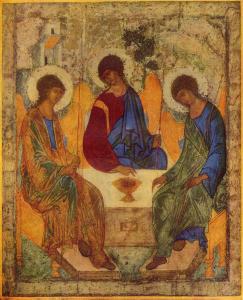
We believe, then, that within the unity of the Godhead there is a distinction of three Persons.
The Eternal Father, himself the Fount of all being, is the First of these Persons. And we are taught to think of him as begetting, by an act of generation which lies altogether outside of time, a Son equal in glory with himself; or, if you will (so little justice can we do to such a mystery by any conceiving of ours), you may say that he gave utterance to a Word, the express Image of himself, a Word Timeless, Uncreated, Personal. And from these two Persons, Father and Son, proceeds a third Person, the Holy Spirit; the Love of the Father for the Son, the Love of the Son for the Father, is Personal too, and thus the Trinity is completed.
The language in which this doctrine is defined does not (as far as we know) come down to us from our Lord himself; but it is the only language capable of safeguarding the beliefs of the earliest Christianity, as it expresses itself both within and outside of the sacred documents. The distinction between the Father, the Son, and the Holy Ghost would be unreal if it were less than Personal; their Unity would be unreal if it were less than substantial.
Creator of Angels
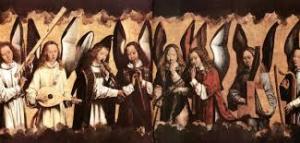
‘Fliat anything should exist besides the Blessed Trinity is necessary neither to the Existence nor to the Happiness of the Godhead. But by a voluntary act God has (we can see for ourselves) brought a Creation into existence. We can see, or infer from what we see, parts at any rate of his material creation. But, since we know from the experience of our own soul-life that matter is not everything, it would be a ridiculously parochial assumption to suppose that there was not a vast invisible Creation as well—to suppose that our spirits are the only spirits which exist, God excepted. And in fact. Revelation assures us that angelic Beings, pure spirits not united to any
material body, do exist—in what number, we have no means of imagining. Some of these spirits, by willful rebellion against that service of God which was the purpose of their existence, have become confirmed in evil and merited God’s eternal reprobation.
Creation of Man
We now proceed to a doctrine which is the most paradoxical, perhaps, the most improbable in the whole of theology. It happens, however, to be a matter of daily experience. I mean the fact that God created a being in whom an immaterial spirit was united with a material body; a being, therefore, who should occupy a unique position of liaison between the two halves of Creation. The industrious quarrying of geologists has not made it clear whether there were once, creatures, now extinct, which, without being human, approximated more nearly to our type than any of the brutes at present known to us. Still less have they produced any reason for supposing that the human race, as we now know it, is not a single species, but arose independently, in various parts of the globe. The probabilities would in any case be against such an assumption.
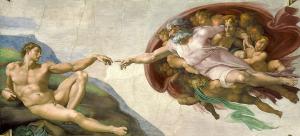
Revelation assures us that the whole human race is, as a matter of fact, descended from a single pair. It also tells us—what science could never prove, what our moral experience might suggest, but could never demonstrate—that this pair were created with natural gifts, and were endowed
with supernatural graces, which they never bequeathed to their descendants. They were created
(for example) in a state of innocence, their consciences not troubled by those suggestions of evil
which now assail us. But a single fault, only less inexcusable than the fault of the rebel angels,
reversed the destiny allotted to them and to their posterity. The supernatural endowments, once
abused, were withdrawn thenceforward; and even our natural powers were mysteriously hampered by that duality of purpose which is our daily and humiliating experience.
The Incarnation
The hope of eternal life was not denied to fallen man, but it was offered, now, only as the price of a severe probation. And he must struggle against an internal enemy he found too strong for him, with only such crumbs of uncovenanted assistance as God’s mercy might afford. It was not intended, in God’s Providence, that this pitiful condition of things should endure as long as the world lasted. Man’s fault had been foreseen, and with the fault the Remedy. God became Man in order that, dying, he might atone for our sins, and win us the graces normally necessary to the attainment of salvation.
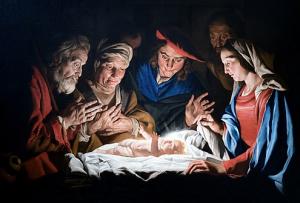
The coming of our Lord was thus not merely a Revelation to illuminate our minds ; it was also designed to rescue man from his impoverishment and his spiritual dangers. It was to win for us, not only those “actual ”graces by which, since then as before, God has turned our hearts to himself, but “habitual” grace, the state of “justification,” in which we are assured of God’s friendship, are enabled, during our lifetime, to perform actions pleasing to him, and at our death, if we have persevered, to attain the felicity of heaven. To achieve such blessings for us, it was needful to make amends for the affront offered by the sin of our first parents to the outraged Justice of Almighty God. Although he could have accepted some lesser sacrifice, he
determined to make atonement for us himself, and to make it in full measure by the perfect offering of Death.
The Hypostatic Union
The Second Person, then, of the Blessed Trinity became Man for our sakes. Without losing or laying aside the Divine Nature, which is his by right, he united to his own Divine Person a second, human Nature, in which he was born, lived on earth, and died. Once more the stubborn tradition of the Church could not rest content until it had fortified itself within these safeguards of definition. To think of our Lord’s Divine Nature as being annihilated, even temporarily, would be nonsense. A mere limitation of it, if that were thinkable, would not make it become truly human. To deny the reality of the human Nature would be false to all our evidence. Nothing less than a personal identity between the Eternal Word and Jesus of Nazareth would constitute a Divine Witness, or a Divine Victim. Every possible substitute for the received doctrine has been tried, and found wanting.
The Mother of God
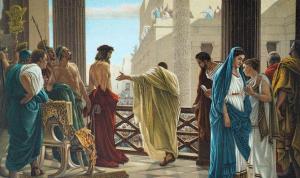
We believe that the circumstances of our Lord’s coming into the world were marked by two miracles especially. In the first place, that she who was to be his Mother was endowed with that same gift of innocence which had been possessed and lost by our first parents; and that this freedom from the curse and the taint of “ original sin ” was bestowed upon her in the first instant of her Conception. It is perhaps worth observing that the doctrine of the Immaculate
Conception means this and nothing else. And we also believe that both in and after the Birth of our Lord she remained a pure Virgin. From her, nevertheless, our Lord took a true human Body, which was the receptacle of a true human Soul. And in this human Nature he lived and died and rose again; and at last ascended into heaven, where it still persists.
The Church as the Body of Christ
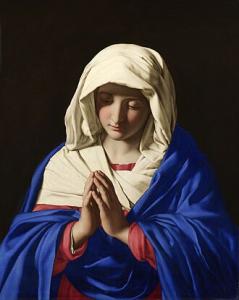
So much for his natural Body; he has also, as we believe, a supernatural Body, his Church. I am using metaphor here. In an ordinary way, when we speak of a collection of people as a “body” of people, we are using an unreal metaphor; we are speaking of a merely abstract solidarity as if it were a concrete thing. But when we speak of the Church as a supernatural Body, although we are still using metaphor, it is not an unreal metaphor; we mean that there is a real, not simply an ideal, solidarity between Christian people in virtue of their “ incorporation ” into Jesus Christ; and this metaphor of a “ body ” is the closest, the most apposite we can find. Thus the Church is not merely an institution outside ourselves or above ourselves; it is ourselves.
We all know how the Englishman will rally to the appeal of his “country”; how he will lock his
doors and hide his ledgers at the very mention of “the State.” His prejudice against the Church is
partly due to the impression that “the Church” is the spiritual analogue of “the State”; he thinks
of it as a tyrannous, prying institution which is bent upon circumscribing his liberty. He does not
reflect that “the Church” is also the analogue of a nation or country, but with a supernatural solidarity of its own which far transcends all merely racial ties. In this sublime creation of Providence, all that natural instinct of gregariousness which has given birth to the clan, the tribe, the nation, the party, the club, is pressed into a higher service and acquires a supernatural character. The Church is our Mother, in that her baptism gave us supernatural life; our Mistress, in that her teaching secures us from speculative error; but she is more than that; she
is ourselves.
The Sacraments
The life of grace which we live in the Church is engendered, nourished, and perfected in us by means of the Sacraments. I wish to indicate here what is the Catholic doctrine about their general character. Speaking first of the “sacramentals” (holy water, blessed medals, etc.), that we
regard these not as conveying grace in their own right, but as the occasions upon which God will see fit to accord us special graces, in answer to the prayers of his Church. Must we give the same
account of the Sacraments themselves? If we do, we lessen their dignity; if we claim more for them, do we not lay ourselves open to the charge of “magic” which the rationalist levels at us?
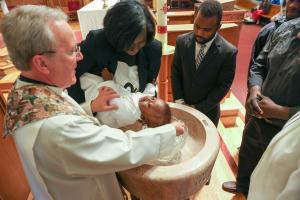
We answer that the Sacraments themselves, with one noteworthy exception, do not “convey ”
grace in the sense in which a boat “conveys” its passengers, but in the sense in which a letter “ conveys” information. The lines traced upon the paper do “convey” information, assuming the
operation of the reader’s intelligence. So the Sacraments “convey” grace, assuming that operation of Divine Power of which they are the covenanted instruments. I say the covenanted instruments;
for here we do not merely trust that God will bestow grace in answer to the prayers of his Church; we know that God will bestow grace in fidelity to his own promises. As surely as God animates with a soul every child that begins to live, so surely he will implant first grace in every soul which receives baptism.
The Eucharist
There is, as I have said, one exceptional Sacrament, the doctrine of which is not to be accounted
for so easily. We believe that our Lord’s human Body and Blood are actually present in the Host and in the Chalice. The explicitness of his own words has forbidden Catholics, in every age, to regard that * I am giving here one theological view, which is not the only view possible to Catholics.
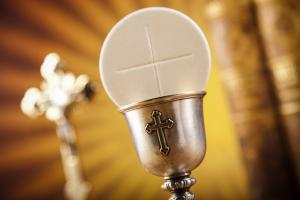
Presence as conditioned in any way by the faith of the communicant or the worshipper. To say, or to imply, that the change effected by the words of consecration is only a change of significance is to rob our Lord’s own words of their plain force. Yet it is a matter of experience that no change
perceptible to the senses, whether of size, shape, color, or texture is observable in the Sacred Elements. Are we to suppose, then, that our senses here delude us? We cannot willingly associate
such deception with any work of God. It follows, then, that the accidents (the philosophical description of all that falls within the province of our senses) really remain unchanged. And from that it follows that the substance in which those accidents inhere must have been the thing changed; this is the last stronghold of reality.
Transubstantiation is the only doctrine which will secure fidelity to tradition on one side, and the evidence of our senses on the other. The Mass, in which this momentous change is affected, is held by Catholics to be a true Sacrifice the renewal of that Sacrifice made once for all on
Calvary.
Mysterious Catholic Summary
And here let it be observed that the four most baffling mysteries of our religion
- —the Trinity in Unity,
- the Union of Natures in the Incarnation,
- the Real Presence in the Holy Eucharist,
- and the relation between Grace and Free Will—
those four mysteries, over which controversy has been most embittered throughout the centuries, lie there centered where human thought most fails us; they drive in their wedges (so to speak) at the weakest points in our human philosophy.
Three Persons in one Substance,
two Natures united in one Person—
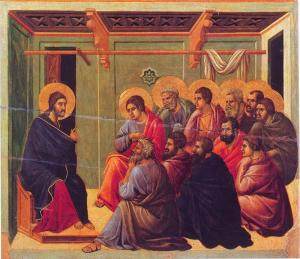
mysterious doctrine, assuredly; but is not the principle of individuation itself a mystery, over
which philosophers have wrangled without attaining any measure of agreement? A change of substance which leaves the accidents unaffected—hard for us to imagine; but then, whose imagination is not puzzled by the whole relation of universals to particulars? Grace all-powerful, yet the human will free—it sounds a paradox; yet is there not paradox already in the reaction of the free human will upon the motives which “determine” it?
There is nothing inconceivable in doctrines such as those we have been citing; they are outside our experience, but not repugnant to thought. The imagination, however, naturally recoils from the contemplation of them, because their very terms plunge us into mystery.
Grace
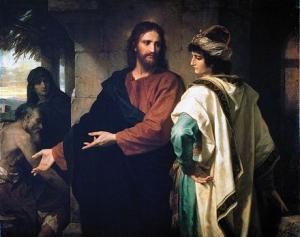
I have mentioned the doctrine of actual grace; it would be beyond the scope of my present undertaking to expound the Catholic system, or rather systems, upon the point. It is enough to recall here that there are two notice-boards (as it were) to guide us, two general principles which secure us from misconceptions. On the one side, it is universally admitted, against the Pelagians, that nobody ever goes to heaven except through the free grace of perseverance. On the other side it is universally admitted, against the Calvinists, that nobody ever goes to hell except through his own fault.
Last Things
The last paragraph reminds us of one department of Catholic theology which needs mention before this rude summary of its teaching is complete—I mean, its doctrine of the Last Things. We believe that the soul is judged immediately after its final separation from the body. If it is found to be outside God’s friendship, it is condemned to eternal punishment, and a punishment which does not stop short with mere regrets, mere moral torments. If it is found in a state of grace, it is secure of its passage to heaven. But, for most of us, an expiation still remains to be made; nor do we achieve eternal happiness until we have paid the “debt” of suffering in which our sins, long ago forgiven, have involved us.
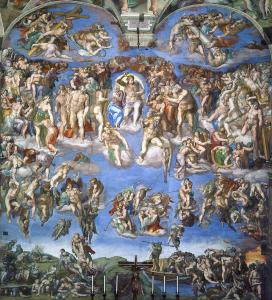
It is for the lightening of this expiation that we pray when we offer our suffrages for the dead; it is for some remission of this debt, and not for any forgiveness of sins, that we hope when we try to gain an “indulgence.” Beyond that lies the open vision of God, and such felicity as we may not dare to imagine. The justice of these, God’s dealings, whether in general or in particular, will be fully revealed when this material order of creation ceases,
and the bodies which are the connatural companions of our soul-life are restored from their corruption, a new creature in Jesus Christ.






 Ad-Free & Subscriber Log-In