

Here is a Picture of Palm Sunday
As Described From
A Selection from the Public Domain Work
The tragedy of Calvary : (1905)
or the minute details of Christ’s life
from Palm Sunday morning till the resurrection and ascension
taken prophecy, history, revelations and ancient writings
by Meagher, Jas. L. (James Luke), 1848-1920

Setting Out On The Road
Coming out of Lazarus’ house, Christ turns to the right and passes along the little street. He went two blocks to where it meets the main road leading through the village from Jericho to Jerusalem and ascends the latter to where another path leads to the right up towards the summit of Olivet. These were not roads over which a carriage could pass, but simple paths, rough and narrow, out of which at present it seems a stone had not been picked for thousands of years. There may have been chariot roads over which Romans passed on the way to Jericho and the Jordan valley, but little sign remains of them today.
Up this path to the right went the Master and his followers. Stone walls lined each side of the road inclosing gardens. In a little depression higher up, in about
fifteen or twenty minutes they came to a still smaller village called Bethphage, “The House of Green Figs.” It is nearly half-way between Bethany and the summit of Olivet. There and in Bethany the priests lived when they came up from Jericho while waiting for their turn in the Temple services.
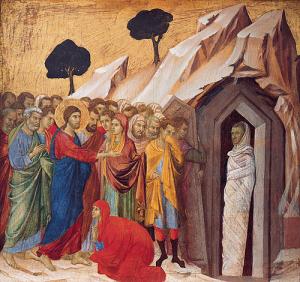
Go Get The Ass
And when they drew nigh to Jerusalem, and ‘were come to Bethphage, unto Mount Olivet, then Jesus sent two of his disciples, saying to them:
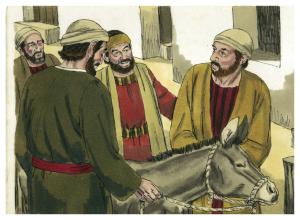
“Go ye into the village that is over against you : and immediately you shall find an ass tied, and a colt with her ; loose them and bring them to me. And if any man say anything to you, say ye : The Lord hath need of them, and forthwith he will let them go.”
Now all this was done that the word might he fulfilled, which was spoken by the prophet, saying:
“Tell ye the daughter of Sion, Behold thy King cometh to thee, meek and sitting upon an ass, and a colt the foal of her that is used to the yoke.”
And the disciples going did as Jesus commanded them.
The prophet Zacharias had foretold this incident hundreds of years before. They found the ass tied to a grape vine, as Jacob, born 2,199 years before, on his deathbed, blessing his sons, foretold:
“The scepter shall not be taken away from Juda, nor a ruler from his thigh, till he come that is to be sent, and he shall be the expectation of nations. Tying his foal to the vineyard, and his ass to the vine, O my son. He shall wash his robe in wine, and his garment in the blood of the grape. His eyes are more beautiful than wine, and his teeth whiter than milk.” *
They had just come over the top of a shoulder of Olivet. From there you see the little village of Bethphage to the northwest, as the Saviour said,
” Go ye into the village that is over against you.”
Near this footpath was discovered in 1877 a sculptured stone covered with figures, representing the resurrection of Lazarus, and showing one
of the apostles being sent into the village, which the inscription calls the village of Bethphage. Where Christ mounted the ass now stand a church attended by the Franciscans.
Why Did He Ride An Ass ?
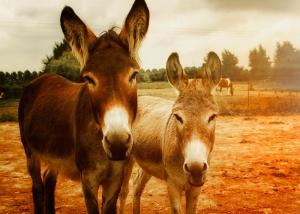
This animal, in Hebrew, chamor, both tame and wild is mentioned in earliest human history. The Hebrew word for ass comes from a root word meaning reddish brown, like the Spanish word for ass — burro, “brown.” It was the beast ridden by the Judges. Samson killed the Philistines with the jaw
bone of an ass. David and Solomon rode on asses. It was the beast of Hebrew royalty, and this is why Jesus chose the ass on which to ride like Israel’s King, when he came that day to take possession of his Father’s Temple.
He rode first on the ass, which the Fathers tell us typified the Hebrew people used to the Law. Then he changed and rode on the colt, which was never ridden before, and this represented the Heathen nations, who knew not the Law till the Hebrews were rejected and the other nations called to the Church.
Taking The Colt
“And going their way they found the colt tied before the gate, in the meeting of two ways, a colt tied upon which no man yet hath sat, and they loosed him. And some of them that stood there said to them
“What do you, loosing the colt ?”
And they said to them as Jesus had commanded them, and they let him go with them.
“And the disciples going did as Jesus commanded them And they brought the ass and the colt, and laying their garments upon them and made him sit thereon.”
The Journey To Jerusalem
Three roads or footpaths lead from Bethany to Jerusalem, one along where is now the carriage road, another higher up the hill through Bethphage, the third, after leaving this little village branches over the summit of Olivet. Christ took this latter path.
From the northern parts of Palestine, and from the Jordan valley, great crowds were coming up to the great Easter feast of the Passover. They had heard of the raising of Lazarus from the dead, and of the wondrous works Jesus had wrought, and they crowded around Bethany and Bethphage. When they came to the great feasts they encamped according to the rules laid down by their great legislator, Moses, in their desert wanderings. Olivet was covered with the tents of the Jews. On the southeast of the Holy City were the tents of Issachar and Zebulon. To the south towards Bethlehem rested the sons of Simon, Gad and Ruben. On the west of the Holy City were the children of Ephraim, Manasses, and Benjamin To the north, along the plain was the camping ground of Dan, Asher and Nephilim. This was the way they surrounded the city” since the days when David made it his capital. Jerusalem at that time contained about
100,000 inhabitants.
The Praises Begin
Oriental peoples are very emotional and excitable. When they came and found Lazarus alive and well the greatest enthusiasm broke out. They crowded around Lazarus and Christ as they went up the hill. Soon it became a processional march, the triumph of a king, as Isaias foretold.
“ Behold the Lord hath made it to be heard in the ends of the earth, tell the daughter of Sion. Behold thy Saviour cometh, behold his reward is with
him, and his work before him.” * ” You shall say in that day, Praise ye the Lord and call upon his name.” ‘ ” Sing ye to the Lord, for he hath done great things, show this forth in all the earth. Rejoice and praise, O thou habitation of Sion, for great is he in the midst of thee, the holy One of Israel.
Fulfilling these words the whole crowd began to shout and praise Him.
At that time Jerusalem was surrounded with gardens and fertile fields — every foot of land cultivated. Trees were everywhere. Olives, the Hebrew zayith, covered the holy mountain. The fig, teenah, lined the paths leading to Bethphage, ” house of figs.” Pomegranates, rimmon bore their beautiful rosy fruit. On the southern slope of Olivet, where they were passing, grew in great abundance the date-bearing palm trees. There were to be seen the watch-towers, from which day and night they watched their flocks, gardens and orchards. Coming to the Feasts they sang hymns of praise to God. The Book of Psalms was the Hymn-book of the Jew, and in their journeys they used to sing the Pilgrim Psalms.
I have lifted up my eyes to the mountains,” etc.8
Praise the Lord for he is good,” etc.4
One band began the sacred hymn, sang as far as the star in our Breviaries, when another band took the refrain and sang it to the end of the verse. In Christ that day they recognized the long looked for Messiah.
Any one who has seen a procession in Jerusalem can imagine the scene.
The Crowds
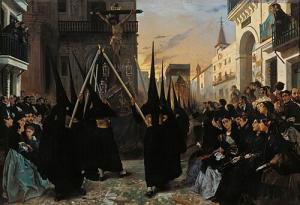
Sitting on the walls of Gethsemane a person saw a Mohammedan procession on Good Friday going out to visit Moses’ tomb on Mount Nebo. The confusion
was indescribable. Each member of the band played his instrument in his own time, note, and melody. Some danced, others shouted. Bedouin chiefs gesticulated with drawn swords surrounded with members of their tribes. Each tribe, race or people had its own peculiar dress. It was grotesque, oriental and disorderly, while thousands looked down from the walls, the stone fences, the houses, the walls of the Temple area.
We suppose it was the same this Palm Sunday, when Christ rode the ass and her foal. At narrow and difficult parts of the road the noise and confusion became bewildering Women screaming in terror of being trampled under foot of camels ; boys running wild through the crowds, parents calling for lost children, friend shouting to friend, drivers beating their beasts, venerable men passing on camels, asses and horses, young men running along, old men carrying canes ; Essenes clothed in white, Pharisees with large phylacteries on their brows and left arms, lordly Sadducees masters of the Temple, priests from Jericho and the North coming up to take their turn when drawn for the Temple service, women leading children, men guiding their families, thus came the great procession, singing Psalms of praise and glorifying God as they went along.
Christ had labored among these peoples in Galilee, and in the northern parts of Palestine, and they had seen His great works and heard His preaching, and now they understood that He was coming to take possession of the Temple and restore the kingdom of Israel as the prophets had foretold. John the Baptist, his ” Angel,” had baptized many of them.
“Behold, I will send my Angel, and he shall prepare the way before my face. And presently the Lord whom you seek, and the Angel of the testament
whom you desire shall come to his Temple. Behold he cometh, saith the Lord of hosts.”
As they passed the flank of the mountain a beautiful sight opened out before them. The city was below them. The city of their fathers rose from Sion, Moriah, Bezetha and Acra, its four hills, with its white palaces, houses and walls. There was the great Temple which Herod had rebuilt and now nearly finished. Few sights are more striking than Jerusalem from the Mount of Olives. The excitement became greater.
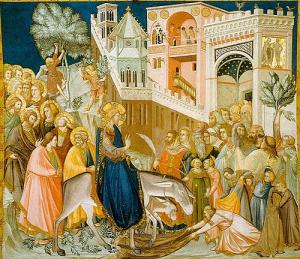
The Crowds Outfits
It was a queerly dressed crowd which came up to the feast. You might see the turban of the Bedouin of the desert, with the white cloth laid on his head with the two woolen fillets, woven round bands, around his brow to keep on the cloth. The sheiks or ” chiefs ” have purple and colored turbans, each differing according to the colors of his tribe. The pure Jews wore large white turbans. Men from the other side of the Jordan wore them falling down their shoulders to keep off the fierce desert sun. With hair tied up in fine netting the women wore veils covering their faces.
Both men and women wore a garment, very much like a clergyman’s cassock, reaching down to the feet, bound with the girdle, the latter of various colors and serving for a pocket. Over this cassock the leaders wore a flow ing cloak, hanging down in graceful folds from their shoulders. On the feet were sandals made of skins, tanned by being placed on the street to be trampled on.
The leaders were known by ‘their long flowing garments. The men and boys were dressed in all kinds of garments made of different materials. Some were clothed in sheep-skins with wool outside, others with the wool inside. Others had a sack on, with simple holes for the head and bound with the girdle, some with wide stripes running up and down. Boys had on a single garment and girdle, girls were clothed in the same way, but the older girls had on veils made of a single thick piece of material.
The materials were of all colors. Some were at one time white, but now bedimmed with dirt. Coming from Jericho where they lived till their ” course ” called them up to the Holy City, were many priests. These wore linen drawers according to the command of the Law.
Hosanna
And a very great multitude spread their garments in the way : and others cut down boughs from the trees, and strewed them in the way. And the multitudes that wentbefore, and that followed, cried saying : Hosanna to the son of David, Blessed is he that cometh in the name of the Lord. Hosanna in the highest ” ” Blessed be the kingdom of our father David.”
And the people of the city, seeing this great triumphal procession coming over the southern slopes of Olivet, went out of the city and hurried to meet him. ” Because many of the Jews, by reason of him, went away and believed in Jesus. And on the next day a great multitude that was come to the festival day, when they heard that Jesus was coming to Jerusalem, took branches of palm trees and went forth to meet him. . . . The multitude therefore gave testimony, which was with him when he called Lazarus out of the grave, raised him from the dead.”
The word Hosanna is the Syro-Chaldaic of verse 25 of the 112th Psalm. In the original Hebrew it is Anna Adonai hoscihanna ; ” O Lord, save me. O Lord, give
good success.” It was used by the Jews in the same way as our Hurrah, the French Vive, the Italian and Spanish Vivat, in all their assemblies.
The garment with which they made a carpet along the road was the Himatia of the Greeks, the Abayeh of the Hebrews, worn as mantle over the tunic. This custom is still followed in the Orient, and at Damascus, in our time the people came out and spread their garments under the feet of the English Consul, when they asked his mediation in their difficulties.
The branches, called in Greek, Klados, were tied with linen fillets mention by Herodotus. A custom peculiar the Orient is to cover the roads and streets with
branches of trees when great personages pass along. It is a testimony of honor and respect. During the procession on Palm Sunday in the Holy Sepulcher, each year at Jerusalem, the Greeks, Armenians and other Oriental Christians carry olive branches, saying the tradition is that they strewed the road with olive boughs as well as with palms.
“And when he was now coming near the descent of Mount Olivet, the whole multitude of his disciples began with joy to praise God with a loud voice, for all the mighty works they had seen. Saying,
“Blessed is he who cometh King in the name of the Lord, peace in heaven and glory on high.”
And some of the Pharisees from amongst the multitude said to him:
“Master, rebuke thy disciples.”
And he said to them
“I tell you, that if these should hold their peace, the stones will cry out.”








 Ad-Free & Subscriber Log-In