

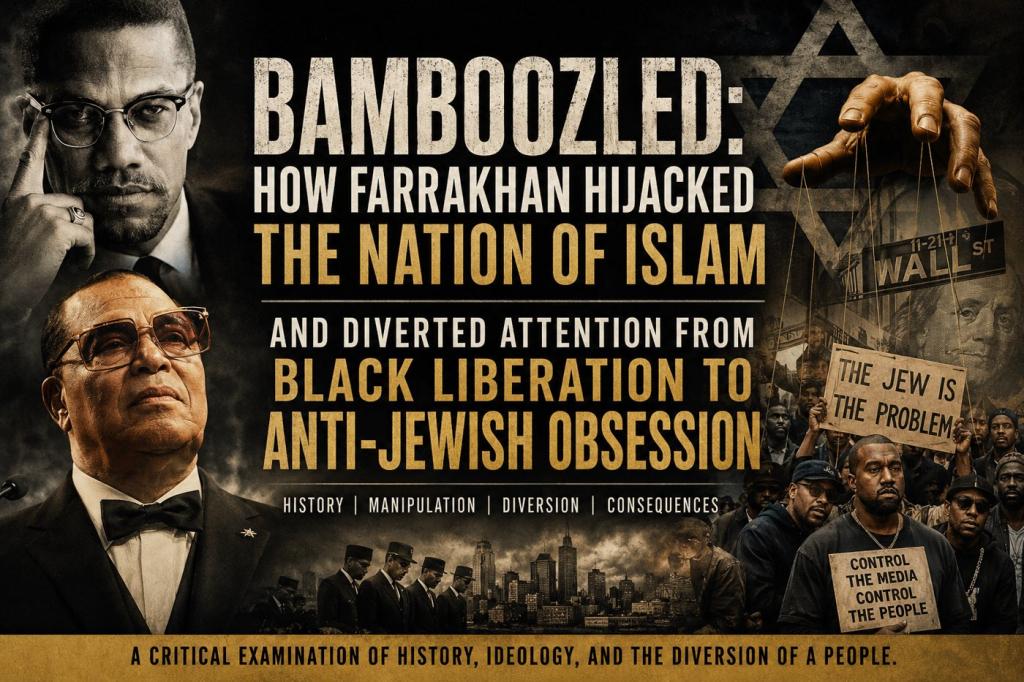
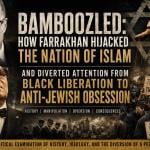
Before even beginning this work, I found myself unable to settle comfortably upon a single framing for what follows. At various points I considered titles such as “From Admiration to Obsession: The Historical Construction of Black American Antisemitic Consciousness”; “The Hijacking of the Original Nation of Islam Vision: How Louis Farrakhan Replaced Reconstruction with Grievance and Conspiracy” and “No People Rise Through Obsession With Another People: The Failure of Farrakhanist Antisemitism and the Lost Path of Reconstruction.”
Each title seemed to capture a different but indispensable dimension of the discussion ahead. One emphasized the historical evolution of an ideological fixation; another the corruption of an originally reconstructive movement into one increasingly centered upon conspiratorial externalization; and the last the broader civilizational lesson that no wounded people can truly rise while psychologically orbiting another people as the explanatory center of their existence.
I likewise debated whether this discussion should include elements of my own conversations with Malcolm Latif Shabazz (October 8, 1984–May 9, 2013), the grandson of Malcolm X (May 19, 1925–February 21, 1965) and Betty Shabazz (May 28, 1934–June 23, 1997), through their daughter Qubilah Shabazz, before his assassination in Mexico City. That question was difficult because any honest treatment would also require addressing the factions, sectarian currents, intelligence interests, transnational ideological networks, and geopolitical actors—from so-called “Hezbollah” to the Khomeinist Velāyat-e Faqīh regime in Iran today—which I personally believe, and possess evidence supporting, played roles in silencing him as he moved toward forms of thought too independent, too transnational, and too resistant to rigid ideological control.
It became still more difficult because his own gravitation toward the Ahl al-Bayt of Muḥammad, as he explained to me in correspondences I still possess and intend to publish in a forthcoming work on his assassination, was launched in large part through his research into the organization I founded shortly before the Double Eclipse of shahr al-qamarī Ramaḍān in 2003: the Taliyah al-Mahdi. Those early writings, which spread rapidly through internet mutashayyiʿ circles two and a half decades ago, popularized the gematria of “313” for the jaysh, or “troops,” of the Mahdī, who was foretold in Shiʿah aḥādīth to live in the Jewish Temple in Jerusalem, pray in Hebrew, and call upon Allah by “the Supreme Name in Hebrew.” This, however, is far beyond the narrow scope of the discussion at hand. The serious scholar may reference many of my published works through New Dawn Publications for a fuller treatment and dalīl concerning these matters.
From the beginning, this current was overtly syncretic and Judeo-Sufi in orientation. His own gravitation toward these ideas, and his dialogues with me after having been introduced through former Congresswoman Cynthia McKinney in 2012, therefore seem particularly relevant because of my own Judeo-Sufi orientation, my own role within the Ṭarīqat ʿĪsāwīyah, and my own absolute and unabashed Jewishness, then as now.
For that reason, Malcolm Shabazz’s interest seemed apropos to mention not merely as a personal memory, but because it illuminated a much larger historical and theological question: whether Islam, as transmitted through Muḥammad’s own family, preserved modes of thought so deeply entangled with rabbinic, Diasporic Essene, Ṣābiʾan, and Torah-observant forms of practice that Sunni polemicists could later accuse the Shīʿah of having been “founded by Jews,” or even by one particular personification of Diaspora Essene “Ṣābiʾan” Judaism: ʿAbd Allāh ibn Sabaʾ—ʿObadiah, son of the Ṣābiʾūn. Once again, while this is a deeply essential discussion for the Ummah to have, the serious scholar is referred to my first master’s thesis, People of the Book: What the Religions Named in the Qur’an Can Tell Us About the Earliest Understanding of “Islam” (2012), and numerous subsequent works for a fuller treatment and relevant dalīl concerning these matters.
The designation Ṣābiʾūn itself is mentioned in the Qurʾān without condemnation, alongside Jews, Christians, and other communities accountable before God (Qurʾān 2:62; 5:69; 22:17), even as later polemical traditions weaponized related language against Muḥammad, his followers, and eventually the Shīʿah themselves.
In the end, perhaps because of the many tangents these subjects and possible titles could lead us down, I concluded that the broader historical and psychological patterns examined here were ultimately more important than any individual personality. The true subject of this work is not merely Louis Farrakhan, Malcolm X, Kanye West, or any other singular figure, but rather the long diversion of revolutionary energy away from reconstruction of the self and toward obsessive fixation upon perceived external enemies.
It is with that focus narrowed, and with the aforementioned considerations established primarily as subtext rather than centerpiece, that this discussion now begins.
Introduction
Few phenomena in modern American political and cultural life are more intellectually corrosive—or more historically misunderstood—than the evolution of antisemitism within segments of Black nationalist discourse in the twentieth and twenty-first centuries. What began as a legitimate cry for dignity among a brutalized and dispossessed people gradually became, in certain ideological currents, transformed into a fixation upon “the Jew” as a symbolic explanation for social failure, economic disparity, media manipulation, cultural decay, and institutional powerlessness. In this transformation, the struggle for liberation was increasingly diverted away from reconstruction of the self and toward mythologies of external control.
This process did not emerge spontaneously. It developed over generations through the convergence of racial trauma, urban economic tensions, imported European antisemitic tropes, religious reinterpretation, conspiracy culture, celebrity amplification, and the ideological radicalization of portions of Black nationalist movements. The result was the creation of an intellectual atmosphere in which resentment could masquerade as revolutionary consciousness and in which hatred of Jews increasingly became confused with resistance itself.
The irony is profound because earlier Black nationalist leaders—including figures within the early Nation of Islam—often viewed Jewish survival with admiration as much as suspicion. Jewish continuity across centuries of exile, persecution, and dispersion was frequently cited as evidence that a broken people could nevertheless preserve literacy, communal cohesion, economic organization, education, memory, and collective discipline. The original lesson was not intended to be one of obsessive hostility. It was meant to inspire internal nation-building.
Yet over time this dialectic of critical admiration deteriorated into something darker. Under the later influence of Louis Farrakhan, antisemitic rhetoric increasingly ceased functioning as occasional polemic and instead became a central explanatory framework through which vast segments of modern life were interpreted. “The Jew” evolved into an almost metaphysical category—simultaneously financier, manipulator, gatekeeper, corrupter, censor, and hidden architect of systemic oppression. In such a worldview, historical complexity collapses into conspiracy, and social reconstruction becomes psychologically subordinate to grievance.
The consequences of this ideological shift extended far beyond the Nation of Islam itself. Through music culture, celebrity networks, prison proselytization, street preaching movements, internet radicalization, pseudo-historical literature, and social media algorithms, these narratives spread into broader currents of Black American consciousness. By the twenty-first century, figures such as Kanye West would publicly reproduce themes that had circulated for decades beneath the surface of popular culture: the idea of hidden Jewish control over finance, media, contracts, careers, and public discourse.
At the same time, the assassination of Malcolm X cast a permanent shadow over the moral legitimacy of later NOI leadership. Malcolm’s own intellectual evolution increasingly moved away from racial absolutism toward international human rights discourse, spiritual universalism, and anti-colonial solidarity. His growing rejection of simplistic racial cosmologies placed him in direct tension with forces invested in maintaining ideological rigidity and personality-centered authority. The lingering controversy surrounding Farrakhan’s rhetoric before and after Malcolm’s assassination, including his later confrontational exchange with Attallah Shabazz, remains one of the most painful unresolved fractures within modern Black political and religious history.
This work therefore does not merely examine antisemitism as prejudice. It examines it as diversion. It explores how a movement originally rooted in psychological resurrection, self-discipline, economic independence, and communal reconstruction gradually risked becoming trapped within a worldview defined by externalized blame. It asks how admiration for Jewish endurance transformed into pathological fixation upon Jewish power. And it considers whether the greatest tragedy of this transformation was not what it did to Jews, but what it diverted Black America away from becoming.
From Original Jewish Admiration in the Nation to the Anti-Jewish Obsession of Farrakhan
The modern crisis of Black American antisemitism did not emerge in a vacuum, nor did it begin with Kanye West suddenly posting conspiratorial tirades online. The rhetoric seen today in celebrity culture, internet spaces, fringe political movements, and segments of Black nationalist discourse is the product of a long and deeply layered historical process in which legitimate grievances, economic frustration, racial trauma, religious mythology, selective historical memory, and ideological manipulation fused together over generations into a recurring fixation upon “the Jew” as both symbol and scapegoat.
The tragedy is that this fixation repeatedly diverted energy away from the very forms of institution-building that earlier Black leaders themselves admired in Jewish communities. Instead of asking how Jewish diasporic survival functioned historically through literacy, family continuity, legal tradition, mutual aid, communal economics, and educational discipline, later movements increasingly drifted toward explaining Black suffering through conspiratorial narratives centered upon Jewish control. The result was not empowerment but dependency upon grievance as a worldview.
The roots of this dynamic stretch back into the late nineteenth and early twentieth centuries, when Black Americans emerging from slavery encountered urban economic systems in which some visible intermediaries—shop owners, landlords, pawnbrokers, garment merchants, and financiers—were sometimes Jewish immigrants or descendants of Jewish immigrants. Economic tension in segregated neighborhoods could then easily be racialized or mythologized. At the same time, Christian supersessionist ideas inherited from European theology had already normalized anti-Jewish assumptions throughout American culture long before they entered Black nationalist discourse specifically.
Yet the more decisive turn came with the rise of movements such as the Nation of Islam under Wali Fard Muhammad and Elijah Muhammad. The NOI emerged in the context of profound Black dispossession, lynching, segregation, and systematic humiliation. Its early appeal lay in restoring dignity, discipline, self-reliance, masculine identity, and communal purpose to people whom American society had systematically dehumanized. Within that framework, Jews occupied an ambiguous symbolic role. On one hand, Elijah Muhammad repeatedly praised Jewish solidarity, education, economic organization, and survival under persecution as examples Black Americans should emulate. On the other hand, Jews were also increasingly portrayed within cosmological and economic narratives as exploiters or manipulators.
For Elijah Muhammad, Ashkenazi Jews were simultaneously presented as proof that a persecuted minority could rise through cohesion and as evidence of alleged hidden domination. That unstable mixture would later become combustible.
Malcolm X initially inherited portions of this worldview, but his intellectual evolution increasingly moved beyond it. After his pilgrimage to Mecca and widening engagement with global anti-colonial struggles, Malcolm’s perspective became far less racially absolutist. He began speaking in terms of human rights, international solidarity, and moral struggle rather than metaphysical racial enemies. He recognized the danger of reducing complex historical systems into simplistic ethnic conspiracies.
This evolution brought him into growing tension not only with the Nation of Islam hierarchy but with forces that depended upon maintaining rigid ideological control. The subsequent assassination of Malcolm X in 1965 remains one of the most traumatic and controversial events in modern Black American history. Multiple men associated with the NOI were convicted in connection with the murder, though later exonerations and historical reassessments complicated the official narrative. Nevertheless, suspicion surrounding Louis Farrakhan persisted for decades because of his incendiary rhetoric toward Malcolm before the assassination.
What made this especially haunting was Farrakhan’s own language afterward. In a notorious and confrontational 1990s interview with Attallah Shabazz, he spoke in terms many critics interpreted as tacit acknowledgment of moral responsibility for the atmosphere that led to Malcolm’s death. Rather than expressing unequivocal remorse, Farrakhan often framed the assassination through ideological justification, speaking as though Malcolm’s break with the NOI had constituted betrayal. To many observers, especially within Malcolm’s family and among historians of the movement, Farrakhan appeared less like a reconciler than a man unable to fully disentangle himself from the political and rhetorical conditions surrounding the murder.
By the late twentieth century, Farrakhan transformed antisemitic rhetoric into one of the defining public features of the reorganized NOI. Under his leadership, “the Jew” increasingly became an all-purpose explanation for media corruption, financial exploitation, political manipulation, cultural decay, and Black suffering itself. This rhetoric spread far beyond the NOI proper through music, celebrity culture, prison networks, urban religious movements, internet subcultures, and political radicalism.
It is through this long ideological pipeline that figures such as Kanye West emerged. Kanye’s public obsession with Jews did not appear from nowhere. It reflected decades of accumulated rhetoric circulating through portions of Black nationalist discourse, celebrity mentorship networks, conspiracy literature, social media algorithms, and pseudo-historical revisionism. The language changes from generation to generation, but the structure remains remarkably consistent: social complexity collapses into ethnic mythology; institutional failure becomes attributed to hidden coordination; personal grievance transforms into civilizational accusation.
The bitter irony is that this fixation often emerged precisely among communities that once admired Jewish survival mechanisms. Instead of studying how diasporic minorities preserved continuity through literacy, commerce, education, legal systems, and internal solidarity, later ideologues increasingly adopted the fantasy that Jewish success itself must be illegitimate. In doing so, resentment replaced reconstruction.
Thus the history of modern Black American antisemitism is not simply a story of hatred. It is also a story of diverted energy: the tragic transformation of a struggle for self-determination into psychological dependence upon an externalized enemy-image.
How Louis Farrakhan Hijacked the Original Mission of the Nation of Islam
The original vision of the Nation of Islam was never meant to devolve into obsession with the Jew as an eternal enemy. The earliest teachings under Wallace Fard Muhammad and later under Elijah Muhammad emerged from the condition of a broken people seeking resurrection, discipline, self-respect, economic independence, and knowledge of self in a society built upon slavery and segregation. The Jew, in those earlier teachings, was often presented not merely as a rival or critic, but as proof that a persecuted people could survive dispersion, preserve identity, build institutions, educate their children, and maintain collective continuity against overwhelming odds.
Elijah Muhammad himself repeatedly pointed to Jewish cohesion, literacy, communal economics, and historical endurance as examples Black Americans should study carefully. The lesson was not “hate the Jew.” The lesson was: “observe how a scattered people survived.” Even where criticism of exploitation or economic imbalance appeared, the underlying theme remained one of self-transformation, not pathological fixation upon another nation.
And Malcolm X, especially after his pilgrimage to Mecca, saw even more clearly the danger of reducing the struggle of Black people into racial mythology and endless grievance theater. He began moving toward a universal language of human dignity, anti-colonial solidarity, and spiritual brotherhood that transcended crude racial absolutism. He understood that no people rise by becoming professional haters. A nation rises through discipline, education, sacrifice, and moral seriousness.
What emerged later under Louis Farrakhan increasingly transformed this earlier framework into something darker: a rhetorical culture in which “the Jew” became not merely a symbol within theological polemic, but a near-metaphysical explanation for worldly failure itself. This inversion fundamentally altered the center of gravity of the movement. Instead of producing builders, scholars, landowners, scientists, disciplined fathers, and spiritually upright communities, the discourse often drifted toward conspiracism, spectacle, and perpetual externalization of blame.
The irony is devastating. A movement originally intended to cure psychological slavery risked becoming psychologically dependent upon the very enemy-image it claimed to resist. Endless fixation upon Jews elevated them into an almost supernatural role within the imagination of followers, granting them omnipotent explanatory power over every social, political, and economic condition. Such thinking ultimately weakens rather than strengthens a people because it transfers agency away from the self.
The early Nation understood something more profound: every conquered people must first reconstruct itself internally. The Jew was once cited as evidence that this was possible. A dispersed people preserved language, memory, scholarship, law, family continuity, and economic networks across centuries of exile and persecution. Whether admired or criticized, the historical fact remained undeniable: they survived because they organized.
That lesson was meant to inspire disciplined nation-building, not endless resentment and excuse-making focused on the perceived other.
The degeneration of this principle into generalized antisemitism represented not the fulfillment of the original vision, but in many respects its corruption. Hatred is easy. Institution-building is difficult. Conspiracy is emotionally satisfying. Self-transformation requires sacrifice. The original impulse of the movement was toward resurrection of the self, not intoxication with grievance.
Even Malcolm’s later evolution pointed back toward this forgotten truth. After witnessing Muslims of every complexion in Mecca, he increasingly rejected simplistic racial cosmologies. He saw that moral corruption and moral excellence were not biologically fixed realities. At the core, the struggle was civilizational and spiritual.
Had the original mission remained centered upon education, land, economic sovereignty, family restoration, martial discipline, and spiritual elevation, the movement might have become one of the most powerful reconstruction projects in American history. Instead, under later rhetoric, too much energy was redirected into symbolic warfare against Jews as an abstract collective entity, producing outrage but little durable institutional transformation.
A people cannot build a future while psychologically orbiting another people. The highest form of liberation is not obsession with an enemy. It is becoming so internally strong, organized, educated, and spiritually grounded that the enemy no longer defines the horizon of one’s existence.
Conclusion: No People Has Ever Succeeded Through Obsession With Another People
The tragedy explored throughout this work is not merely that antisemitism emerged within segments of modern Black nationalist discourse. The deeper tragedy is that it increasingly displaced the very principles of reconstruction, discipline, education, communal organization, and economic sovereignty that earlier generations sought to cultivate in the aftermath of slavery, segregation, and systematic dehumanization. A movement that once aimed to resurrect a broken people risked becoming psychologically captive to an enemy-image that consumed enormous amounts of intellectual, emotional, political, and spiritual energy.
The historical irony is impossible to ignore. Early Black nationalist thinkers, including elements within the original Nation of Islam, often looked at Jewish history with a mixture of admiration and envy because Jews represented something undeniable: a dispersed and persecuted minority that nevertheless preserved literacy, memory, law, institutional continuity, family structure, communal solidarity, and transnational economic networks across centuries of exile and catastrophe. The original question was supposed to be: “How can a conquered people rebuild itself?” Over time, however, that question was increasingly replaced by another: “Who secretly controls our suffering?”
That substitution proved disastrous.
Once “the Jew” becomes transformed into an all-purpose explanation for failure, institutional weakness, cultural dysfunction, economic disparity, celebrity exploitation, or political impotence, genuine self-analysis begins to disappear. Structural problems become mythologized. Internal failures become external conspiracies. Nation-building gives way to performative outrage. And the energy required for schools, businesses, land ownership, stable families, scholarship, martial discipline, economic cooperation, and political sophistication becomes redirected into symbolic warfare against abstractions.
This is why the later evolution of Louis Farrakhan represented such a decisive turning point. Under Farrakhan, antisemitic rhetoric increasingly ceased to function as peripheral polemic and instead became central theater—an emotionally satisfying but ultimately sterile mode of political expression. The consequence was not liberation, but fixation. Not sovereignty, but dependency upon grievance. A people psychologically orbiting another people can never fully become itself.
The life of Malcolm X stands in sharp contrast to this trajectory. Malcolm’s intellectual maturation after Mecca demonstrated an alternative path: one grounded not in racial mythology but in moral seriousness, internationalism, anti-colonial solidarity, and spiritual transformation. His evolution suggested that genuine liberation requires transcending simplistic racial cosmologies rather than intensifying them. That evolution may help explain why his legacy remains so contested. Malcolm increasingly moved toward a worldview capable of criticizing oppression without collapsing entire ethnic or religious groups into metaphysical enemies.
The persistence of these themes into contemporary celebrity culture, particularly through figures such as Kanye West, demonstrates that this ideological inheritance did not end with the twentieth century. It adapted itself to new technologies, new audiences, and new forms of cultural influence. Social media now accelerates the spread of conspiratorial thinking at speeds unimaginable to earlier generations, while celebrity culture grants instant legitimacy to narratives once confined to fringe spaces. Yet the underlying structure remains remarkably unchanged: complexity collapses into ethnic mythology, and personal or communal frustration seeks relief through externalized blame.
Ultimately, the central question raised by this history is civilizational rather than merely political. Can a wounded people rebuild itself through discipline, institution-building, education, spiritual depth, and collective organization? Or will it become trapped within cycles of resentment that substitute symbolic enemies for genuine reconstruction?
The answer matters not only for Black America or for Jews, but for any society attempting to emerge from historical trauma without surrendering to the intoxicating simplicity of conspiracy and hate.
No people rise through obsession with another people. They rise by mastering themselves.









 Ad-Free & Subscriber Log-In