

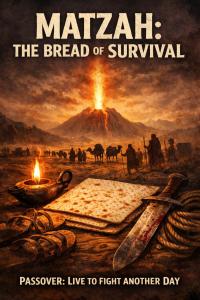
On Passover we eat matzah to remember suffering. Then, almost immediately, we flip the script and turn Passover into a story of universal liberation, freedom, and celebration. It’s a nice concept, but not at all what Exodus declares. Exodus is not the story of humanity being set free. It was about freeing a specific people so they could bring G-d’s law to the world.
Matzah: The Bread of Survival
However, in order to do that, they had to survive the night. They didn’t eat matzah because it was theologically sound, to prove a point, or to show empathy. They ate the matzah because there was no time for the dough to rise, according to Exodus 12:39. Survival came first, because without survival, there could be no covenant.
Passover was about living to fight another day. Passover isn’t about ritual and law. It’s about what happens before the law. Passover is about what happens when survival is urgent and time is lacking. Passover is about survival and that is the true purpose of the matzah. Deuteronomy 16:3 calls matzah leḥem oni, “the bread of affliction.” What does affliction mean? Affliction is hardship, poverty, and depravation. When a people are under affliction, they can only meet the bare minimum of survival. A better term for Matzah is the bread of survival. It is what you eat when there is nothing else.
Passover: Live to Fight Another Day
The ritual came later. Sinai happened later. The law came later. Survival came first, because a nation cannot carry Torah to the nations if there is no nation to receive it. They
cannot be a light to the world if the light is allowed to go out. This Passover when you eat matzah and remember the tears of our ancestors, remember this as well: You are here because they chose survival. We must also choose Pikuach nefesh, the idea that preserving life overrides almost every other law. Before you turn it into a story of universal liberation, remember that it was the liberation of a people called to live long enough to do G-d’s work in the world. Isaiah 42:5 says:
“I am the Lord; I have called you in righteousness; I will take you by the hand and keep you; I will give you as a covenant for the people, a light for the nations,”
Once you’ve remembered this call, remind yourself that the work isn’t complete yet.
Choose Matzah: Survival First
We must live to fight another day. Does Torah call us to be kind to the stranger? Absolutely, but Torah never asks us to disappear as a people to enact that care. Passover does not ask us to give up our identity as a people, allow the destruction of our people, or give up our land. Exodus calls on us to do the opposite. It asks us to live another day, to find the promised land, and to be the people other nations refused to be.
Passover doesn’t begin with ideas, theology, or ritual. It begins with survival. Survival requires difficult decisions about identity, boundaries, and responsibility in a world that is not always safe. We live in a world that tells us universality is the correct stance in every situation, that asks if Israel has a right to exist, and that forces us to reconsider our very identity and survival. Passover reminds us that survival comes first and the rest follows. There could be no Sinai without the bread of survival coming first. Before Sinai, there was matzah. Before law, there was survival. And if we forget that, we misunderstand the very foundation of the covenant itself. When we are asked to give up identity, safety, and freedom, Exodus commands that we respond with matzah: survival first.










 Ad-Free & Subscriber Log-In