
 Cry 'Woof'
Previous Parts: I, II, III, IV.
I’ve always maintained that the only way to really learn a programming language is to code up some kind of project using it: not something out of a book, but something of my own, something that’s fun. For many years, my project of choice was the old fashioned text adventure. I got started with computers in the mid-1970’s, when we all we had were dumb-terminals and today’s beautifully 3-D rendered games were not even a dream. Text was king; and text adventure games like Advent and Zork seemed like magic. I spent a lot of time writing small games in those days, but doing a full-up “adventure game” always seemed beyond my skills, or perhaps beyond my tools. I tried it in BASIC and didn’t get far; I tried it in Pascal and floundered. And then in college I got a LISP system called LISP-80 that ran on my Kaypro 4, and I discovered that LISP is incredibly well suited to writing text adventures. I don’t have the code to that game anymore, more’s the pity, but I remember quite a lot about it. Memory was very limited, so I had to design the game world in areas, and load and delete different areas as you moved about the world. I had great fun.
It was perhaps inevitable, consequently, that my attempts to learn Clojure would lead me in the direction of writing a text adventure. Back then, I had aspirations to writing a game others might play, or even a serious system for writing adventure games. Things have changed significantly since then; if writing what’s now called “interactive fiction” is your thing, there are a number of excellent systems out there that will help you. The Inform system is particularly amazing, and I spent quite a lot of time playing with it before I realized that I didn’t really want to write adventure games for people to play. Instead, I wanted the fun of implementing the system that the game is written in. The game itself is secondary.
My goal, then, is to write a simple text adventure: a network of rooms that you move around in using simple commands, with objects to pick up and move and manipulate. The focus isn’t on writing a detailed game, but rather on figuring out how to do the various tasks efficiently and beautifully in Clojure.
And you can play along, too! I’m keeping my code at GitHub; the project is called whd-advent, and you can go look at it. You can look at the code, and my notes, and you can even download it and give it a try.
Mind you, I don’t suggest you do that unless you’re really interested in playing with Clojure, because it isn’t much of a game.
Here’s an example of what the game code looks like:
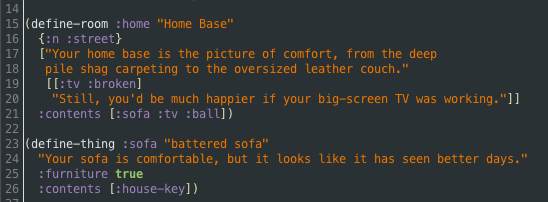
This defines one room in the game world, your “Home Base”. You can go north (:n) to the “Street” (:street); and at the beginning of the game the room contains a sofa, a TV, and a ball. (It happens to be a soccer ball. Go figure.) The room’s description is a given as a vector of strings; note the bit that says [:tv :broken]. That’s a conditional part of the description; it’s included only if it is a fact that the TV is broken. Once you fix the TV, it will go away.
Note also the definition of the sofa. There’s some keys in the sofa; I imagine they are under a cushion, and will need to be searched for. Baby steps.













 Ad-Free & Subscriber Log-In