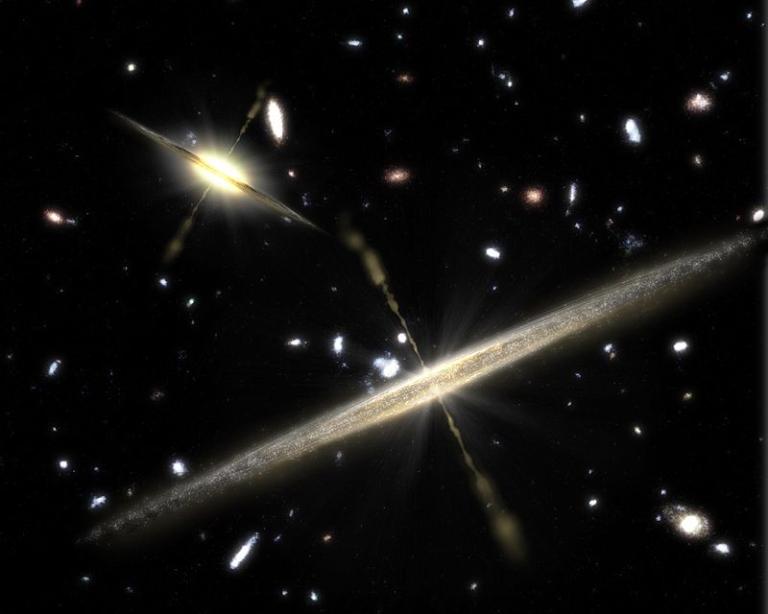
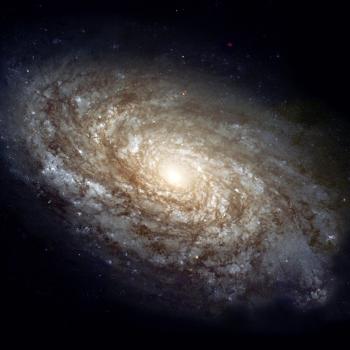
An artist’s conception of two distant galaxies (Wikimedia Commons public domain image)
I marked a number of passages during my recent reading of Believe: Why Everyone Should Be Religious, by the New York Times writer Ross Douthat. (See my 19 June 2025 Meridian Magazine article ““Believe”: A Thoughtful Defense of Religion in a Secular Age.”) Here is one in which Douthat describes the intuitive sense of the divine that many people, if not most people, have experienced at one point or another in their lives — even though more than a few have then gone on to talk themselves out of it:
Start with the physical world, the material universe that human beings inhabit and experience and study. What your naive religious self observes, at every level of visible existence, are regular-seeming, complex, and predictable systems: the progress of the seasons, the stars in their courses, the everyday workings of the human body. In your own embodied existence, you find yourself surrounded by complex machines of flesh and bone, filament and fiber—animals and insects, trees and flowers, their individual operations woven together in still-more-complicated ecosystems. And these systems don’t just manifest a crude functionality; they often seem beautiful, graceful, and sublime, offering visions that even on an ordinary day can stir extraordinary awe, that both inspire and exceed the human capacity for art. “The heavens declare the glory of God,” the Bible says, and when the biblical God wants to answer a suffering mortal’s questions in the book of Job, He goes straight to this initial human intuition. The intuition that the world seems like a workshop and a cathedral and a theater and a machinist’s shop and more. That nothing so vast and complex and beautiful could exist by simple accident. That either some Mind or Power must have made or organized all this matter for a reason, or else the Mind or Power is somehow inherent to the system, and the cosmos is itself divine. (14)
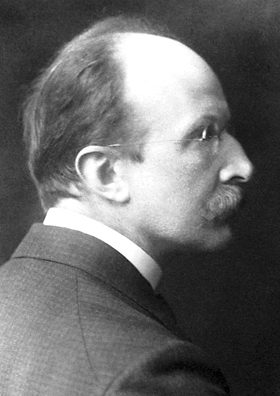
Max Planck’s official 1918 Nobel Prize photograph (Wikimedia Commons) Planck, the founder of quantum theory, was among the most significant scientists of the twentieth century. He died in 1947.
And now for a second and even longer passage from Believe: I realize that quantum physics can be a tempting playground for cranks and wild speculations. (Ideal territory for me, right?). But some implications of some interpretations of quantum theory are really, really interesting. Consider this, for example:
Quantum theory is, from one perspective, the place where the scientific project’s expectations of perfect order and law-bound predictability have finally been disappointed, its questions answered by paradox and riddles. How can light be both a wave and particle? How can particles remain somehow “entangled” even when separated by a great distance? And above all—how can human observation be the only thing that transforms quantum contingency into definite reality, wave into particle, probability into certainty? . . .
But the simplest explanation is still the so-called Copenhagen Theory, named for the city where Niels Bohr and Werner Heisenberg did their pioneering work, in which the conscious observer places a mysterious but essential role in collapsing quantum possibility into physical reality. That simplicity, wild as it seems, returns us to the fundamentals of the religious perspective on the world. It’s scientific evidence that mind somehow precedes matter, that our minds have some integral relationship to physical reality, and that what holds all of the physical universe in actual existence, not just mere possibility and probability, is some larger form of consciousness itself. . . .
Spencer Klavan, in a recent essay on the long wrangle over quantum mechanics, makes the point this way: It has become customary to speak of the universe as existing for “billions of years” before the advent of conscious life—an empty cathedral built by no one, hurled into existence by a great burst of energy. The various competing explanations of this process all depend on resolving the many quantum possibilities of a tiny infant universe into a timeline of definite unfolding events, from the appearance of the first photons to the blazing fusion that would eventually create the first stars. But since those possibilities are manifold and indeterminate until observed—since things like “years,” “energy,” “photons,” and “atoms” are exactly the kinds of things that cannot quite exist unseen—it may turn out that we have been talking mostly about how these things would have behaved if there was someone there to watch them. And “the most fearsome heresy of all,” he concludes, “in an age committed to materialism, is that indeed there was someone there.” (30)
There is light, even amid darkness (Wikimedia Commons public domain image)
For the 11 August 2025 Come, Follow Me segment of the Interpreter Foundation Podcast, Martin Tanner and Brent Schmidt talked about the Come, Follow Me Doctrine & Covenants lesson for August 25 – 31 covering D&C 93. The Discussion segment of the 11 August 2025 podcast can be accessed at https://interpreterfoundation.org/interpreter-podcast-august-11-2025.
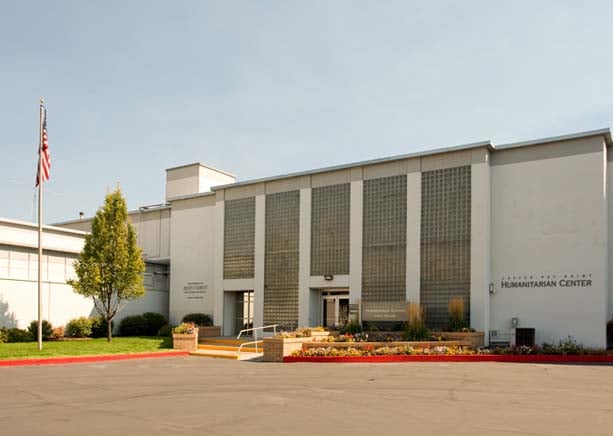
The main entrance to the enormous Humanitarian Center of the Church of Jesus Christ of Latter-day Saints in Salt Lake City, Utah (LDS Church photo)
I close, as I frequently do, with specimens of horror that I’ve retrieved from the Christopher Hitchens Memorial “How Religion Poisons Everything” File™:
It seems that there is always a serpent in paradise. Even among the balmy breezes and swaying palm trees of the Pacific islands, the evils of theism are impossible to avoid.












 Ad-Free & Subscriber Log-In