


(Wikimedia Commons public domain image)
This column of mine, which I originally published in the Deseret News for 4 July 2013, seems to me relevant also to our celebration of Labor Day, which is today: “A day for celebration and remembrance”
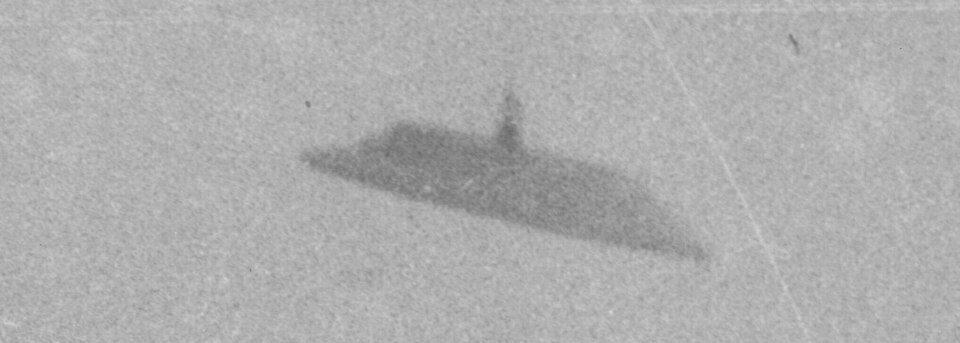
Driving over to Depoe Bay from Portland, we passed very near McMinnville, and I couldn’t help thinking of the famous 1950 McMinnville UFO sighting. So, as we drove along, my wife read to me from “The History of the 1950 Trent UFO Sighting in McMinnville, Oregon.” And, coincidentally, we drove right by the Evergreen Aviation and Space Museum — the home of Howard Hughes’s famous “Spruce Goose” — within about sixty seconds of her reading the article’s mention of “the area where Evergreen Aviation stands today,” which figures in the story.

We hadn’t been in our condo fully five minutes yesterday before we noticed the spout of a gray whale just off shore, perhaps two hundred yards away. While the day remained light, it was virtually impossible to go more than a minute or two without seeing a whale. And they’re still at it out there today. Grazing and slowly moving back and forth close in by the shore. (There is a resident pod of gray whales here, along with migrating groups of humpback whales, orcas or killer whales, and, rarely, blue whales.) And, of course, there are the Canada geese. Lots of them. Right now, a group of six or eight are savoring the grass right outside our door.
I’ve sometimes wondered what it would be like to be a whale. Or, more often, what it would be like to be a dolphin. How do they see the world around them? Then I think of Ludwig Wittgenstein’s famous (and typically oracular) statement that, “If a lion could speak, we could not understand him” (Philosophical Investigations, 223). We wonder about alien life in other worlds, but we’re surrounded by alien life here upon our own — some forms of which, at least, may have “minds,” albeit minds very foreign to our own.
There have been some limited but apparently successful attempts to communicate via actual language with great apes. We know that whales have “songs” and that they exhibit certain behaviors that appear to be communicative. Beyond that, though, we understand remarkably little. What pectoral-fin slapping and whale songs signify, we don’t know.

As the hart panteth after the water brooks, so panteth my soul after thee, O God. (Psalm 42:1, KJV)
Is the yearning that many — perhaps most, although not all — humans seem to feel for something transcendent, the divine, or “cosmic meaningfulness” itself evidence for the existence of what might broadly be called God? Some have argued that, indeed, it is.
You made us for yourself, O Lord, and our hearts are restless till they rest in you. (Augustine, Confessions)
There is a god-shaped vacuum in the heart of every man, and only God can fill it. . . . Man tries unsuccessfully to fill this void with everything that surrounds him, seeking in absent things the help he cannot find in those that are present, but all are incapable of it. The infinite abyss can be filled only with an infinite . . . object . . . God himself. (Blaise Pascal, Pensées)
Christian optimism is based on the fact that we do not fit in to the world. (G. K. Chesterton, Orthodoxy [London: Hodder and Stoughton, 1996], 114)
Creatures are not born with desires unless satisfaction for those desires exists. A baby feels hunger: well, there is such a thing as food. . . . If I find in myself a desire which no experience in this world can satisfy, the most probable explanation is that I was made for another world. (C. S. Lewis, Mere Christianity)
The fact that a man is hungry doesn’t prove that he will actually obtain food. He may well starve to death, as many men have. But hunger surely proves that a hungry man comes from a species that needs to eat and that he lives in the kind of world in which edible substances exist.
In the same way, though I do not believe (I wish I did) that my desire for Paradise proves that I shall enjoy it, I think it a pretty good indication that such a thing exists and that some men will. (C. S. Lewis, Mere Christianity)
And what about religious experience? Can it provide any actual evidence for the existence of God or of a transcendent reality? It seems fairly obvious that a religious experience in the first person is more likely to persuade than in the third person, when it is reported by someone else. This is reasonable. But the religious experience of others can, still, count as evidence to those who hear of it.
The theist may argue that throughout human history a host of individuals have claimed to have known and had a personal relationship with God. This claim has been made across cultural and geographic boundaries as well as over time. For the atheist’s claim that there is no God to be true, every single one of these individuals must be wrong about the matter that they themselves would characterize as the most important human concern. (Paul D. Feinberg in Cowan, ed., Five Views on Apologetics, 161)
Here enters in what the Oxford philosopher Richard Swinburne calls “the principle of credulity”:
It is a basic principle of knowledge . . . that we ought to believe that things are as they seem to be, until we have evidence that we are mistaken. . . . If you say the contrary — never trust appearances until it is proved that they were reliable — you will never have any beliefs at all. For what would show that appearances were reliable, except more appearances? (Richard Swinburne, “Evidence for God,” in Gillian Ryland, ed., Beyond Reasonable Doubt [Norwich: Canterbury Press, 1991]).
Of course, religious experiences can be rejected. (Think of Laman and Lemuel, as two obvious examples of this.) Jean-Paul Sartre, for instance — an existentialist and a vocal atheist who loomed much larger in the twentieth century, I sense, than he does now in the twenty-first — recounts an autobiographical experience from his childhood that, he says, led to his rejection of God:
I had been playing with matches and burned a small rug. I was in the process of covering up my crime when suddenly God saw me. I felt His gaze inside my head and on my hands. . . . I flew into a rage against so crude an indiscretion, I blasphemed. . . . He never looked at me again. (Jean-Paul Sartre, Words [London: Penguin, 2000], 102)
The material immediately above represents notes that I took for my future use from Peter S. Williams, The Case for Angels (Carlisle: Paternoster Press, 2002), 50-52. I make no claim of originality for them.

Finally, as I frequently do, I close with something that I recently retrieved from the Christopher Hitchens Memorial “How Religion Poisons Everything” File™. Revealing efforts by religionists to mess with the minds of vulnerable young people of college age, it should serve as a call to arms for those who want higher education to be free of the baneful effects of theism and of entanglement with religiosity: “How faith-based colleges are saving a generation in crisis.”
Posted from Depoe Bay, Oregon















 Ad-Free & Subscriber Log-In