

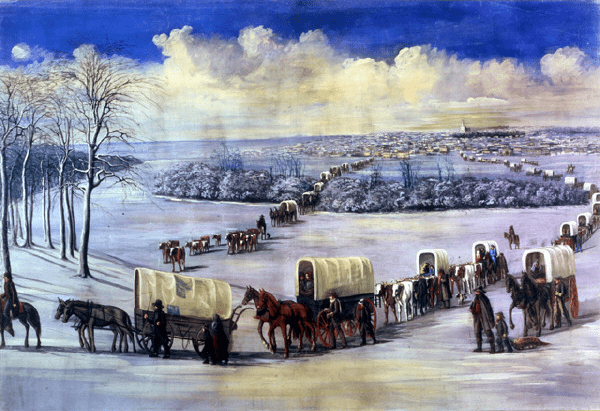
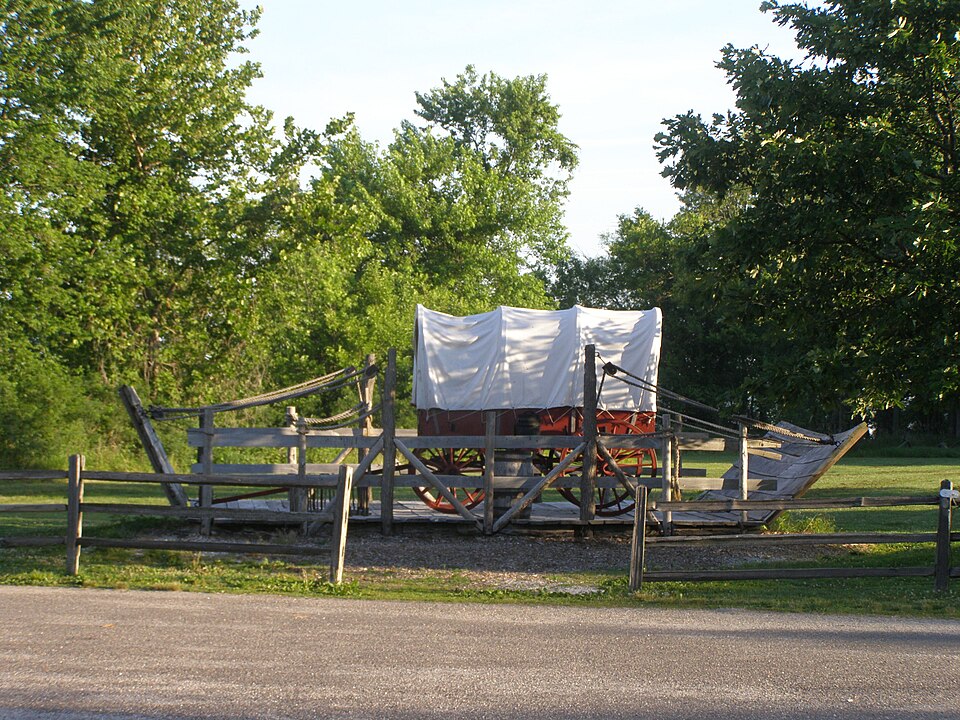
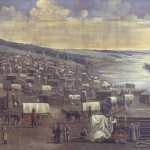
We began the day quite early, as we usually do during these filming expeditions, down on the eastern bank of the Mississippi River where the “Trail of Hope” comes to the shore. This is apparently the spot where the Latter-day Saints began their crossing of the river and their flight into Iowa Territory and beyond. We chose the spot, of course, because we were filming part of an episode on the exodus to the west.
I can scarcely imagine the feelings of those who were going into exile in the barely explored American West. This was not only a city that they had built. They had reclaimed the malarial swamp upon which much of it stood. They had labored to build a temple high above it, a deeply holy place in which they believed the glory and power of God to be uniquely manifest. They were leaving behind the graves of their martyred prophet and patriarch
But they were under enormous pressure and threats of violence — threats that were entirely credible because of the violence that had already occurred (including, but not limited to, the assassinations of Joseph Smith and Hyrum Smith and the severe wounding of John Taylor at Carthage Jail, about a year and a half before). So, when unseasonably mild spring-like weather came to the area, the first Latter-day Saints took the opportunity to cross the river by ferry. The emigration began on 4 February 1846. But it was very slow and laborious work. Fully wintry weather — actually, exceptionally cold weather — returned with a vengeance on 19 February. The Saints who were already encamped several miles into Iowa experienced violent winds and measured eight inches of snow. The Mississippi temporarily froze over, so that teams and wagons were able to cross it without needing to wait for ferries.
Then we drove off across Iowa ourselves, recording some dialogue within one of our two cars along the way. I’ve learned that in-car filming is surprisingly difficult and can be time-consuming.
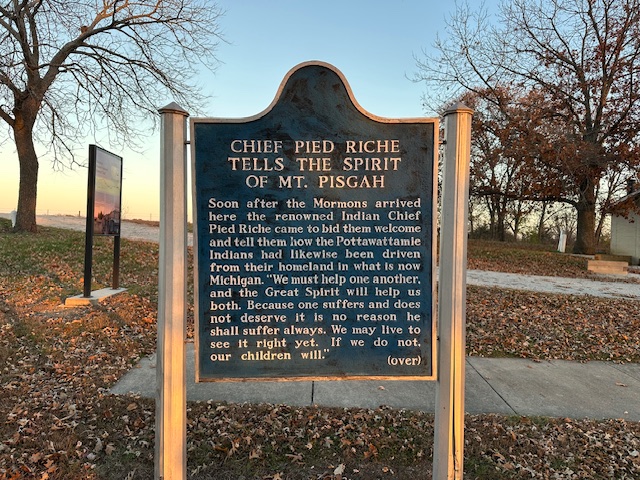
In the evening, we headed off the main road to Mount Pisgah, which was, for about six years, one of the “way stations” along the Mormon Trail. The Saints had first founded a settlement at a place that they called “Garden Grove,” building homes there and clearing, ploughing, and planting roughly 715 acres. But there was insufficient timber there for their needs (e.g., for building and for winter firewood). So they commenced a search for a more suitable location.
It was Elder Parley P. Pratt, of the Quorum of the Twelve, who located a wooded hillock about twenty-five miles to the northwest that overlooked a level area of about a thousand acres or so. He called it “Mount Pisgah.” Elder Pratt seems, quite obviously, to have been saturated in the Old Testament. In the Hebrew Bible, the name Pisgah (פִּסְגָּה, which means “summit”) refers to the mountain from which Moses was shown the entire land of Canaan, the Promised Land — extending from Gilead and Dan in the north to the Mediterranean Sea in the west and the Negev in the south — that God had promised to Abraham, Isaac, and Jacob. See Deuteronomy 34:1-5, where it is also said that Moses died on Mount Pisgah. The mountain is identified by many with Mount Nebo, a traditional pilgrimage destination (and tourist site) in today’s Hashemite Kingdom of Jordan.
If Elder Pratt was thinking that they had almost reached the Promised Land — that is, the Valley of the Great Salt Lake — he was seriously mistaken. However, I doubt that he did. The leaders of the Church of Jesus Christ of Latter-day Saints knew pretty well by then where they were going and how great the distance was going to be. But he plainly liked the area, and I can easily understand why. Ezra T. Benson, himself ordained an apostle on 16 July 1846 and, as it turned out, the great grandfather of Ezra Taft Benson (the future thirteenth president of the Church), commented that it was the first place since he had left Nauvoo where he would have been happy to stay.
But the Saints didn’t stay. They used Mount Pisgah as a temporary way station on the trail to the Great Basin. Emigrating members of the Church continued to pass through and then, after six years, they left it altogether. It had served its purpose. And they left behind the bodies of between five and eight hundred of their loved ones who had died there from the difficult conditions of the Mormon Trail, including exposure and overexertion and suboptimal nutrition.
Among the many who died and are buried there is an ancestor of my own, Joseph Knight Sr. He passed away at Mount Pisgah on 2 February 1847, at the age of seventy-four.
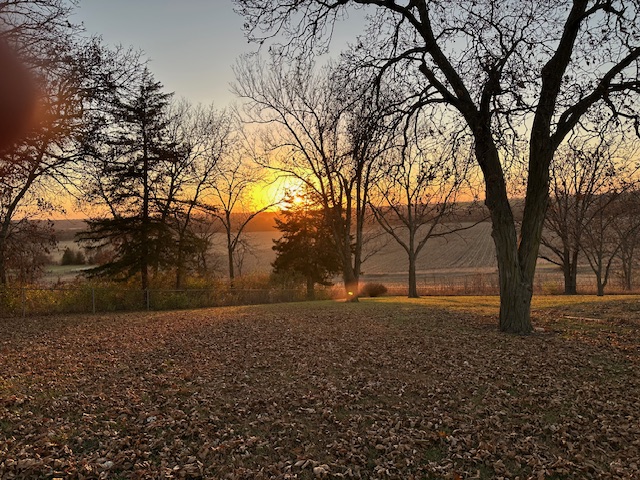
We filmed at Pisgah shortly before dusk. It’s far off the beaten path. The light was marvelous; my photograph above doesn’t do it full justice. The place was serene and beautiful and, I thought, rather wonderfully melancholy. It was, for me, a deeply and personally meaningful visit.
I posted three links here yesterday about Bravo’s idealistic new campaign to promote sympathetic understanding for an often misunderstood and even persecuted minority religious faith. You may have been hearing a bit about it elsewhere, too. It’s called Surviving Mormonism with Heather Gay. And now, here’s another relevant link. However, this one, by contrast, suggests how Latter-day Saints ought to respond to such ventures in religious scholarship: “Attention Is Cheap. Love Is Expensive. It’s Worth It.” I’m afraid that the authors are not recommending an especially easy path.
Posted from Creston, Iowa











 Ad-Free & Subscriber Log-In