

I’ve been traveling and busy, and I’ve fallen behind in calling your attention to new items appearing from the (completely comatose) Interpreter Foundation. Here are three of them:
“Finding the Elect Lady,” written by Spencer Kraus, was published earlier today, Friday, in Interpreter: A Journal of Latter-day Saint Faith and Scholarship:
Review of Lincoln H. Blumell, Lady Eclecte: The Lost Woman of the New Testament (Minneapolis, MN: Fortress Press, 2025). 314 pages. $48.00 (hardcover).
Abstract: For centuries, the consensus reading of 2 John 1 maintained that the epistle was written to a local church, metaphorically addressed as an “elect lady.” This has most especially been the case over the last 150 years of scholarship. However, new findings from Lincoln Blumell challenge the consensus reading, restoring the elect lady to her proper place as an actual individual in the early Christian world. This lady, moreover, can be identified by name, and it is only through haplography that confusion over her identity has been introduced at all. Blumell’s restoration of the text of 2 John 1, based on papyrological and manuscript evidence, is groundbreaking work that will shape scholarship on the New Testament and early Christianity for years to come.
This reprint appeared on Wednesday. Sorry for my tardiness is alerting you to it: Steadfast in Defense of Faith: “Proving That the Church Is True,” written by Steve Densley
Part of our book chapter reprint series, this article originally appeared in Steadfast in Defense of Faith: Essays in Honor of Daniel C. Peterson, edited by Shirley Ricks, Stephen D. Ricks, and Louis Midgley. For more information, go to https://interpreterfoundation.org/books/steadfast-in-defense-of-faith/.
“As a trial attorney, proving my case and demonstrating that the other party has failed to prove their case is central to what I do. Thus, the concept of proof looms large in my professional life. My ears perk up whenever I hear people talk about whether something can be proven, especially about whether we can prove that the Church is true.”
And Interpreter’s complete and utter failure ever to produce anything isn’t limited merely to the written word. There is also this new item, for example: “The Interpreter Foundation Podcast — November 6, 2025: Special guest D. John Butler, who raised funds benefiting the family of the Michigan chapel shooter”
In the 6 November 2025 episode of the Interpreter Foundation Podcast, Terry Hutchinson, Kevin Christensen, and Mark Johnson interview special guest D. John Butler, who raised funds benefiting the family of the Michigan chapel shooter.
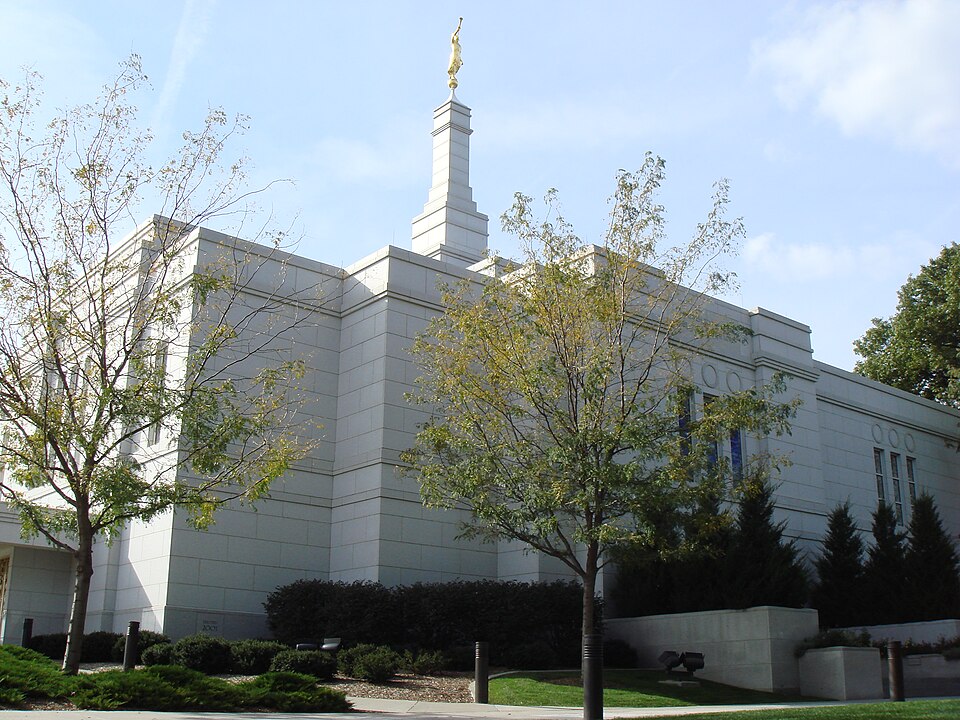
We did some filming along the road on Friday and in the (arbitrarily chosen) small Iowa town of Corning that we passed through before arriving in Florence, Nebraska. In Florence, we parked at the Mormon Trail Center at Winter Quarters . It’s located across the street from the Mormon Pioneer Cemetery, which, in turn, is directly next door to the Winter Quarters Nebraska Temple.
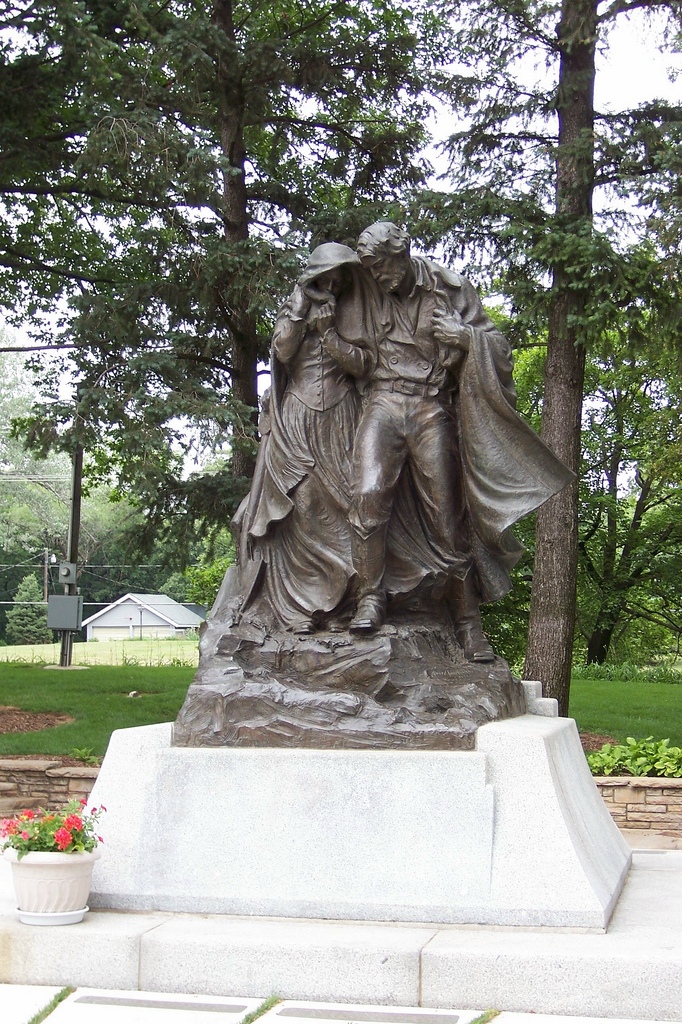
We filmed a brief but unexpectedly emotional segment at the cemetery, near the marvelous Avard Fairbanks statue “Tragedy at Winter Quarters,” which I consider one of the finest and most powerful pieces of sculpture in the Latter-day Saint artistic tradition. As shown above, it depicts a pioneer mother and father who are gazing down, one last time, at their infant child. They have just placed their infant’s lifeless body in a shallow grave, newly dug in the frozen soil of Winter Quarters.
We spoke there about the human cost of the westward migration. Approximately seven hundred Latter-day Saints — men, women, and children, especially old people and infants and (too often) mothers in childbirth — died during the winter of 1846-1847 in the Camps of Israel that were strung out across Iowa. Recording at Mount Pisgah on Wednesday evening, I spoke of my own direct ancestor, Joseph Knight Sr., who is buried there. At Winter Quarters, standing before that moving bronze portrayal of grieving parents, I was hit very hard, personally but in a way that I had not anticipated:
I know something of what those representative parents were feeling, having gone happily out to Orlando, Florida, years ago for the birth of my first grandchild and then, to my agony and shock, to preside over her small private funeral just a few days later. It was as low as I have ever felt in my life. I remember having heard sympathetic people say to others who were suffering or grieving that they wished that they could trade places with them. That, if they could, they would willingly take the sorrows of those others upon themselves. That they wished that they could suffer instead. I had never, before then, really felt such a thing. I honestly wondered whether I was capable of so unselfish an emotion, of such empathy. But, on this occasion at least, I absolutely was. I would have traded places immediately, without hesitation, with my son and my daughter-in-law. I would instantly have assumed the burden of their grief. But I could do nothing. I could only watch powerlessly, offer impotent gestures and awkward words of sympathy and comfort, and cry.
I’ve thought that there might be something deep in that experience for me to learn about the atonement of Christ.
He is despised and rejected of men; a man of sorrows, and acquainted with grief: and we hid as it were our faces from him; he was despised, and we esteemed him not.
Surely he hath borne our griefs, and carried our sorrows: yet we did esteem him stricken, smitten of God, and afflicted.
But he was wounded for our transgressions, he was bruised for our iniquities: the chastisement of our peace was upon him; and with his stripes we are healed.
All we like sheep have gone astray; we have turned every one to his own way; and the Lord hath laid on him the iniquity of us all.
He was oppressed, and he was afflicted, yet he opened not his mouth: he is brought as a lamb to the slaughter, and as a sheep before her shearers is dumb, so he openeth not his mouth.
He was taken from prison and from judgment: and who shall declare his generation? for he was cut off out of the land of the living: for the transgression of my people was he stricken. (Isaiah 53:1-8)
In contemplating the sorrowing parents who are depicted in Avard Fairbanks’s statue, I felt my own grief once again. And the tiny fissure that slightly exposed my usually rather unemotional self — a trait that I’ve always blamed at least partially on my Scandinavian descent — didn’t exactly help my co-hosts, Camrey Bagley Fox and John Donovan Wilson, with their own composure. They both have young children. They understood.
It was all caught by the cameras and the microphones. I don’t know that our lapses in professionalism will survive into the final cut but, if they do and if you ever watch this particular installment of Becoming Brigham, I hope that you’ll show us a little mercy and understanding. We didn’t plan on what happened.
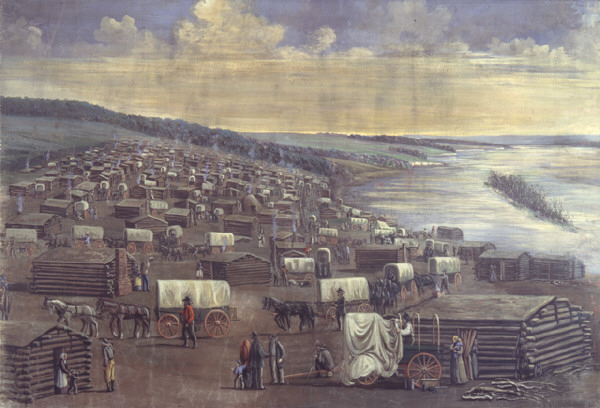
We had a chance to look through the visitor center there, the Mormon Trail Center. It is very well done and extremely interesting. And we enjoyed visiting with the senior missionaries there. Very cold weather is on its way, but Friday was pleasant and beautiful. I asked when the best time to visit Winter Quarters might be. They’re very busy during the summer, of course, and the weather can be warm and humid. In the winter, greater Omaha (where the Winter Quarters sites are located) is often extremely cold. But April and September, they said, are optimal. The buses and crowds have not yet arrived or have ceased to come. If you haven’t visited Winter Quarters, I heartily recommend it.

(Wikimedia Commons public domain photograph)
Finally, here’s something from the “Surviving Mormonism” section of the never-failing Christopher Hitchens Memorial “How Religion Poisons Everything” File™: “Church Responds to ‘Urgent Need’ in the Philippines After Typhoon Kalmaegi: Over 7,300 people have taken shelter in Church meetinghouses and leaders have activated emergency response plans”







 Ad-Free & Subscriber Log-In