

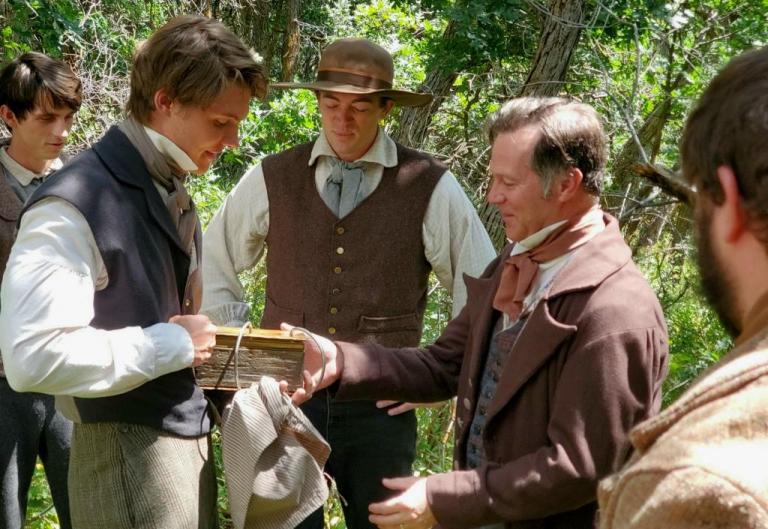
Newly posted on the website of the Interpreter Foundation: Steadfast in Defense of Faith: “An Everlasting Witness: Ancient Writings on Metal,” written by Noel B. Reynolds:
Part of our book chapter reprint series, this article originally appeared in Steadfast in Defense of Faith: Essays in Honor of Daniel C. Peterson, edited by Shirley Ricks, Stephen D. Ricks, and Louis Midgley. For more information, go to https://interpreterfoundation.org/books/steadfast-in-defense-of-faith/.
“From Joseph Smith’s earliest days as a prophet, talk of a record inscribed on metal plates caught the imagination of people on the American frontier, and it has continued to provide fodder for scandal down to the present. Few realized Joseph Smith was really talking about multiple ancient metal records, including not only Mormon’s gold plates but also the brass plates that figure so prominently in the Book of Mormon as well as other metallic records created by or known to the Nephites. But in the twenty-first century it is acknowledged by academics studying the ancient world that a wide variety of materials, including metals, have been used for records at various times in different places.”
For the sake of some of my readers who seem still to be having difficulty grasping the concept, the article above is a “reprint” or, more accurately, a republication of a previously printed article. We republish articles from our printed books regularly. Each week, in fact. We’ve been doing it for quite a while. For a long time, this occurred on Thursdays. Now it occurs on Wednesdays. A few readers, failing to understand the difference between our “book chapter reprint series” and our weekly new articles, which always appear on Fridays, have become confused and disoriented and, as a result of their mental fog, have angrily accused us of deceptively attempting to palm mere reprints off as new articles. (Perhaps they have a hard time distinguishing Thursdays — or, now, Wednesdays — from Fridays? Perhaps they haven’t yet learned to differentiate between a new article and one that is explicitly identified as “‘part of our book chapter reprint series”? Who knows? The problem remains a mystery to medical science.)

Rather often, when I’m reading online comments from some of the more embittered, alienated, and angry critics of the Church of Jesus Christ of Latter-day Saints, I’m powerfully reminded of a passage from near the conclusion of The Last Battle, which is, itself, the final volume in C. S. Lewis’s wonderful seven-volume series “The Chronicles of Narnia”:
Aslan raised his head and shook his mane. Instantly a glorious feast appeared on the Dwarfs’ knees: pies and tongues and pigeons and trifles and ices, and each Dwarf had a goblet of good wine in his right hand. But it wasn’t much use. They began eating and drinkung greedily enough, but it was clear that they couldn’t taste it properly. They thought they were eating and drinking only the sort of things you might find in a stable. One said he was trying to eat hay and another said he got a bit of an old turnip and a third said he’d found a raw cabbage leaf. And they raised golden goblets of rich red wine to their lips and said “Ugh! Fancy drinking dirty water out of a trough that a donkey’s been at! Never thought we’d come to this.” But very soon every Dwarf began suspecting that every other Dwarf had found something nicer than he had, and they started grabbing and snatching, and went on to quarreling, till in a few minutes there was a free fight and all the good food was smeared on their faces and clothes or trodden under foot. But when at last they sat down to nurse their black eyes and their bleeding noses, they all said:
“Well, at any rate there’s no Humbug here. We haven’t let anyone take us in. The Dwarfs are for the Dwarfs.”
“You see,” said Aslan. “They will not let us help them. They have chosen cunning instead of belief. Their prison is only in their own minds yet they are in that prison; and so afraid of being taken in that they cannot be taken out.”
I’ve been reminded of the passage yet again while, in sorrow, reading the surprisingly angry and indignant remarks of certain former Latter-day Saints about the Giving Machines project. It is, they say, a fraud, a dirty scam, merely cynical, an attempt generate self-serving publicity, probably a greedy plot to covertly channel cash to some unidentified group of Church leaders’ relatives or cronies, and — quoting one of the critics — “Hell no!” they won’t give a dime to it.
Which, of course, is their perfect right. However, I hope that they’re finding other ways to benefit the poor, the needy, and the suffering, and to feel at least a little bit of the spirit of Christmas.
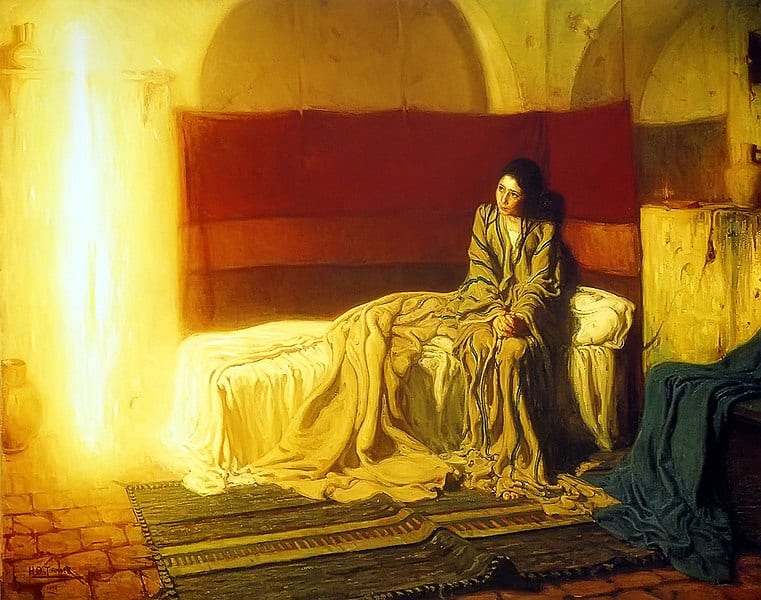
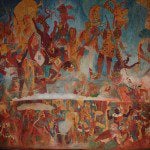
(Wikimedia Commons public domain image)
In my judgment, one of the most unearthly, ethereally beautiful pieces of modern classical Christmas music is Morten Lauridsen’s setting of O magnum mysterium. It seems perfection to me, achingly and piercingly lovely. Angelic.
Here is the Latin text:
O magnum mysterium,
et admirabile sacramentum,
ut animalia viderent Dominum natum,
jacentem in praesepio!
Beata Virgo, cujus viscera
meruerunt portare
Dominum Christum.
Alleluia.
And here is an English translation:
- O great mystery,
- and wonderful sacrament,
- that animals should see the new-born Lord,
- lying in a manger!
- Blessed is the Virgin whose womb
- was worthy to bear
- Christ the Lord.
- Alleluia!
I’ve been reading Michael Nahm’s fascinating book
Again, in the spirit of the Christopher Hitchens Memorial “How Religion Poisons Everything” File™, please reflect upon the grievous harm that the world has suffered because of Lauridsen’s setting of O magnum mysterium, and how much better off everybody would be if it — and, for that matter, the Christmas holiday itself — could somehow be altogether erased.











 Ad-Free & Subscriber Log-In