

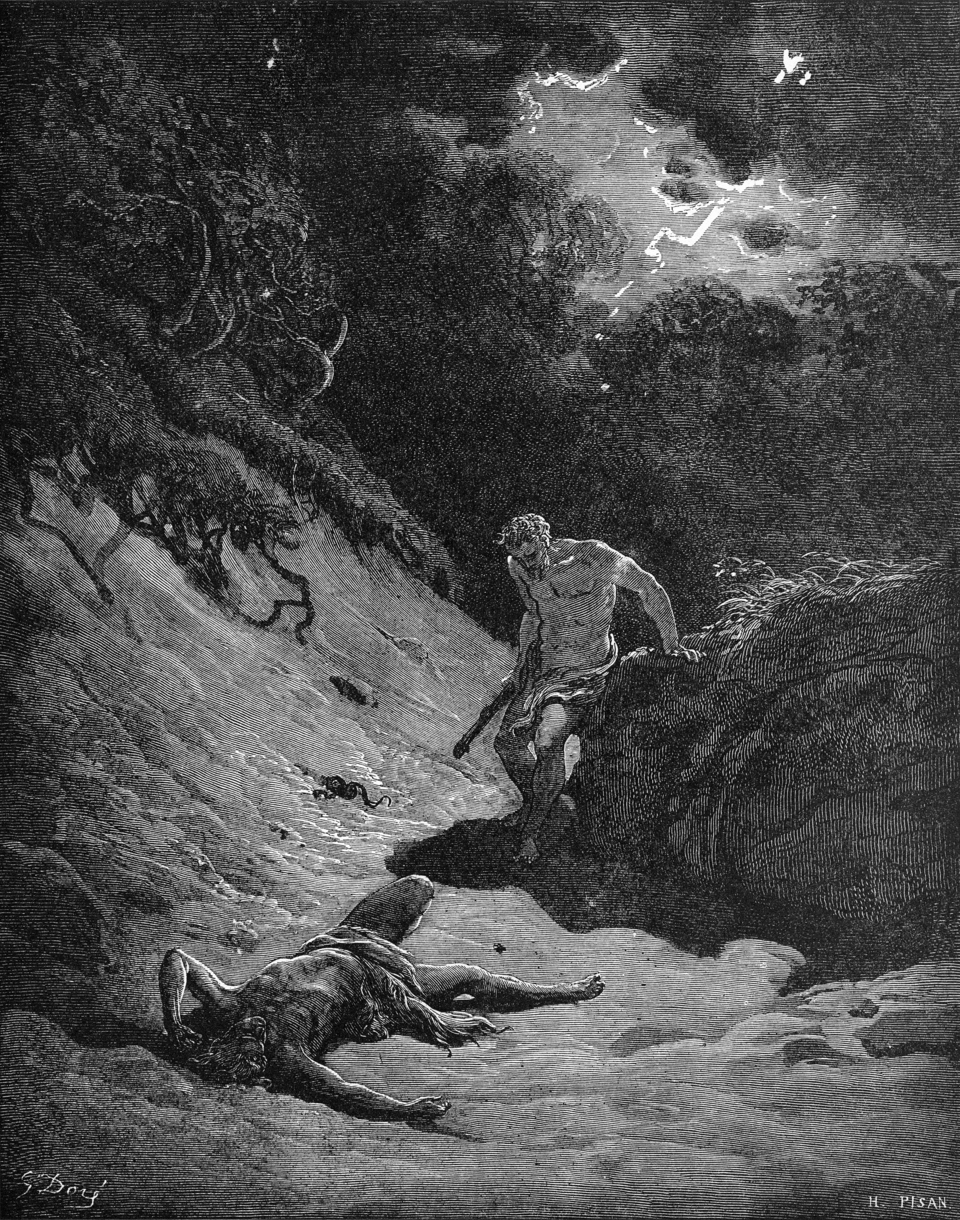
A new article has appeared in Interpreter: A Journal of Latter-day Saint Faith and Scholarship 68 (2026): 119-132. It is “The Lord Gave Cain a Sign,” written by Kent P. Jackson:
Abstract: God didn’t “set a mark” on Cain. Instead, he gave Cain a sign. The unfortunate translation of Genesis 4:15 in the King James Bible (KJV) has been the source of much misunderstanding over the years. This article is about the English words that the King James translators chose in Genesis 4:15 and the Hebrew words from which they are translated. It shows that the renderings of the words in that verse are inconsistent with how the KJV treats the same words and grammatical features in other passages. The result is a translation that cannot be justified from the Hebrew Bible.
On the website of the Interpreter Foundation, Professor Jackson’s article is accompanied by “Interpreting Interpreter: The Sign of Cain,” written by Kyler Rasmussen:
This post is a summary of the article “The Lord Gave Cain a Sign” by Kent P. Jackson in Volume 68 of Interpreter: A Journal of Latter-day Saint Faith and Scholarship. All of the Interpreting Interpreter articles may be seen at https://interpreterfoundation.org/category/summaries/. An introduction to the Interpreting Interpreter series is available at https:/interpreterfoundation.org/interpreting-interpreter-on-abstracting-thought/.
A video introduction to this Interpreter article is now available on all of our social media channels, including on YouTube at https://youtube.com/shorts/V-_os4GDrzk.
The Takeaway: Jackson presents an alternative translation of the “mark of Cain” passage in Genesis 4:15, arguing that the underlying Hebrew better supports God “[giving] a sign” that Cain wouldn’t be killed than that he “set a mark” upon Cain.
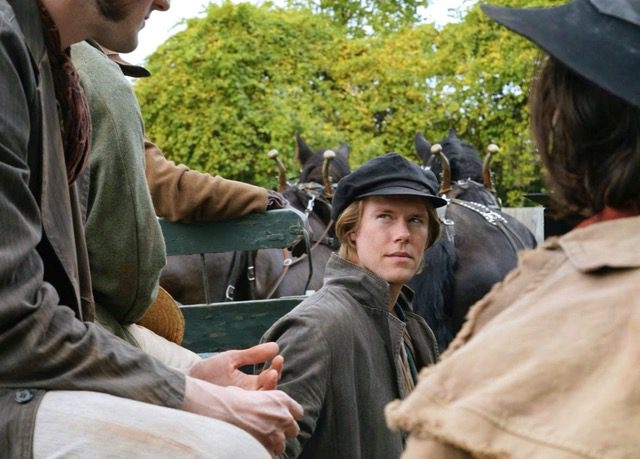
If you find the Becoming Brigham series interesting, helpful, and/or enjoyable, we hope that you’ll subscribe to it (at no cost!) at becomingbrigham.com, and that you’ll encourage others to have a look at it and perhaps even to subscribe to it, as well. We’re still at the opening stages of getting the word out. All of the episodes that have been made public thus far are available at becomingbrigham.com — including Episode 5, which is (as of today) the most recent — accompanied, too, by some other links and materials that you might like.

A group of Latter-day Saints in Belgium got together this past Friday to watch the 2024 film Six Days in August, which was produced by Redbrick Filmworks on behalf of the Interpreter Foundation. I like this idea, and I hope that more such “watch parties” can happen. The group in Belgium hopes to make similar screenings an annual event.

Serious Latter-day Saints who have given serious attention to the arts have long reflected on the words of the future apostle Orson F. Whitney in an 1888 address entitled “Home Literature”: . While, in 1888, he wasn’t thinking about filmmaking, I’m confident that Elder Whitney would happily include the cinema among his aspirations for the future:
We will yet have Miltons and Shakespeares of our own. God’s ammunition is not exhausted. His brightest spirits are held in reserve for the latter times. In God’s name and by his help we will build up a literature whose top shall touch heaven, though its foundations may now be low in earth. Let the smile of derision wreathe the face of scorn; let the frown of hatred darken the brow of bigotry. Small things are the seeds of great things, and, like the acorn that brings forth the oak, or the snowflake that forms the avalanche, God’s kingdom will grow, and on wings of light and power soar to the summit of its destiny.
I can testify from personal experience that “the smile of derision” does, in fact, “wreathe the face of scorn” and that “the frown of hatred” definitely “darkens the brow of bigotry” as pertains to attempts to express and to celebrate the Restoration in creative ways. But I’m not discouraged by such reactions. The cause and the effort are worth it. I think, in this context, of the famous words of Theodore Roosevelt, given in a speech at the Sorbonne in Paris, on 23 April 1910:
It is not the critic who counts: not the man who points out how the strong man stumbles or where the doer of deeds could have done better. The credit belongs to the man who is actually in the arena, whose face is marred by dust and sweat and blood, who strives valiantly, who errs and comes up short again and again, because there is no effort without error or shortcoming, but who knows the great enthusiasms, the great devotions, who spends himself in a worthy cause; who, at the best, knows, in the end, the triumph of high achievement, and who, at the worst, if he fails, at least he fails while daring greatly, so that his place shall never be with those cold and timid souls who knew neither victory nor defeat.
President Spencer W. Kimball shared Elder Whitney’s dream of great Latter-day Saint creations to come. Here is a passage adapted from his seminal address “Education for Eternity,” which was given to the faculty and staff of Brigham Young University in 1967 and a portion of which has come to be known as “The Gospel Vision of the Arts”:
For years I have been waiting for someone to do justice in recording in song and story and painting and sculpture the story of the Restoration, the reestablishment of the kingdom of God on earth, the struggles and frustrations; the apostasies and inner revolutions and counter-revolutions of those first decades; of the exodus; of the counter-reactions; of the transitions; of the persecution days; of the miracle man, Joseph Smith, of whom we sing “Oh, what rapture filled his bosom, For he saw the living God” (Hymns, no. 136); and of the giant colonizer and builder, Brigham Young.
We are proud of the artistic heritage that the Church has brought to us from its earliest beginnings, but the full story of Mormonism has never yet been written nor painted nor sculpted nor spoken. It remains for inspired hearts and talented fingers yet to reveal themselves. They must be faithful, inspired, active Church members to give life and feeling and true perspective to a subject so worthy. Such masterpieces should run for months in every movie center, cover every part of the globe in the tongues of the people, written by great artists, purified by the best critics.
Our writers, our motion picture specialists, with the inspiration of heaven, should tomorrow be able to produce a masterpiece which would live forever. Our own talent, obsessed with dynamism from a CAUSE, could put into such a story life and heartbeats and emotions and love and pathos, drama, suffering, fear, courage; and they could put into it the great leader, the mighty modern Moses who led a people farther than from Egypt to Jericho, who knew miracles as great as the stream from the rock at Horeb, manna in the desert, giant grapes, rain when needed, battles won against great odds.
We’re not there yet. But, as the ancient Chinese proverb has it, 千里之行始于足下: “A journey of a thousand miles begins from under the feet” or “A thousand mile journey begins where one stands,” or, as it is most commonly phrased, “A journey of a thousand miles begins with a single step” (Lao Tzu, Tao Te Ching [Chapter 64]). In order to reach the destination foreseen by Elder Whitney and President Kimball and others, the Latter-day Saint community needs the creative talents of writers, composers, artists, and performers, yes, but it also needs the support of faithful and committed patrons and donors. And it needs encouraging audiences, large enough audiences to make the sacrifices and the effort worthwhile and to make future and better work viable. In this as in many other areas, it really does take a village.












 Ad-Free & Subscriber Log-In