

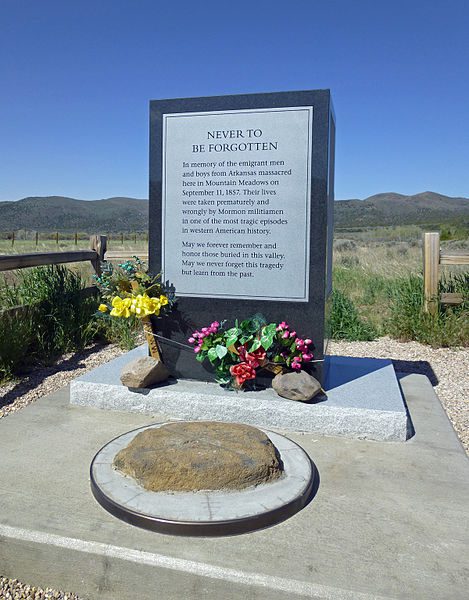
(Wikimedia Commons public domain photograph) Do you really imagine that we’re not going to address the Mountain Meadows Massacre? Really?
I’ve been seeing complaints in a few circles that our treatment of certain topics in the Becoming Brigham series (e.g., of Brigham Young and race, and of Brigham Young and violence) has been woefully, even shamefully, deficient. I’m serenely confident, of course, that, for many of those who are leveling such criticisms, our treatment of those topics will always be insufficient, no matter how much time and effort we devote to them. The only way in which we could ever hope for the approval of those critics would be to declare Brigham an irredeemable racist, a tyrant, and a mass murderer — which we’re, well, quite unlikely to do.
But I do want people to bear in mind that we’re not done. The five installments of Becoming Brigham that are currently available (here) represent only the merest beginning of the effort, which will ultimately, we anticipate, come to somewhere on the order of seventy-five episodes. They have been introductory, and the fifth one only came out on Monday. We have miles to go before we sleep.

Sigh. I’ve apparently never done a decent thing in my life, nor had a kind or a good thought. My statement, yesterday, that I never met Tim Guymon, the long-time typesetter for Interpreter: A Journal of Latter-day Saint Faith and Scholarship who recently passed away, was instantly seized upon at the Peterson Obsession Board as proof that I’m willing to exploit “the little people” but that I otherwise disdain them and refuse to mix with them.
After all, I’ve visited Florida innumerable times (presumably with all of my travel and lodging and dining expenses covered by the Interpreter Foundation) while poor Brother Guymon slaved for us, year after year, without any compensation and with no expense account. Yet, even so, I couldn’t be bothered to grace him with My Presence even when I was right there with him in Florida, practically in his front yard. Heck, chimes in one eager chorister, we never even invited him to join our annual birthday party in Utah.
Actually, Brother Guymon worked as Interpreter’s typesetter on a contract basis, and he was paid for his efforts — one of our very few paid workers. And he was invited to our birthday party every single year, without fail, even though he lived somewhere near Pensacola, at the western end of the Florida panhandle and, thus, nearly nineteen hundred miles away.
My wife and I visited Florida multiple times because a Second-Generation Unit, a Legally-Recognized Second-Generation Unit, and a Third-Generation Unit lived in Orlando at the time. (Their names have been redacted to shield them from the tender mercies of the Obsession Board, and, anyway, they’ve since moved from the state.) My wife and I paid for those visits to Florida every single time; no Interpreter monies were used for either our transportation, our food, or our lodging. (I believe that such family visits are still considered ethically permissible by most people, perhaps even if they involve me.)
Florida is a large state. Orlando, where my family members lived, is slightly more than 450 miles from Pensacola, near which Brother Guymon lived. I have never visited Pensacola. Brother Guymon wasn’t the only person in the Pensacola area whom I haven’t met.
Note: An additional accusation has now been appended to those above. Allen Wyatt, who had had by far the longest and most direct interaction with Tim Guymon of any of us at Interpreter, went down to visit Brother Guymon when the latter’s health began to fail. According to the Obsession Board, Allen did so at the expense of Interpreter Foundation donors. However, the demonstrable fact is that no Interpreter funds were used to pay for any portion of Allen’s trip — which probably means, then (and, here, I’m offering my own suggestions, though employing the Obsession Board’s typically rigorous standards of evidence), that Allen’s compensation must have been routed through clandestine Interpreter payments to a Mexican drug cartel, or ISIS, or, my personal favorite, The Syndicate. (For enjoyable documentary evidence regarding The Syndicate, see Mission: Impossible – Rogue Nation [2015] and Mission: Impossible – Fallout [2018].]
Even after more than twenty years of this kind of nonsense, the malevolent fantasies of the Obsession Board still sometimes astonish me. The hatred slumbers not, nor sleeps.

It’s reassuring to know that the future of American journalism continues to be bright. See, for example, this brilliant bit of reporting out of The College of New Jersey: “Mormonism Goes Mainstream.” It can be paired with this, from Fox News: “Mormon-born soda craze is replacing coffee and cocktails across America: ‘Modern take on old-fashioned soda shop’ as young people drink less alcohol”
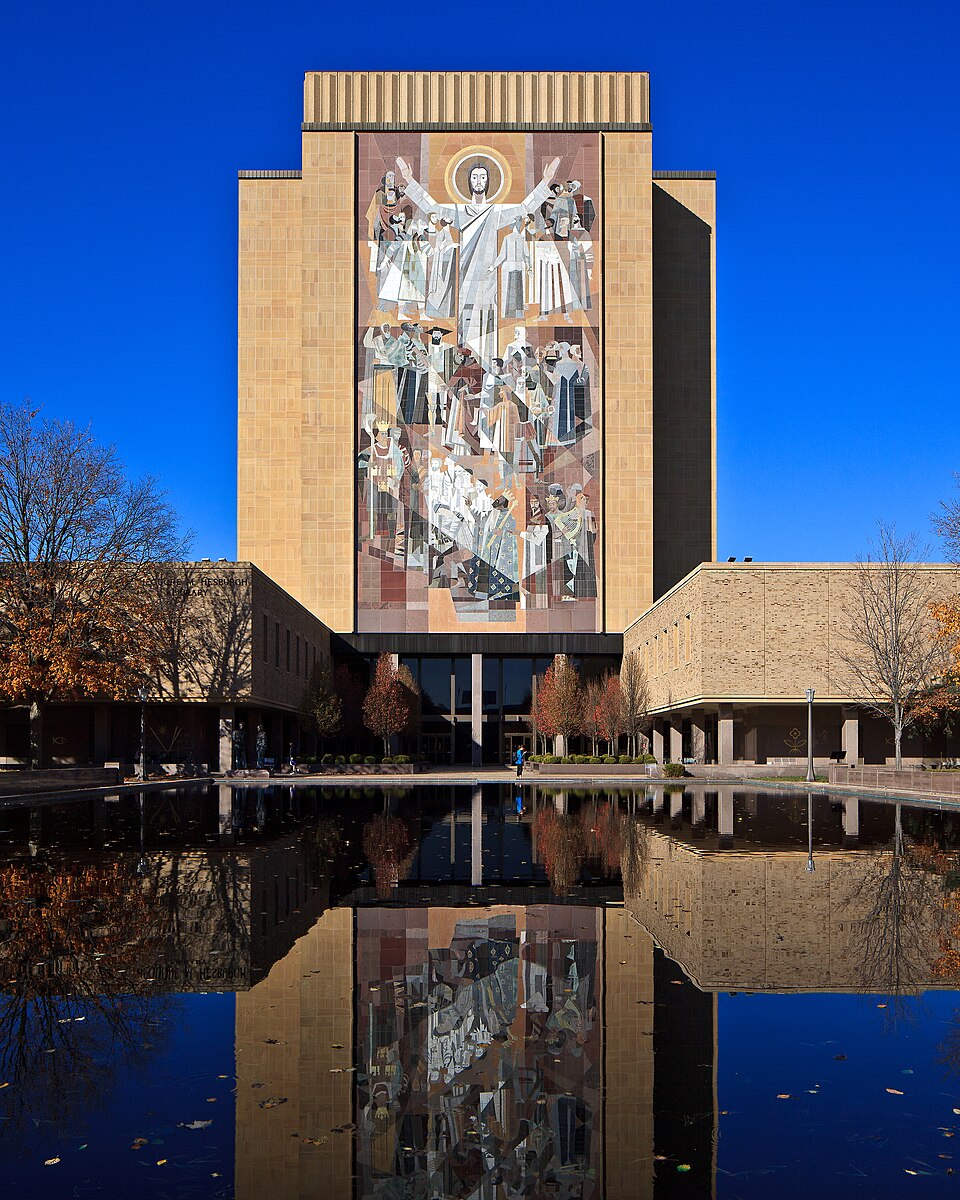
The recent appointment of Elder Clark G. Gilbert as the newest member of the Quorum of the Twelve Apostles has drawn fire for a number of reasons, among them his lack of the proper ethnicity or skin color, his Ivy League background, and so forth. But a major angle of attack has focused on his efforts to ensure that Brigham Young University (along with its sister schools in Idaho and Hawaii) remains aligned with the doctrines and values of its sponsoring institution, the Church of Jesus Christ of Latter-day Saints.
This is a far more important matter than the recent sputtering of the University’s basketball team, unfortunate as that is, and it deserves serious attention. For the record, I completely support Elder Gilbert’s intentions as, until recently, the Church’s Commissioner of Education. People can certainly debate this or that measure toward that end, but the end is, in my judgment, non-negotiable. If BYU isn’t to be a genuinely Latter-day Saint school then, to me, it loses any particular interest that it might once have had.
So I’ve been quite interested in a recent controversy at the University of Notre Dame, which now seems to have begun to resolve itself, at least in part: “Pro-Abortion Notre Dame Professor Rejects Prestigious Appointment after Pro-Life Backlash” (National Review)













 Ad-Free & Subscriber Log-In