


The Daily Mail — a daily British middle-market tabloid — has often been criticized for unreliability, sensationalism, and inaccuracy. In February 2017, the English Wikipedia actually banned its use as a source. Happily, though, The Daily Mail has made a regular hobby of publishing sensationalistic articles about marginal or former Latter-day Saints — just Google “Daily Mail Mormon” to see what I mean — and this one is pretty much par for the course: “The REAL lives of Mormon wives: Why a fundamentalist ‘prophet’ at the head of the world’s biggest polygamous sect is being sued by his ex-wife in a Utah court” The author nods halfheartedly in the direction but, on the whole, makes no really serious effort to distinguish the Church of Jesus Christ of Latter-day Saints from polygamist schismatics or, for that matter, from representative examples of Latter-day Saint womanhood such as those featured on The Secret Lives of Mormon Wives. (He cites the dynamics of what seems to be an unusually terrible family in the Apostolic United Brethren sect, or AUB, as exemplifying “the oppressively patriarchal world of strict Mormonism,” while describing “Mormonism” as “a religion traditionally dismissed as staid, boring and bizarre.” (“More practically, the AUB also differs from other Mormon sects in believing that sexual intercourse can be a source of pleasure, not an act solely designed for purpose of procreation.”) We just can’t win: At one and the same time, we’re staid, prudish, and boring, and yet — being also oppressively patriarchal and bizarre — we’re so irresistibly fascinating that The Daily Mail simply can’t stop publishing lurid articles about us.

We’ve entered the month of December, and, with Thanksgiving behind us, I’m now willing to acknowledge that we’re into the Christmas season. (See this notable bit of holiday cheer from Chicago!)
At some point between now and Christmas Day, I hope that you will take the opportunity to watch the eighteen-minute film The Christ Child: A Nativity Story, which I regard as one of the best movies ever made by the Church of Jesus Christ of Latter-day Saints. It has the characters speaking the real languages of the story. It sets the story properly in a first-century Judaea that actually looks like first-century Judaea. The ambience is, well, humble. The manger is, as it almost certainly was, a stone feeding trough for animals (from the French verb manger [pronounced roughly mahn-zhay], “to eat”) in the style of stony Palestine, rather than a wooden crib in the style of forested Austria or Bavaria or wooded Jacobean England. And the emotional reaction of the principal “Wise Man” to the Christ child — who is of the proper age: no longer an infant but a toddler — never fails to move me.
This is the first of my Christmas-related media recommendations for 2025. It won’t be the last, however, although by far most of them will be concerned with music.
Wikimedia Commons public domain image
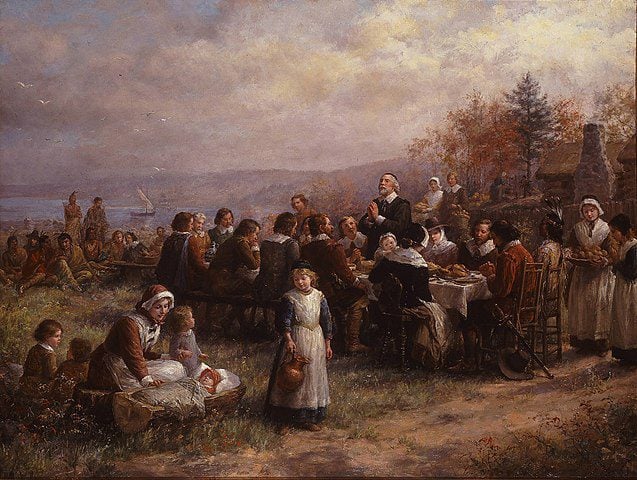
America’s formal Thanksgiving Day holiday is in our rearview mirror and is rapidly receding into the distance, but the holiday season is still with us, and the holidays are a wonderful time altogether for expressing gratitude and giving thanks. So I think it appropriate, even now in December, to share a column that I wrote for Meridian Magazine at Thanksgiving 2021 but didn’t include in my two Thanksgiving-related blog entries here last week, “A Really, Really Long Post For The Eve Of Thanksgiving” and “Four More for Thanksgiving.” It’s entitled “Giving Thanks and Giving Thought.”

(Wikimedia Commons public domain photograph)
But, alas, it’s time for a look at the Christopher Hitchens Memorial “How Religion Poisons Everything” File™, which preserves a record of the horrors and depredations visited upon the world by ravening theists and the vicious absurdities of theism:
- “Church of Jesus Christ donate 6,600 pounds of kimchi to Korean families and welfare centers.” Can you imagine 3.3 tons of kimchi? The mind boggles.
- “Generosity Shines During BYU Alumni Service Projects for Away Football Games: The Church, BYU fans and alumni donated thousands of pounds of food, books and other supplies”
And here are some further items from the neighborhood of the Hitchens File:
- “People Invited to Light the World at Unveiling of Salt Lake City Giving Machine Kiosks: Visitors can transform simple donations into hope for thousands, leaders say as Giving Machine stations are unwrapped at City Creek Center”
- “Giving Machine Kiosks Debut in LA During Tree Lighting Event: Donations to help rebuild following wildfires”
- “Elder Stevenson Attends Light the World Launch in Kansas City, Missouri: Giving Machines proceeds will benefit seven local and two global charities”
- “Tokyo Turns Vending Culture Into a Culture of Giving: Giving Machines debut in Japan, offering a new way to share joy and help those in need this Christmas season”
- “Elder Kearon Brings Hope and Comfort to Survivors of Twin Typhoons in Cebu, Philippines”
And this article, I think, is an absolute must-read about the unmixed blessings that come from rejecting religion: “Perspective: Let’s get real about loss of faith: Individuals who have stepped away from faith speak candidly about real life trade-offs, heartaches and ongoing challenges”
Happily, though, in another important article, there seems reason to hope that organized religion is losing its hold on (at least American) humanity and that, therefore, crimes against decency such as those mentioned immediately above may someday be mere dim memories of our barbaric past: “Analysis: Confidence in religion is declining – along with confidence in everything else: A focus on declining confidence in organized religion misses the broader backdrop where institutional confidence is falling virtually everywhere”
And the disappearance of religion may well open the future up for absolutely great things: “As Religion Weakens, Socialism Strengthens” There have, it’s true, been halfhearted attempts at building socialist utopias in the past — in, for instance, Albania, Cambodia, China, Cuba, North Korea, the former Soviet Union, Vietnam, and, in its “National Socialist” variant, in Germany and much of Europe in the 1930s and 1940s — but these have always been marred by glitches and minor mishaps. Surely, it’s time to try again. The State is waiting to be adored again as the source of whatever rights we might claim and whatever good we might desire. What could possibly go wrong?














 Ad-Free & Subscriber Log-In