


This year’s Interpreter Foundation Christmas message went up earlier today: “Christmas Stars: Inviting Us to Come to Christ,” written by Shirley S. Ricks:
Abstract: The Christmas season evokes tender feelings within us as we contemplate the newborn Christ child, whose life and mission would change the world forever. Many retellings of the nativity story include the unusual—the awkward boy/innkeeper who impulsively offers his own room to Mary and Joseph or the Herdman kids who unwittingly impart a realistic view of the Christ child’s birth. The Christmas star of Bethlehem, leading the wise men to the newborn baby, symbolically invites us to come unto Christ as we celebrate the season through memorable stories and Christmas songs.
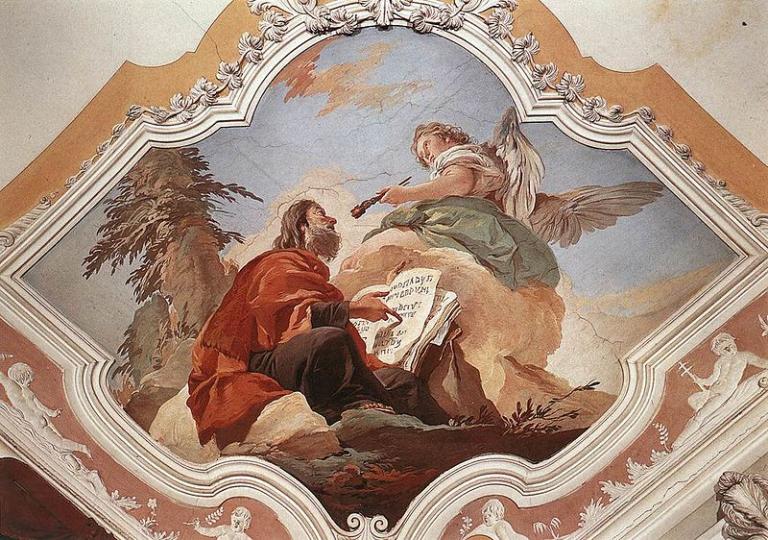
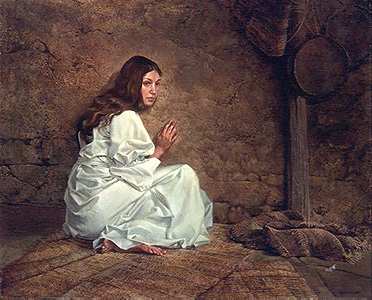
(Wikimedia Commons public domain image)
I enjoyed this article by Richard D. Gardner, which appeared in Meridian Magazine. It treats a subject that I think quite appropriate to consider as we approach Christmas: “The Fatherhood of Christ.”
For unto us a child is born, unto us a son is given: and the government shall be upon his shoulder: and his name shall be called Wonderful, Counsellor, The mighty God, The everlasting Father, The Prince of Peace. (Isaiah 9:6)
And I’m pleased to report that Kyler Rasmussen’s brief summaries of many of the articles that appear in Interpreter: A Journal of Latter-day Saint Faith and Scholarship will now be appearing in Meridian Magazine as well as on the website of the Interpreter Foundation. See, for example, his brief article “The King Who Shouldn’t Have Been: Nephi’s Surprising Claim to Divine Authority,” which commences his new column for Meridian.

(Wikimedia Commons public domain)
It’s been a busy day and a long one. I’ve just returned from several hours spent with two of my immediate offspring and a third-generation unit at Luminaria, The annual Luminaria Christmas light show, at Thanksgiving Point in American Fork, is nothing short of spectacular and is a huge gift to the Wasatch Front and to Utah more generally from Alan and Karen Ashton
I spent much of this morning meeting with two of the vice presidents of the Interpreter Foundation and the head of the company that, over the past two years, fundamentally redesigned the Foundation’s website. Then it was up to the Church History Library in Salt Lake City to be present during an interview for the Interpreter Foundation’s forthcoming series of short Becoming Brigham documentaries. (We have now, by the way, barring some unforeseen surprise, settled on a launch for Becoming Brigham on Monday, 26 January 2026. New episodes will then be released each and every Monday thereafter.)
Our team did two interviews today. Unfortunately, because of my website-related meeting in the morning, I was unable to be there for the first of them, which involved our “Emma,” Camrey Bagley Fox, interviewing Matthew McBride regarding the completion of the Nauvoo Temple.
I was, however, able to be present for John Donovan Wilson’s interview with Christopher B. Rich, the co-author, with LaJean Purcell Carruth and Professor Paul Reeve (both of whom we have already interviewed), of the award-winning Oxford University Press book This Abominable Slavery: Race, Religion, and the Battle Over Human Bondage in Antebellum Utah. (I’ve praised this book publicly in at least two venues, in my remarks at the August 2025 FAIR conference (“Brigham Young and Slavery”) and in a 26 August 2025 article for Meridian Magazine (“Brigham Young, Race, and Slavery: Reexamining Utah’s 1852 Service Act”).

(I hope that this will somehow count as fair use or, at least, as well-intentioned advertising.)
I’ve always loved Gustav Holst’s beautiful setting of Christina Rossetti’s beautiful 1843 poem “A Christmas Carol,” which is far better known to most of us by its opening words:
In the bleak mid-winter
Frosty wind made moan,
Earth stood hard as iron,
Water like a stone;
Snow had fallen, snow on snow,
Snow on snow,
In the bleak mid-winter
Long ago.Our God, Heaven cannot hold Him
Nor earth sustain;
Heaven and earth shall flee away
When He comes to reign:
In the bleak mid-winter
A stable-place sufficed
The Lord God Almighty
Jesus Christ.Enough for Him whom cherubim
Worship night and day,
A breastful of milk
And a mangerful of hay;
Enough for Him whom angels
Fall down before,
The ox and ass and camel
Which adore.Angels and archangels
May have gathered there,
Cherubim and seraphim
Throng’d the air,
But only His mother
In her maiden bliss
Worshipped the Beloved
With a kiss.What can I give Him,
Poor as I am?
If I were a shepherd
I would bring a lamb,
If I were a wise man
I would do my part! ‘
Yet what I can I give Him,
Give my heart.
Of course, those opening words are almost certainly historically false; as most Latter-day Saints and many others understand, there is no real reason to believe that Jesus was actually born “in the bleak midwinter.” But it was probably still cold in a stable in Bethlehem in April (situated at about 2543 feet above sea level) and, anyway, the misconception probably helps to emphasize the undoubtedly humble and uncomfortable circumstances of his birth and, in that sense, may actually have done us a bit of good.
Moreover, as I’ve said here before, because of its vagueness, its lack of concreteness, I regard the line “If I were a Wise Man, I would do my part” as rather weak. So this year, as on prior occasions, I invite anybody out there who wants to make the attempt to try to fix it. I myself haven’t yet thought of a good way to change the line that would preserve the overall power of that final stanza. And yet it seems to me that this stanza, the second, is absolutely magnificent:
Our God, Heaven cannot hold Him
Nor earth sustain;
Heaven and earth shall flee away
When He comes to reign:
In the bleak mid-winter
A stable-place sufficed
The Lord God Almighty
Jesus Christ.
Listen, here, to the Royal Choral Society sharing the wonder of the piece and its message in 2022 at St. Giles, Cripplegate, in the City of London: https://www.youtube.com/watch?v=OHHl0NiIAy4









 Ad-Free & Subscriber Log-In