

Book-length accounts of single near-death experiences are not my preferred means of gaining information on the subject, though I don’t summarily dismiss them. I’m much more inclined to credit short, modest, anonymous accounts provided to reputable researchers by people who didn’t seek their attention and who don’t stand to gain financial profit or notoriety from the reports that they give. Extravagantly detailed narratives and exceedingly didactic or preachy discussions also worry me.
Nevertheless, I share with you a couple of passages from Marvin J. Besteman, with Lorilee Craker, My Journey to Heaven: What I Saw and How It Changed My Life (Grand Rapids, MI: Revell, 2012).
Marvin Besteman was a graduate of Calvin College in Michigan, a veteran of the U.S. Army, and a retired bank president. He died in January 2012, shortly after completing the manuscript of the book, having told the story of his near-death experience for six years or so after it happened in 2006. I never knew him, of course, but even the brief description of him that I’ve just provided here suggests that he was, very likely, a person of soberness and probity, neither known for deception nor given to wild flights of fantasy. And, with that as a background, I think that some out there might appreciate a particular portion of Mr. Besteman’s narrative, in which he tells of finding himself standing in a kind of otherworldly line before a large heavenly gate. Let this passage serve as a preface:
One of the darkest times in my life was when our baby son, William John, died after just ten hours of life. I will tell you more about William and all the babies I saw in heaven later on in my story. For now, I’ll just say that anyone who has lost a child knows that our hearts were broken in a million pieces when William died. (67)
[I know, too. We lost Lena Alaia, our first grandchild, in 2014.]
Most of the people in line were around my age or older, which is the way things should be. Believe it or not, some were even much older than me. Most of the men in line were between fifty and seventy years of age, and most of the women were between seventy and ninety years of age.
There were three children in line, each of them around four or five years of age. These little ones were not standing still, but moving around, wiggling in their spots in line, like children do. They all had big smiles on their faces.
It’s terribly sad, I know, to think about children dying, and of course these precious kids had died or they wouldn’t have been in that line. Their loved ones were experiencing the heartrending loss of a child – perhaps the worst and deepest loss anyone can ever experience. I wish I didn’t know how awful that is, but I do. So what I’m about to tell you is said from a heart that has felt the wretched loss of a child. I don’t share this piece lightly. But I promise you, dear one, those children were delighted to be in that place. Their eyes were shining with life and pleasure, just like everyone else waiting for their turn through the huge doorway. (76)
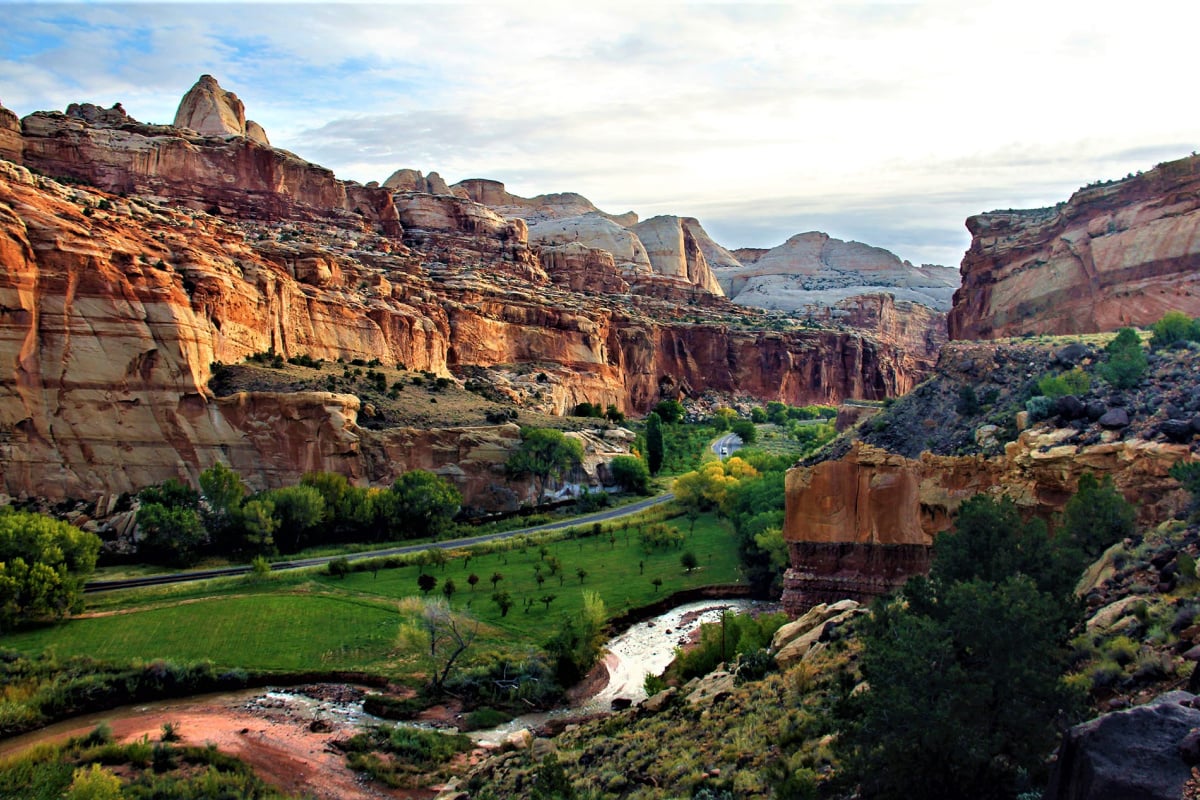
Continuing on our luxury fine-dining tour of southern Utah today, we did in-car filming and drone filming for Becoming Brigham in the general vicinity of Koosharem. I doubt that many people who haven’t themselves been involved in filmmaking can appreciate how time-consuming and even repetitious it can be. Just a few minutes of finished product can require hours of prior work; this has all been quite enlightening, eye-opening really, for me. I now look at movies and television dramas with a considerably altered sensibility.
We also filmed a segment from an off-road location looking toward Capitol Reef National Park. However, our final filming work of the day took place at Anasazi State Park, in Boulder, Utah, and within the Anasazi State Park Museum. As you might perhaps guess, our principal topic for the day was relations between Latter-day Saints and Native Americans in early Utah Territory, which saw an abundance of conflicts, challenges, misunderstandings, and, sometimes, tragedies.
Anasazi State Park contains the ruins of an Ancestral Puebloan settlement that flourished in the twelfth century after Christ and then was fairly suddenly abandoned for reasons that remain unknown. (Ancestral Puebloan is the preferred term among scholars today for the people who continue to be commonly known as the Anasazi, who were almost certainly the forebears of today’s Hopi. We don’t know what they called themselves, and the term Anasazi was given to them by modern Navajo workers on archaeological sites; it means “ancient enemies.”)
But I need to report on the elements of today’s travel that most fascinate the crack investigators over at the Peterson Obsession Board, who are posting very enthusiastically about this trip of mine, subjecting my reports to intense, meticulous, and extremely skeptical analysis:
- I began the day with an exquisite bowl of Quaker instant oatmeal at our motel in Richfield, and I polished that oatmeal off with a very fine glass of reasonably cold milk.
- For lunch, we pulled in at The Wild Rabbit Cafe, in Torrey (population, in the 2020 census, 171), where I ate a really rather good Philly cheesesteak sandwich.
- For dinner, I had two chicken strips and some chocolate milk at a food truck.
- We needed to spend the night in or near Escalante (the population of which, in the 2020 census, was 786), and we’re staying in the only “hotel” where the Redbrick Filmworks guys could find six places for us. It’s an exceedingly curious operation called Ofland Escalante. I was just expecting and hoping for a basic, functional place, so I’m both pleasantly surprised and a bit put off. My individual “tiny cabin” is modern and nice. So is the communal bathhouse and restroom facility, which is about a hundred and twenty yards away down a dirt road. (The dirt parking lot is maybe two hundred and fifty yards away.) Nearby are some vintage Airstream trailers that can also be rented, as is a small adjacent private drive-in theater where, tonight, they’ve been showing Grease. (Really old engine-less cars are provided as seats for the drive-in theater.) I’ve been laughing since we arrived here, thinking it’s both fun (like camping) and, if you weren’t planning to camp, quite inconvenient.
It’s been a long day, I’m running out of energy, and I need to walk down that dirt road before retiring to bed. So I think that I’ll reserve until tomorrow my comments about the spectacularly scenic road that we drove today. It was even more interesting than my oatmeal, sandwich, and chicken strips were.
Posted from Escalante, Garfield County, Utah









 Ad-Free & Subscriber Log-In