

On this day dedicated to Saint Valentine, we remember a man who, according to Christian tradition, stood for the sanctity of marriage even under imperial pressure. Today, as we discuss dating and marriage, we reflect on what it means to honor love with courage, responsibility, and dharma.

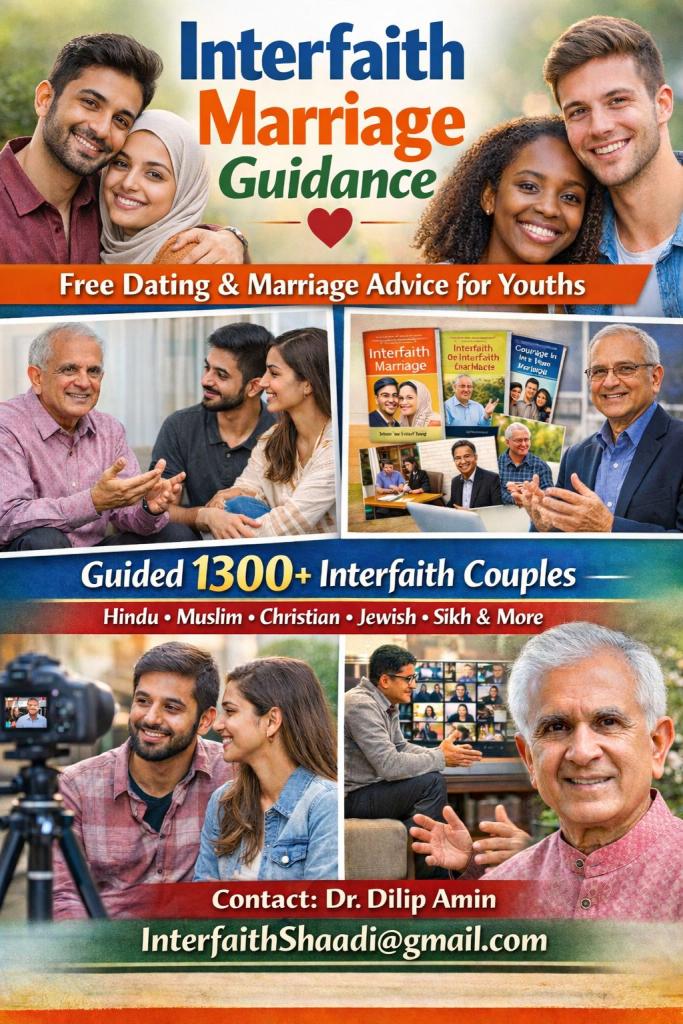
Over the past 20 years, I have guided more than 1,300 young people in interfaith relationships and summarized those experiences in five books. I have found 38% of Hindu marriages involve Christians, Jews, or Muslims in America. If that is the case, it is reasonable to assume that perhaps nearly 70–80% of Hindu youth may have dated someone from an Abrahamic background during their college years or in life.
I am neither for nor against interfaith marriage. I am here to help you make fully informed decisions — so that whatever you choose, you can build a happy and lasting married life.
Let me begin with a message to Hindu parents. If you assume that your son or daughter in America will automatically have an arranged marriage within the same jati, that assumption may not reflect today’s reality. Severely limiting their choices may not increase their chances of finding the right life partner. Instead, educate them about marriages. Equip them with knowledge. Then trust them. The outcome will be healthier and more stable.
I have seen interfaith marriages that are loving, respectful, and enduring. I have also seen situations where youth suffered deeply because they entered interfaith relationships without understanding long-term religious expectations.
So what makes the difference?
In my experience, the issue is not religion itself, nor scripture itself. The issue is mindset. The real challenge is exclusivism.
An exclusivist mindset believes that only one path is true and that all others are spiritually inferior or invalid. In some traditions, this may include the belief that salvation is available only within that faith community. Such theology can create pressure for religious conversion — either before marriage or later.
Many Hindu youth today are wise enough to decline conversion before marriage. However, a newer pattern has emerged that I call “skip-generation conversion.” Instead of insisting that the spouse convert, the focus shifts to the children.
We see examples in public life where one partner does not convert, but the children are raised exclusively in the other faith. The result is that, within one generation, the Hindu lineage effectively disappears. Whether intentional or gradual, this outcome is very real.
The same dynamic can occur in other interfaith combinations. For example, in some Catholic settings, a non-Christian spouse may be required to sign a document promising that children will be baptized and raised Christian in order to marry in the Church. Many Hindus interpret a “dual ceremony” as equality, but they may not fully understand the theological and institutional expectations involved. These commitments can later have serious implications, especially during child-custody disputes.
Similarly, in some Hindu-Jewish marriages, families may perform both Hindu naming rituals and a Bar or Bat Mitzvah. On the surface, this appears equal. But one must understand the depth of formal religious education and identity formation that may accompany one side more than the other.
In many Hindu-Muslim marriages, conversion is often expected before an Islamic nikah, and children are generally expected to be raised exclusively Muslim. While there are exceptions, it is important to understand normative expectations before entering the marriage.
So what does this mean for you, especially on Valentine’s Day?
Love is beautiful. Attraction is natural. But marriage is not only about romance. It is about shared worldview, shared values, and shared responsibility toward future generations.
If you are dating someone from an Abrahamic faith, have clear conversations early:
- How will children be raised?
- Will both traditions be practiced equally?
- Will either partner be pressured to convert?
- What role will religious institutions play in your married life?
If you encounter rigidity, exclusivism, or unwillingness to grant equal space to your dharmic identity, take that seriously. Love should not require erasing yourself.
What I am saying today is simple: your love is important — but so is your spiritual integrity. A marriage built on mutual respect, equality, and freedom of conscience can flourish. A marriage built on hidden expectations or theological superiority will struggle.
My guiding principle, as reflected in my book title, is: Share and Respect with Equality.
Make informed decisions. Ask hard questions. Think long term — not only about the wedding day, but about the next generation.
On this Valentine’s Day, let us celebrate love — but love guided by wisdom, courage, and dharma.
Thank you. Namaste.
.
More reading material
Critical conversations before marriage (pre-marriage counselling)
Love-Jihad: Use and misuse of the term
Legal implications in Interfaith marriage








 Ad-Free & Subscriber Log-In