


GM Foods-Substantially Equivalent or Subsequently Dangerous?-Part One
Several agencies worldwide have claimed GM crops are substantially equivalent to non-GM crops.
First, let us see who is financially supporting this organization, which claims GM crops are substantially equivalent to the non-GM crops:
- Government & International: USAID, USDA/FAS, ACIAR, European Commission, various national agricultural biotechnology programs in the Philippines and Kenya, the Australian Centre for International Agricultural Research (ACIAR), European bodies, and the African Agricultural Technology Foundation (AATF).
- Philanthropic & Academic: Bill & Melinda Gates Foundation, John Templeton Foundation, Rockefeller Foundation, and universities like Cornell and Michigan State University, and Ghent University.
- Private Sector: CropLife International/Asia, Bayer, BASF, Corteva Agriscience, and industry councils like the U.S. Grains Council, Corteva Agriscience, alongside industry groups like CropLife International/Asia.
- Key Partners: Collaborations with organizations like the International Rice Research Institute (IRRI) and International Livestock Research Institute (ILRI) facilitate project implementation.+
However, several independent studies confirm it is not true. Isaaa.org GMWatch.org
This article is written in two parts and is in the form of a dialogue between Acharya (Teacher) and Shishya (Student) to make it a little easier for reader to make sense
It is important for everyone, because everyone eats food.
And, just like taking medicine helps fight some disease, eating right food can keep the disease away to a great extent.
Class One (Part-One)
Aacharya (Teacher) and Shishya (student) chanting this mantra (hymn)
evaṁ pravartitaṁ chakraṁ nānuvartayatīha yaḥ
aghāyur indriyārāmo moghaṁ pārtha sa jīvati
(O Parth, those who do not accept their responsibility in the cycle of sacrifice established by the Vedas are sinful. They live only for the delight of their senses; indeed, their lives are in vain)
Shrimad Bhagavad Geeta (16:3)
Shishya: Acharya, why did you begin today’s class with this shloka from Shrimad Bhagwad Geeta?
Acharya: Today, we’ll be discussing the kind of food that is being produced by men, overtaking nature’s role of doing that, only for his insatiable greed for money and in turn creating a Frankenstein that mankind would not be able to handle. I also want you to understand why our government is supporting this food and why you have to work to educate people to avoid, as far as possible, eating such dangerous food and to ask them to take charge of their health.
Shishya: Please tell me which is that food that you are so worried about.
A: The food that is worrying us all is GM food.
S: What does GM stand for?
A: It is genetically modified.
S: What is wrong with GM?
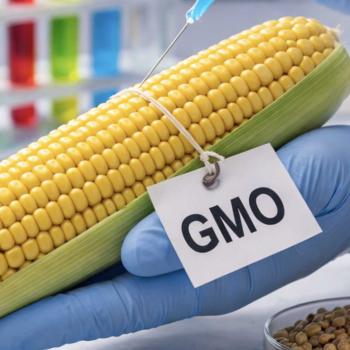
A: Everything is wrong with GM. This genetic modification is the introduction of a gene from the DNA of one organism into the DNA of another species. For example, some particular genes of a bacterium that occur in the soil, viz. Bacillus Thuringiensis (let us call it BT), which produce pesticide to kill certain kinds of pests that attack, say, our brinjal or corn, is removed from those bacteria and introduced into the DNA of brinjal or corn, so that then onwards brinjal or corn DNA starts producing pesticides to kill the pests.
S: Isn’t it good to have something like this, so that we do not have to use pesticides, which are so toxic and expensive too? I think that is a blessing for farmers as well as for consumers. I do not understand why you have to worry for this.
A: It is not as simple as you think. Naturally occurring bacteria in the soil produce pesticides to kill the pests, but do not leave residue on the brinjal, so when you eat brinjal, you do not have to eat pesticides.
Pesticide production by BT brinjal (genetically modified) is round the clock, non-stop, and the production will likely continue even after you eat the brinjal and there is a likelihood of that gene being transferred to the GOOD BACTERIA THAT RESIDE IN OUR INTESTINE (BACTERIAL FLORA, THAT HELPS OUR DIGESTION, AND ALSO KILL DISEASE-CAUSING BACTERIA THAT ENTER OUR BODIES). So, your own intestine is likely to become a pesticide factory and that pesticide is toxic. Apart from all these problems, our farmers will be forced to buy seeds from these companies, so that their independence is compromised and their farming costs will go up. And, we Indians will lose the biodiversity of our foods. For example, we have about 2500 varieties of brinjal now. Thereafter, we’ll have only one variety. This is repeating the same mistakes we made at the time of the launch of green revolution. Earlier, we had almost 2, 00,000 varieties of rice. After the launch of the green revolution, we lost almost all varieties.
S: What are the other problems with GM foods?
A: They can cause a lot of diseases like loss of fertility, may compromise immune system, develop new kinds of allergies, affect internal organ growth, may cause atrophy of liver, can cause cancer and create completely new kinds of diseases as the gene introduction into a totally new species, such as from bacteria into plants, causes massive collateral damages in the host DNA.
S: Have they done any studies proving all that you say?
A: The biotech companies have done a few studies. Some of their studies do prove what I said earlier. But many of their studies do not, for several reasons, such as doctored reports, heavy dilution of the concentration of the GM ingredients, changed protocols of the tests, not sticking to guidelines etc. Against that, there have been more than 600 studies done by independent researchers and almost all the researches point to the harm caused by GM foods.
S: Oh, that sounds terrible. If that is so, why is our government supporting to bring such food in our country?
A: There could be many reasons for that. First of all, most politicians have no time to really read or study or ask detailed questions. Unfortunately, the bureaucracy is too busy too like their bosses. Then, there’s so much misinformation provided to them by the representatives of the bio-tech industries. The majority of the agricultural universities and research institutes are most of the times at the mercy of the bio-tech industry for funding, so they become obliged to sing only to the tune that bio-tech industry likes. Then, there is pressure from American government which wants to push its exports and which wants to help its own industry, all in the name of reducing hunger and tackle malnutrition in the third world.
S: Why do you say that the American government is pushing to help in the name of reducing hunger and tackling malnutrition? How can GM seeds reduce hunger or malnutrition?
A: The biotech industry is extending these arguments that it can tackle malnutrition as well as hunger with its GM seeds. However, it is millions of light-years away from the truth. The truth is that this argument is only for selling their products. Then Monsanto, now Bayer, was foreseeing the decline in the company’s fortunes after September 2000 as the patent of their money-making product Roundup was going to expire then in the USA. A few years before that was to happen, it started developing a strategy to meet the challenge of this decline. The result was acquiring several seed companies and getting into high-tech agribusiness, such as genetic engineering of seeds. The GM industry has not marketed a single GM crop with enhanced nutrition, drought-tolerance, salt-tolerance or any of the other ‘beneficial’ traits long-promised by the industry. In the last almost 30 years or so of GM crop’s introduction, till today, Hawaiian papaya is the only crop that was developed to survive ring spot virus that was destroying the plants, which is less than 1% of the total GM crops in the whole world.
S: So, if the seeds are not designed for reducing malnutrition or hunger, then what kind of seeds are they?
A: The seeds were designed in such a way that they either become resistant to roundup (commonly referred to as RR seeds), their money-spinner herbicide or the seeds that produce their own pesticides like BT brinjal I mentioned earlier. So, when farmers have to buy RR seeds, they must buy the herbicide roundup too. In fact, the farmers must sign a contract that they will not buy the generic herbicide (which is glyphosate) from another manufacturer when they buy seeds from Monsanto, now Bayer. Almost 99% of GM crops involve just 2 traits. Herbicide tolerance (or RR) is found in over 80% of all GM crops planted worldwide. GM crops have contributed substantially to increased pesticide use. Most new GM crop varieties are also pesticide-promoting. GM crops have caused an epidemic of herbicide-resistant weeds. This is encouraging the use of more toxic pesticides such as 2-4-D, which is highly toxic.
S: What are the benefits to these companies and how do they derive these benefits by selling these seeds?
A: The real beneficiaries to these companies are huge profits from patents, expensive GM seeds, and increased herbicide sales. Monsanto, new avatar being Bayer, is the world’s largest seed firm, controlling almost 90% of GM seeds in the world. It is the world’s fifth largest pesticide firm and is the manufacturer of the world’s biggest selling herbicide roundup controlling almost 60% of the market for glyphosate (the active ingredient of Roundup) and, interestingly, the seeds are designed Roundup Ready, which means they can tolerate huge doses of Roundup without being affected. As I told you before, the farmers have to buy the seeds as well as the herbicide Roundup together and sign a contract that they would not buy glyphosate from another manufacturer.
S: What has been the price trend for these items in the last few years?
A: In the USA, the average price for soybean seed, the largest GM crop in the US, rose by more than 50% in just two years from 2006 to 2008 – from $32.30 to $49.23 per planted acre. Retail prices for Roundup herbicide increased from just $32 per gallon in December 2006 to $45 per gallon a year later, to $75 per gallon by June 2008, a 134% price hike in less than two years.
S: Do we in India grow any GM crops?
A: Right now, nearly 80% of the global area planted with GM crops is in just three countries, namely USA, Argentina and Brazil. The US alone plants over 50% of the world’s GM crops.
However, Canada, China, Australia and India do plant some GM crops. In India, so far, we have only GM cotton, called BT cotton, introduced in 2002.
S: So, why are you worried about cotton? It is not a food item as such.
A: Cottonseeds are used as animal fodder. Cottonseed oil is used on a very large scale as edible oil in many households in India now. When the milch animals are fed GM cottonseeds, our milk and all the dairy products become contaminated with GM ingredients. The sweets, the mainstay of our festivities, could now almost be GM-contaminated. Further, the farmers working on GM cotton fields have developed allergies. The cattle that grazed on GM cotton farms have been reported to have died in hundreds. And, now, a lot of edible oil manufacturers add cheaply available cottonseed oil to other more expensive edible oils in India to the extent of 16-20% without any labelling.
S: However, for those who do not use cottonseed oil and who consume milk or dairy products obtained from cows that do not eat cotton seeds, need not worry, right?
A: These days, there is a big problem with GM foods all over India too because of huge imports of processed food items from USA. We import soy and soybean oils, may be some corn oil and canola oil too. We import all kinds of snacks like chips, cookies, crackers, cereals, many kinds of chocolates and hundreds of varieties of American snacks and more than 70 % of them are likely to have either corn or soy ingredients. From corn or soy, they extract several ingredients and they all are used in the snacks as well as drinks.
S: What are the ingredients that they extract from corn and soy?
A: They get corn starch, corn flour, corn syrup, fructose, corn meal, high fructose corn syrup, dextrose, glucose, maltodextrin, , corn oil, maltose, corn gluten etc. from corn and from soy they get soy protein, soy milk, soy oil, soy lecithin, tofu, vitamin E, soy flour, soy isolates, isoflavones etc. The list could be much bigger, but this can give you some idea as to how a common man has lost complete control on what he can eat and drink.
S: So, it appears that the politicians in the USA, other countries, as well as here in India, are turning a blind eye to these reports. Is there not enough pressure on all these governments to stop GM?
A: There is a lot of pressure. But the biotech industry is very powerful. In May 2009, the American Academy of Environmental Medicine issued this statement: “Physicians must educate their patients, the medical community and the public to avoid GM foods when possible and provide educational materials concerning GM foods and health risks”.
International Assessment of Agricultural Knowledge, Science and Technology for Development (IAASTD) had published the result of a deliberation by 400 participating scientists and non-government representatives from 110 countries around the world and came to the conclusion that small-scale organic agriculture is the way ahead for coping with hunger, social inequities and environmental disasters.
S: For how many years have Americans been eating these GM foods?
A: First milk was introduced in 1994 in the USA, which had bovine growth hormone in it. The same could not be done in Canada due to some strong protests by 3 scientists of Health Canada (equivalent of the FDA in the USA). Then, FlavrSavr tomato was introduced in the USA but was withdrawn within a few months. Around 1996, cotton, corn and soy were introduced in the USA and thereafter in Canada, GM canola, along with GM corn and GM soya, were introduced. Today, almost 70 % of the ready-to-eat items available in grocery stores in both the USA and Canada are likely to have GM ingredients.
S: From what I learn from you so far, the situation looks very grim. However, If I have to read all this that you say, where can I find all the information and the proofs?
A: You may read Seeds of Deception, by Jeffrey Smith who is the leading spokesperson on the health dangers of genetically modified (GM) foods. This book is the world’s bestselling and #1 rated book on the topic. His second book, “Genetic Roulette: The Documented Health Risks of Genetically Engineered Foods”, provides overwhelming evidence that GMOs are unsafe and should never have been introduced. Mr. Smith is the executive director of the Institute for Responsible Technology, whose Campaign for Healthier Eating in America is designed to create the tipping point of consumer rejection of GMOs, forcing them out of our food supply. You may also visit some websites such as www.gmwatch.org, www.responsibletechnology.org, www.greenpeace.org etc. In fact, once you visit any of these sites, you will see many links taking you to all the useful sites.
S: I will read and ask you more questions in my next class.
A: Tathaastu (so be it). We will meet next week at the same time.
S: Pranaam!
A: May you be blessed!
To read part two of this series, please click here.
Udit Shah









 Ad-Free & Subscriber Log-In