


Amid the feud between President Trump and Pope Leo XIV, Vice President J.D. Vance tried to defend the US-Israel strikes on Iran by referring to the “more than a 1,000-year tradition of just-war theory” in Christianity. Within days, he got a pushback from the United States’ Conference of Catholic Bishops.
Bishop James Massa, chairman of the bishops’ committee on doctrine, released a statement on April 15 clarifying that “a constant tenet of that thousand-year tradition is a nation can only legitimately take up the sword ‘in self-defense, once all peace efforts have failed’ (Catechism of the Catholic Church, No. 2308). That is, to be a just war it must be a defense against another who actively wages war, which is what the Holy Father actually said: ‘He does not listen to the prayers of those who wage war.’”
Bishop Massa added, “When Pope Leo XIV speaks as supreme pastor of the universal Church, he is not merely offering opinions on theology, he is preaching the Gospel and exercising his ministry as the Vicar of Christ. The consistent teaching of the Church is insistent that all people of goodwill must pray and work toward lasting peace while avoiding the evils and injustices that accompany all wars.”
History will decide whether the US-Israel military operation against the Iran regime started on February 28, 2026 in the middle of diplomatic talks to resolve the disputes was in self-defense.
I want to point out that the Christian just war theory finds parallels with the Indians religious traditions, which have given the concept of ahimsa (non-violence) to the world as exemplified by Mahatma Gandhi as he led India’s struggle for independence from the British.
Indian epics and ‘Dharma Yuddha’
Upholding ahimsa as a principle, did not, of course, prove an antidote to conflicts in the subcontinent. War, claimed as just, is at the absolute center of the two Indian epics, the Ramayan and the Mahabharat. However, their conclusions offer a startling contrast and may make you uncomfortable. The Ramayan ends in restoration: Ravan, the demon king of Lanka, is vanquished, Sita is liberated from his captivity, and Lord Ram establishes Ram Rajya—the ideal, benevolent state.
Conversely, the Mahabharat war at the battlefield of Kurukshetra, leaves us with a haunting image of “scorched earth.” Its aftermath—a barren landscape populated largely by widows and orphans—is enough to turn any heart against any armed conflict. Yet, it was within this very setting that Lord Krishna, God Incarnate, counseled his friend and disciple Arjun to fight, no matter that his own kith and kin were in the opposing army. Krishna’s reasoning? War under the circumstances was “just,” necessary to defeat the evil designs of Duryodhan and restore the moral compass of the world. This episode is narrated in the Bhagavad Gita, the most consequential spiritual text of Hinduism. However, Krishna’s own brother, Balaram, perhaps foreseeing the aftermath, remained neutral and went on a pilgrimage during the 18-day fierce battle.
In Hindu philosophy, a just war is known as Dharma Yuddha. It is a righteous battle fought to uphold dharma (justice, duty, and cosmic order) against adharma (evil, unrighteousness). Crucially, Dharma Yuddha is a last resort. It is justified only when every avenue of peace has been exhausted, and its goal must be the protection of the innocent rather than selfish gain.
We see this exhaustion of diplomacy in both epics. In the Ramayan, Lord Ram sends multiple envoys to Ravan, pleading for the respectful release of Sita, only to be rebuffed. In the Mahabharat, Krishna himself acts as a mediator, famously proposing that the five Pandav brothers including Arjun would accept a mere five villages in lieu of their rightful half of the kingdom. Point blank refusal by their Kaurava cousins led by Duryodhan made war inevitable.
Pacifism of Buddhism and Jainism
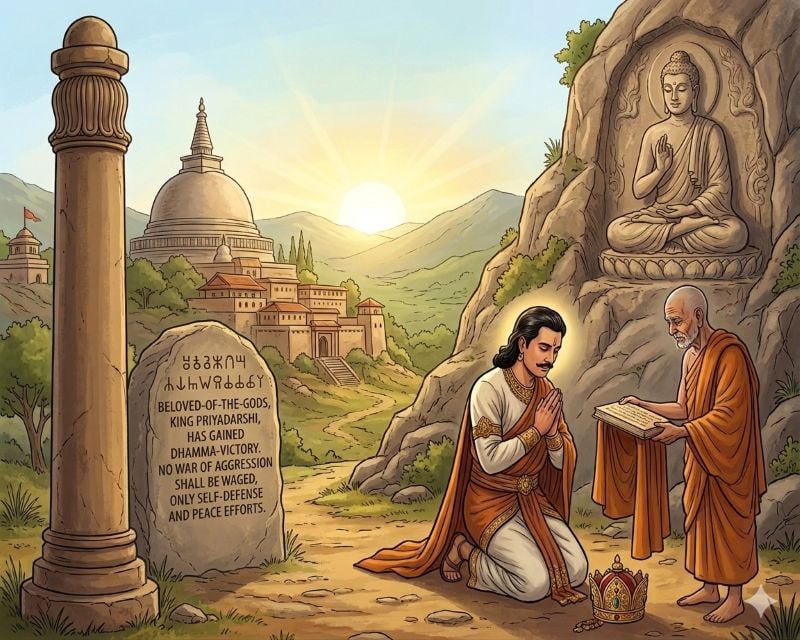
From the recorded history of India, what resulted from the last war Emperor Ashoka waged has much to teach humanity. To extend the empire of the Maurya dynasty, he wanted to conquer Kalinga, a feudal kingdom in India’s southeast. The Kalinga War was one of the largest and deadliest battles in Indian history, taking the lives of 250,000.
Witness to the bloodshed and horrors of war, Ashoka felt deep remorse for his role as recorded in one of his Rock Edicts. The transformed ruler, already a non-engaged Buddhist, replaced military conquest with “Dharma” (righteous conduct), focusing on moral education, tolerance, and social welfare as state policy. He sent Buddhist emissaries to various regions, including Greek kingdoms in West Asia and a mission led by his children, Mahendra and Sanghamitra, to Sri Lanka. He thus played a major role in the spread of Buddhism, the most pacifist religion in the world. Some militant forms of Buddhism, however, have appeared in Myanmar, Sri Lanka, and Thailand, but they are an exception.
Jainism, however, takes the prize for the most pacifist religion. Perhaps as ancient as Hinduism, it vows non-violence in thought, word, and action toward all living beings, not just humans. Their monks walk barefoot and wear a cloth piece over their mouths to avoid killing even microscopic creatures.
From St. Augustine to the UN
The concept of just war is also deeply rooted in Western philosophy. Developed by early Christian theologians like St. Augustine in the 4th century and later refined by St. Thomas Aquinas, the theory sought to reconcile the biblical prohibition against killing with the moral duty to defend the vulnerable.
Today, this framework remains the bedrock of international law and statecraft. It dictates two main categories: Jus ad bellum (the right to go to war) and Jus in bello (right conduct within war). For a war to be “just” today, it must meet strict criteria:
- Just cause: Protecting life or responding to aggression.
- Proper authority: Sanctioned by a recognized body (like the UN).
- Right intention: Aiming for sustainable peace, not revenge.
- Proportionality: The good achieved must outweigh the suffering caused.
The modern dilemma
In our current landscape, these theories are being tested to their breaking point. We see “Just War” invoked for humanitarian interventions to prevent genocide, yet we also see it challenged by the existence of nuclear weapons, which by nature violate the principle of discrimination between combatants and civilians.
Furthermore, the United Nations—intended to be the arbiter of these laws—is increasingly viewed as a toothless tiger. Its power is often hamstrung by the vetoes of the five permanent Security Council members (China, France, Russia, the UK, and the US), who frequently align the definition of “justice” with their own national interests.
This erosion of international law threatens our global foundation. As we look at the conflict involving the US, Israel, and Iran—tamped down at the time of this writing but still unresolved– interdependent nature of our world becomes painfully clear. Even non-combatant nations in the Middle East have been pulled into the war zone. From Asia to Europe, oil shortages, inflation, and economic contraction are inflicting misery on those far removed from the front lines.
Praying for an off-ramp in the Iran war
In ancient epics, war was a tool to restore order. In a nuclear-armed, hyper-connected world, war more often threatens total disorder.
As we reflect on the conditions of a just war, one must wonder if a war can ever truly be just if its collateral damage is the global economy and the well-being of billions. We can only hope for saner voices to prevail—those counseling cessation of hostilities and a diplomatic off-ramp in the Middle East. Maybe it is too much to hope that diplomacy and negotiations will prevail in other flashpoints centering on nuclear arms to prevent the scorched earth of the Mahabharat becoming a global reality.







 Ad-Free & Subscriber Log-In