

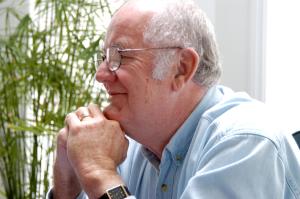
My dad died in October from dementia. He was a good man and a good father, and had lived a good, long life. For almost 50 years, he’d served as a minister in Mennonite and Methodist congregations, and it’s no accident that my favorite Bible verse was his, too, as he embodied the words of Micah 6:8, doing justice, loving mercy, and walking with humility.
He was also a peacemaker, ardently advocating for nonviolence in the communities where he ministered, and in the world he inhabited. I learned a good deal from his peaceful witness, and as an adult, affirmed pacifism as a virtue to which I believe God calls us.
It was probably grief about my dad’s death, and the principles of peace he taught me, that made me incandescent with rage last week when President Donald J. Trump had Washington D.C.’s Institute of Peace renamed to become the Donald J. Trump Institute of Peace. The next day, when the president for soccer’s international body gave Trump the first-annual FIFA Peace Award, I was nearly apoplectic.
I know, I know: my response was not the least bit peaceful.
The (Fake) FIFA Peace Prize
For some, the president’s peace award was a convenient joke, a punchline on late-night television. Others pointed out that the FIFA prize was simply a grift, a made-up award for one hollowed-out man, given by an organization and its leader who has faced significant corruption charges.
It’s easy to discount the peace prize because the award itself is meaningless, an attempt to appease a craven person thirsty for the Nobel Peace Prize, allegedly because his predecessor, Barack Obama, received the prize in 2009—and certainly not because peacemaking is a virtue to which we should all aspire.
And of course, the president has tried to fashion himself as the peace president, both before the 2024 election, when he campaigned on a promise of no new wars; and after the election, when he weirdly (perversely) has bragged about resolving eight nine ten wars in the last ten months. One need only ask the people in Ukraine, or Gaza, whether Trump’s claims of ending those wars is anything but absurd. The people in Cambodia and Thailand no doubt agree.
But as someone who takes seriously the gospel message of peace, and who has witnessed, first-hand, the work of peacemaking, I’m not amused by the president’s attempts to redefine what peace means, because his redefinition makes peace meaningless, a vacuous slogan rather than a self-sacrificial act that takes neighbor-love (and enemy-love) seriously.
Blessed are the (real) Peacemakers
Because when I think about true peacemakers, I think about those who are advocating for the worth of Palestinians, those who are sacrificing their own safety and well-being to assure that the humans living in Gaza, humans who have lost nearly everything, can have a secure future, free of the nightly violence that terrorizes them. A peacemaker does not supply bombs to kill Palestinian children, then brag about building a resort on their graves.
When I think about true peacemakers, I think about Mennonite and Quaker congregations, including my own, who are finding ways for their immigrant neighbors to worship safely on Sundays; and giving immigrant children rides to school so their parents can avoid ICE; and accompanying immigrants to court. A peacemaker does not weaponize a country’s immigration system, paying armed militias to swipe humans from their homes, and schools, and churches.
When I think about true peacemakers, I think about the saints who dedicated their lives to the civil rights movement, using nonresistance and civil disobedience to demand equal treatment under the law, using their bodies and voices to proclaim that every person is created in God’s image. A peacemaker does not determine that white lives are superior, that some people are pigs, that some immigrants are “filthy, dirty, and disgusting,” that they are stupid, that they don’t deserve to live.
When I think about true peacemakers, I think about the men whom I studied for my first book, Mennonite conscientious objectors who sacrificed their lives and livelihoods to protest the First World War, when over 16 million people died in protracted battles for land and empire that primarily benefited the wealthy. Conscientious objectors in that and other wars courageously, defiantly resisted those who saw war as not only necessary, but praise-worthy. A peacemaker does not celebrate war or the extrajudicial murder of unarmed civilians clinging to boats, nor does a peacemaker sacrifice military members for want of land and access to oil.
When I think about true peacemakers, I think about my husband’s work with The Civility Project, and about Braver Angels, and about United as Neighbors, local groups trying to heal divisions that exist in their communities, recognizing that rancor and chaos weaken communities by turning neighbors against each other. These local peacemakers know that incivility dehumanizes those with whom we disagree, and dehumanization can further marginalize community members who are already vulnerable. A peacemaker does not proclaim at every turn that those who disagree politically are the enemy of the people, or that they are committing treason by simply sharing their beliefs.
In the last decade, President Donald Trump and his sycophants have tried to redefine so much in the language they use to push through widely-unpopular actions. He says costs in the United States are lower, despite every metric suggesting otherwise. He is opaque, but says he is transparent. He argues that he is the law-and-order president, even as he pardons criminals. He rails against the weaponization of the government, even as his Department of Justice prosecutes his political enemies.
He wins a prize for peacemaking while inciting violence.
When will Enough be Enough?
This week, Christians around the globe are celebrating Advent, lighting a peace candle as a reminder that the Prince of Peace is coming, upending a social order that favored the wealthy and powerful by being born in a manager. Jesus’ life and ministry testified to the values that should guide us all, including the call for peace and justice and love for the least of these, values that are the antithesis of the FIFA peace prize winner.
My dad often ended conversations, emails, even text messages with Shalom, a call for peace in all things, for harmony with others and the soul’s well-being with God. I long for Shalom in our time and place: A kind of peace that resists redefinition by the powerful and will not be co-opted by the corrupt. I’m grateful for the message of Shalom exemplified in my dad’s life and in the work of peacemakers everywhere, and pray that Shalom will reign this Advent season, including in those who use peace as a convenient cudgel to maintain power.
(My dad really was the best. You can read more about him in the eulogy I wrote for his memorial.)













 Ad-Free & Subscriber Log-In