

A friend of mine asked me this question the other day: is complementarianism misogyny? Or put another way: does restricting women’s roles in the church and home show an inherent hatred of women?
Complementarians would say no. Their view that women’s roles should be restricted in the church (and often in the home) isn’t based on hating women; it’s based on their belief that God ordains these restrictions and their sincere desire to live a life that is faithful to God. They believe that men and women are equal in being but have different roles.
Complementarianism: misogyny hiding in plain sight?
Put another way, complementarians believe that women and men are ontologically equal (in being) but functionally unequal in the sense that women should have subordinate positions. But there’s a fundamental problem with this premise. This “functional” difference that complementarians say dictates different roles in the church / home is based on our God-ordained sex. And all of us would agree that sex is fundamental to our ontology, e.g., “Male and female He created them.” (Gen. 1:27)
So in fact, what complementarians refer to as functional difference, in terms of women’s subordination, is actually ontological. The inequality they promote is ultimately ontological, not functional, and contradicts the Biblical account of creation. In other words, the complementarian claim to equality is just rhetoric that doesn’t hold up to either reason or Biblical truth.
Of course, men and women by design are wonderfully, functionally different. That truth is written on our bodies, which are beautifully differentiated. Egalitarians, who oppose a gender hierarchy, celebrate these differences, but we do not falsely infer that they imply women’s subordination to men. The purpose of our sexual differentiation is to facilitate our unity and the fruit that bears, physically and otherwise – not to establish contrived, hierarchical gender roles that defy the equality of our ontology. And I do not buy the complementarian argument that a hierarchy between men and women paradoxically creates some kind of ineffable unity. The “unity” they speak of, albeit with good intentions, is the same vile “unity” of whites and blacks under “separate but equal.”
What about female complementarians?
A lot of complementarians seem to think that because women can be complementarian, these views obviously are not sexist or bad; otherwise, why would women support it?
Well, that’s easy enough to explain by looking at history.
Thanks in part to the efforts of suffragists – activists who lobbied for women’s right to vote – women in the United States gained that right in 1920.
But did you know there were many women who opposed the right for women to vote?
That’s right. In a piece aptly entitled “Our Own Worst Enemies: Women Opposed to Woman Suffrage”, Jeanne Howard explains the arguments of these female anti-suffragists. Interestingly, some of their arguments against women voting are virtually identical to complementarian arguments against women’s equality in the church and home. Here are a couple anti-suffragist arguments that Howard summarizes as follows:
- Men and women are ordained (by God or nature) to separate spheres, each with specialized expertise, each superior in his/her own realm.
- Woman suffrage is inextricably tied to revolutionary social movements and threatens the social order.
Howard identifies these arguments against women’s voting from various sources, including quotes by women of the time and from popular women-led publications:
“The founthead of woman suffrage is the revolutionary Socialism of Europe” (Caroline Corbin) – Remonstrance, 1892
“If you hold your family relations, your home, your religion as sacred and inviolate . . . then work with all your might against the companion, the handmaiden, the forerunner of Socialism – Woman Suffrage.” – Remonstrance, April 1914
“This is the real menace of woman suffrage – its diabolical alliance with socialism and feminism.” – July 1915, The Woman’s Protest
Like the anti-suffragists of the late 19th and early 20th centuries, complementarians typically appeal to critiques of socialism, concerns over social order, and/or the authority of God.
My point here is simply this: women have historically fought to oppress women making what most of us know are false appeals to God, to scripture, the social order, etc.
So female complementarians inherently demonstrate the merits of complementarianism about as much as female anti-suffragists demonstrated the merits of women’s political oppression.
Asking “how can women be complementarians if complementarianism is so bad for women?” is a good question, and it’s one I’ve asked myself. The best answer is from history. Sadly, we women have fought hard for our own oppression with the best of intentions. We have been our own worst enemies.
Incredibly, some modern complementarians have even begun to question women’s right to vote. But is it so incredible? Although one can be complementarian and support women’s voting, anti-suffragist and complementarian positions are ultimately rooted in similar (bad) arguments from scripture, making this sad convergence somewhat inevitable.
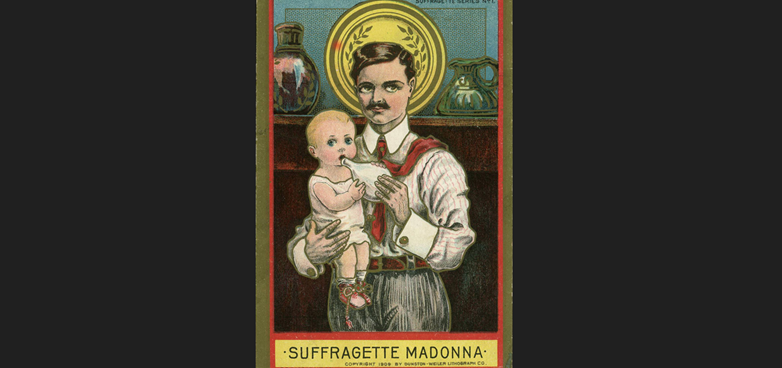
The 1909 anti-suffrage postcard featured in this post, “The Suffragette Madonna,” comes to mind. The provocative image capitalizes on Christian iconography to falsely portray women’s voting as a violation of sacred Biblical truths. A modern-day, complementarian equivalent of this image would be an Internet meme called the “The Egalitarian Madonna” that falsely evokes Biblical feminism as a disruption and threat to divinely-ordained gender roles.
What does the Bible say about gender roles?
Although the Bible was produced in a patriarchal context, remarkably, there are only a handful of passages that complementarians can even draw upon to support their views. Adding to this tenuousness – the meaning of some of these few passages is highly contested, and interpreting them as supporting complementarian ideology is questionable. Why?
Because egalitarian scholars (Gordon Fee, Ben Witherington III, Philip Payne, Alan Padgett, and more) offer alternative interpretations of these passages that actually make more sense and cohere better with the whole of scripture: from Genesis, where male and female are created in the image of God (Gen. 1:26–27), to the obvious emergence of male rule after the fall / sin (Gen. 3:16), to Paul’s repeated calls for mutual submission (1 Peter 5:5, Eph 5:21-33) and his repudiation of hierarchies in Christ (Gal. 3:28). This narrative trajectory makes sense, as we are called to lives reflecting the redemptive work of Christ on the cross, as well as the sacrificial love Christ modeled for us.
Many complementarians presume that egalitarians are sacrificing Biblical principles for secular ideas, such as feminism.
But here’s the truth: egalitarians don’t support equal roles for women in the church and home in spite of the Bible but because of the Bible.
Our argument is rooted in scripture and confirmed by reason. No complementarian has ever adequately addressed the deception hiding in plain sight at the heart of their claim.
I do not believe that complementarians are inherently bad Christians or bad people. As an analogy, my paternal grandfather, who was born in 1899, was racist, but he was not wicked. He believed that black people were created only for manual labor, but he was a true believer and treated people generally with respect, despite the views he held. I think many complementarians fall into this category. But here’s the difference: my grandfather didn’t have access to the truth. He was simply living out what he knew, and he knew nothing else. Practically every white person in early 20th century America was racist, and although my grandfather was bright, he, like most Americans at the time, did not have a college education.
The world is very different now in this respect, and given recent history, complementarians have a deep moral responsibility to rigorously question the hierarchical views they hold. We may disagree over how to interpret scripture. But the arguably poor interpretive choices of complementarians put them in lockstep with oppressors of the past. The defenders of slavery, Jim Crow, and women’s political disenfranchisement used some of the same biblical passages to defend their false views of humanity, even the same arguments, that complementarians use now.
So let’s learn from these oppressors of the past, lest we become them by repeating their errors.











 Ad-Free & Subscriber Log-In