

As Jeanne headed into Dunkin’ Donuts to purchase her customary large decaf French Vanilla with eight creams and three Equals (and  pity the fool who doesn’t get it right), I stayed in the car surfing the FM dial—my coffee intake for the morning had already exceeded its quota. I landed on New York’s NPR classical station just in time to hear “Ombra mai fu,” the opening aria from Georg Friedrich Handel’s 1738 opera Serse.
 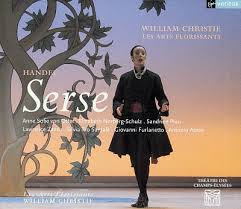 Parked in an ugly Double-D parking lot on Long Island, I thought to myself that when the angels sing, they must begin and close with this piece—perhaps the most beautiful I’ve ever heard.
As is my frequent custom, I shared my unexpected and much appreciated encounter with Handel’s “Ombra mai fu” with my Facebook acquaintances, then on my blog. Several who share my love of classical music shared their own favorite versions of the aria on YouTube; a good-natured debate arose over whether the aria is most beautiful in the soprano range, as Handel wrote it,
http://www.youtube.com/watch?v=QO3AlJT2GjM
transposed into the lower and richer mezzo-soprano or contralto ranges,
or perhaps sung by a male soprano, as it would have been originally, since the aria is sung by King Xerxes in Handel’s opera.
The music is so glorious that I, not knowing Italian, speculated that the text of the aria was probably religiously themed along the lines of so much of Handel’s compositions. But no—the text of “Ombra mai fu” contains no lofty sentiments, no paeans to the divine. It’s a brief poem of thanks for the shade of a plane tree.
Ombra mai fu Never was a shade
di vegetabile of any plant
cara ed amabile, dearer and more lovely,
soave più. or more sweet.
Over the centuries Handel’s glorious music has been co-opted for different texts, such as the hymn “Holy Thou Art.”
But it is fitting that one of the most inspired pieces of music ever written is originally in honor of a tree.
One of the greatest continuing insights of Reverend John Ames, the aging Calvinist minister from Marilynne Robinson’s Gilead, concerns the sacredness of all things. As he nears the end of his life, he pays close attention to the mystery and miracle of things most of us dismiss as “ordinary.”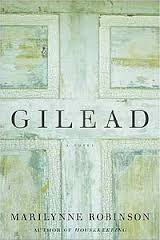
It has seemed to me sometimes as though the Lord breathes on this poor gray ember of Creation and it turns to radiance—for a moment or a year or the span of a life. And then it sinks back into itself again, and to look at it no one would know it had anything to do with fire, or light. . . . Wherever you turn your eyes the world can shine like transfiguration. You don’t have to bring a thing to it except a little willingness to see. Only, who has the courage to see it?
For Reverend Ames, everything is a sacrament with intimations of holiness. And the Divine Being he has served and conversed with for decades is still a mystery.
“You don’t have to bring a thing to it except a little willingness to see. Only, who has the courage to see it?” Good question. It takes a lot more courage to embrace this world with all of its imperfections and disappointments as a spectacular and continuing divine miracle than to step back and bemoan the fact that it seldom is the miracle we would have performed if it were up to us. It isn’t up to us—the power and glory of our created, sacred world is far above our pay scale. And yet sacredness and beauty embedded in imperfect matter is a reminder that according to the Christian narrative, this very strange yet compelling fusion of the divine and the imperfect is God’s intention with us.












 Ad-Free & Subscriber Log-In