

Today is Lent 5–the gospel text is John 11, John’s account of the raising of Lazarus. I had the privilege of giving the sermon at St. Matthew’s Trinity Lutheran Church in Pawtucket, Rhode Island this morning. Here’s what I said.
During my childhood, we did not go to movies—that was something, along with a bunch of other things, that good Baptists didn’t do. But we did watch television—except on Sundays. So my brother and I occasionally saw movies on television, after careful censoring by my parents. We always looked forward to the weeks leading up to Easter with great anticipation—not because it was Lent followed by Holy Week (I never even heard of Lent until I was an adult), but because that was when the networks might be showing Hollywood epic treatments of stories either from or related to the Bible: “The Ten Commandments,” “Ben Hur,” “Quo Vadis,” “The Robe,” and others. Particularly favored was “King of Kings,” a full blown life-of-Jesus movie. These movies, despite their frequent failure to live up to the King James Version standards that we considered authoritative, were guaranteed to be approved by the parental censors. My mother, brother, and I popped popcorn and watched the Bible come to life in living black-and-white.
Then in 1966, when I was 10 years old, United Artists released “The Greatest Story Ever Told,” one of the last of the great Hollywood biblical epics, directed by George Stevens. The cast was full of established as well as up-and-coming stars, including Max Von Sydow, in his first English-speaking role, as Jesus; Biblical epic superstar and future president of the NRA Charlton Heston as John the Baptist; Claude Rains, in his final movie appearance, as Herod the Great; Martin Landau, the master of disguise in the “Mission: Impossible” as Caiaphas; Telly Savalas of “Kojak” fame as Pontius Pilate, David McCallum (formerly one of the stars of “The Man from U.N.C.L.E” as Judas Iscariot; and my favorite: John Wayne as the Centurion at the foot of the cross, who delivers his one line—“Truly this man was the son of God!”—with all the sensitivity and reverence of a cowboy.
Stevens’ directorial choice is to hinge the whole three-hour-plus spectacle on the raising of Lazarus, which takes place just over halfway through the movie. It is a remarkable piece of cinematography—instead of focusing on Jesus and Lazarus, the camera focuses on the reactions of those present. Shocked faces, stunned silence, a woman drops to her knees, a man bursts into tears. One witness runs down the road, grabbing random people and sharing the news—“Jesus of Nazareth . . . I saw it, I saw it with my own eyes! Lazarus was dead, and now he’s alive!” “The Messiah has come! A man was dead, and now he lives!” And indeed this is a blockbuster miracle, worthy of a predictable Hollywood musical effect, the rapturous singing of the final measures of the “Hallelujah” chorus from Handel’s Messiah in the background. As the witness nears the walls of Jerusalem, he is joined by two men healed by Jesus earlier in the movie: “I was crippled, and now I walk!” “I was blind, and now I see!” “Who has done this?” shouts a Roman centurion from the walls of the city. “The Man Called Jesus!” Remarkable. Astounding.
I have lots of questions! If this is, indeed, Jesus’ signature, career-defining miracle, why is it only reported in one of the four canonical gospels? Why do Matthew, Mark, and Luke not consider the story important enough to include in their accounts? Why does Jesus deliberately delay travelling to Bethany upon hearing that his friend is deathly ill, dawdling along the way in order to ensure that Lazarus is dead by the time Jesus arrives? What exactly is the depth and nature of the Jesus and Lazarus friendship? We know a lot about Jesus with Lazarus’s sisters Mary and Martha, but this is the first time we’ve heard about Lazarus. Is he the domineering older brother of Mary and Martha, or the spoiled younger brother on whom they dote? Why does Jesus weep? And why is Lazarus still wrapped in his graveclothes when he emerges from the tomb?
The gospel author mentions Lazarus only one other time, in the next chapter just before Jesus’ triumphal entry into Jerusalem that we’ll celebrate next Sunday. The crowds around Jesus have increased exponentially, as much to gawk at Lazarus as to see Jesus. The chief priests, plotting behind the scenes as always, plan to see both Jesus and Lazarus dead—this time there won’t be any resurrection. And Lazarus dissolves into our imaginations. What happened to him? How did he live out the rest of his life?
These are questions worthy of discussion, as are the questions raised by the account of the miracle itself. But this morning, let’s not be like those who hung around the house of Lazarus and his sisters, hoping to catch a glimpse of this guy who was once dead and now is alive. Let’s not turn Lazarus into a side show. Because Lazarus is not a museum piece to be dusted off and talked about once in a while. C. S. Lewis once provocatively wrote that followers of Jesus must p “die before you die.” The story of Lazarus is our story, the story of all of us who seek, in our individual and unique ways, to be friends with Jesus.
This morning’s reading from the Jewish scriptures is the prophet Ezekiel’s visions of a valley of dry bones. Dry bones are the remaining evidence of something that was once alive, but hasn’t been for a long time. Those who put the lectionary together knew what they were doing, because Lazarus in the tomb is well on his way to becoming a pile of bones—“Lord, already there is a stench because he has been dead four days.” We all, I suspect, have spiritually experienced a valley-of-dry-bones season. Dry bones are the remaining evidence of something that once was alive but hasn’t been for a long time. Each of us has been through a “dark night,” a time in which everything relied upon turns out to be unreliable, and everything that made sense no longer does. Let’s look at an example.
I claim to be a follower of Jesus, but the internal flame has slowly decreased to an ember that is threatening to die out. I haven’t seen or talked with Jesus, really spent time with him, for a while. Those closest to me might realize that something’s wrong but are unable to help. Nothing but silence. And deep down, I know this is not just a dry period, a time in the desert. The spiritual embers flicker out, leaving a cold, empty space full of ashes at my core. This is real death, from which there is no return. “Lazarus is dead.”
Dietrich Bonhoeffer, the Lutheran pastor and theologian who was murdered by the Nazis, once wrote that “[w]hen Christ calls a man, he bids him come and die.” And death is not attractive. It isn’t pretty. No matter how beautiful the dress, how snazzy the suit, how professional the make-up job, a corpse is still a corpse. Spiritual corpses go through the motions, pretending that “there’s still some life left in these bones,” but deep down they know it’s a lie. “My bones are dried up, and my hope is gone. I am cut off completely.”
But after what seems like a spiritual eternity—a rattling of bones, a puff of breath, and there are the stirrings of life. I’ve been dead for so long, I’m disoriented. I don’t recognize my surroundings, nor the voice in the distance. “Come forth!” As a moth toward a flame, I’m drawn toward that sound, toward a pinpoint of light, and I find that, against all odds, what was dead is alive again. I’m surrounded by those I thought I had lost, those whom I’d thought I would never truly see again. “We thought you were dead!” “I was!” But I can’t move properly, can’t see clearly, I feel like a mummy who just became alive again. And I hear a commanding voice: “Loose him, and let him go.”
I’ve been raised to new life—so why am I still bound by the vestiges of death, by the graveclothes of a past that I thought was gone? Because spiritual renewal and growth are like the evolutionary process—I drag the remnants of a past reality into my new life. Vestiges of what has died still remain. If inattentive, I will attempt to weave new garments of salvation out of old, stinking rags that have long outlived their purpose. And I cannot remove them by myself—I need help. I need the help of those who love me and who know what it’s like to try to get one’s bearings as a newly resurrected corpse. And the Lazarus cycle goes on.
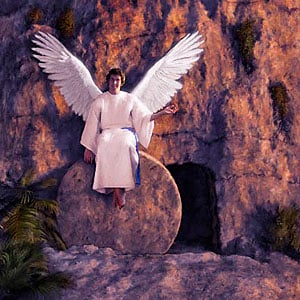
The message of the story of Lazarus is “Don’t be afraid to die”—especially to those things we cannot bear to even think about losing. Don’t be afraid to release even what seems most necessary—familiar thoughts, comfortable patterns of behavior, toxic relationships, habits set in stone, well-intentioned but self-centered expectations—the very things that for each of us seem to be the cornerstone of existence. To truly live, we have to die. As Simone Weil wrote,
They alone will see God who prefer to recognize the truth and die, instead of living a long and happy existence in a state of illusion. One must want to go towards reality; then, when one thinks one has found a corpse, one meets an angel who says: “He is risen.













 Ad-Free & Subscriber Log-In