Looking at music itself, you will find that from the beginning of the world it has been instilled and implanted in all creatures, individually and collectively. … Music is still more wonderful in living things, especially birds, so that David, most musical of all kings, and minstrel of God, in deepest wonder and spiritual exultation praised the astounding art and ease of the song of birds in Psalm 104. … And yet, compared to the human voice, all this hardly deserves the name of music, so abundant and incomprehensible is here the munificence and wisdom of our most gracious Creator.
Holman goes on to discuss Luther’s compositions and his collaboration with other musicians. A sample:
Luther knew that the power of music went beyond texts. So he also encouraged a new style of congregational participation: the chorale—unison singing, mostly syllabic text setting (meaning single words are not stretched over several different notes), in strophic form (in which all the stanzas are sung to the same music), and a capella, the organ only providing the pitch. Choirs in his churches often sang from within the congregation to provide teaching and support. . . .
Lutheran chorales were intended to be sung monophonically (in unison) by the congregation. They were also set for publication typically in four parts—soprano, alto, tenor, bass—with the melody in the tenor voice in some (more effective with trained choirs) and the soprano voice in others (more practical for congregational singing).
Paul Grime’s article, Changing the Tempo of Worship, tells about how Luther made singing by the laity a part of Christian worship. He too gives some fine Luther quotes and contrasts his views with those of other Reformers:
Ulrich Zwingli, leader of the new church in Zurich, was a trained musician. Yet under his influence, Zurich’s magistrates banned all playing of organs, and some of Zwingli’s followers went about smashing organs in their churches. Though Zwingli later permitted some vocal music, he rejected instrumental music.
John Calvin, though he considered music a gift of God, saw it as a gift only in the worldly domain. Thus, its role in the church was severely limited. He considered instrumental music “senseless and absurd” and disallowed harmonies. Only unison singing of the Psalms was permitted.
Not so for Martin Luther. “I am not of the opinion,” he wrote, “that all arts are to be cast down and destroyed on account of the gospel, as some fanatics protest; on the other hand, I would gladly see all arts, especially music, in the service of him who has given and created them.”
Music in congregational worship remains one of Luther’s most enduring legacies. “Who doubts,” he said, “that originally all the people sang these which now only the choir sings or responds to while the bishop is consecrating?”
So even churches that reject his theology, if they employ congregational singing in their worship services–as even Catholics do today–owe a debt to Martin Luther.
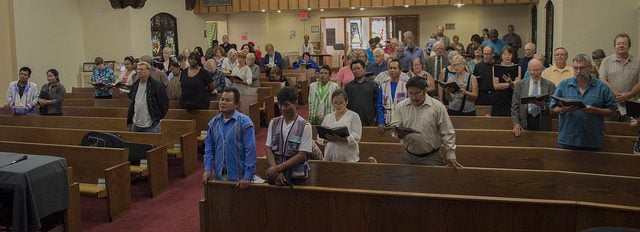
Photo: “Congregation” by Ian Buck, via Flickr, Creative Commons License












 Ad-Free & Subscriber Log-In