
News that church membership in the United States has fallen below 50% has provoked a host of discussions about what that might have happened, expanding to considerations of a wide range of dysfunctions in the church and in society. This blog has participated in those discussions.
But, we might wonder, what would Christians of the past say about our current problems? How, for example, might Luther diagnose the church’s woes today?
The Reformers said that the doctrine of justification–that is, how sinners are put right with God through the work of Christ–is “the article upon which the church stands or falls.” Today in many of America’s churches, this teaching can scarcely be heard.
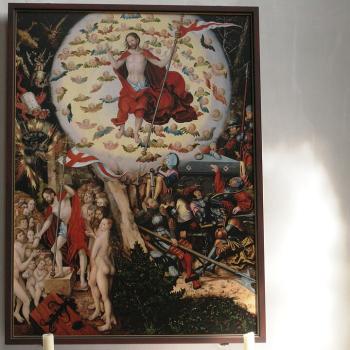
“Objective justification”–in which Jesus took upon Himself the sin of the world, paid its penalty of death, and brings us to new life through His resurrection–is often explicitly rejected. “Subjective justification”–in which the individual Christian receives Christ’s work when the Holy Spirit creates faith by means of the Word and Sacraments–is often completely distorted. Faith is not a decision, an experience, a conversion, or a relationship. To be sure, all such things can be important facets of a Christian’s life, but they come from faith and are not faith itself. Faith is an ongoing trust, belief, and dependence. And it matters what–and who–you are putting your faith in. I have heard a TV preacher talking about salvation by faith, but it turned out to be faith in one’s self. (Have faith in yourself, and you’ll have the power of positive thinking, which will open up to you health, wealth, and prosperity.) As opposed to faith in the cross of Christ. Thus, subjective justification depends wholly on objective justification.
So if justification is the article upon which the church stands or falls, when the church stops teaching justification, of course it is going to fall! It will replace this Gospel with toned-down, easily-achievable versions of Law–such as moralism, politics, social gospels, psychology, prosperity, or whatever–and when this happens, the church should fall!
Of course, it may well be that a church that preaches one of these other gospels may seem very successful, accumulating lots of members, wealth, and glory. Nevertheless, that church has fallen. Conversely, a church that holds high the cross may well have to endure its weakness and shame. But the gates of Hell will not prevail against a church like that.
(I go into this more in the Preface to the new edition of my book The Spirituality of the Cross: The Way of the First Evangelicals.)
Image by Pexels from Pixabay
















 Ad-Free & Subscriber Log-In