

In the course of an essay on the loneliness epidemic and how nearly 43% of adults say they turn to AI for emotional support, Brad Littlejohn brings up Adam and Eve.
From A Helper Corresponding to Him at Mere Orthodoxy (my bolds):
After observing the plight of Adam’s loneliness, God responds to this state of affairs by creating for him a “helpmeet,” a word introduced into our language by the KJV’s attempt to render the Hebrew ezer kenegdo. We have tended to flatten this term into simply a synonym for “helpmate” or “helper,” but it is something much more profound than that. The Hebrew means something like “a helper corresponding to” or “a counterpart”—Eve is a helper that stands opposite Adam and meets him face to face. In Eve, Adam can recognize himself as in a mirror, greeting with joy a fellow image of God: “bone of my bone and flesh of my flesh,” he exclaims. And yet this image is not himself but another, it is like and yet unlike. It is this that we crave when we seek companionship; it is this without which the world is “not good.”
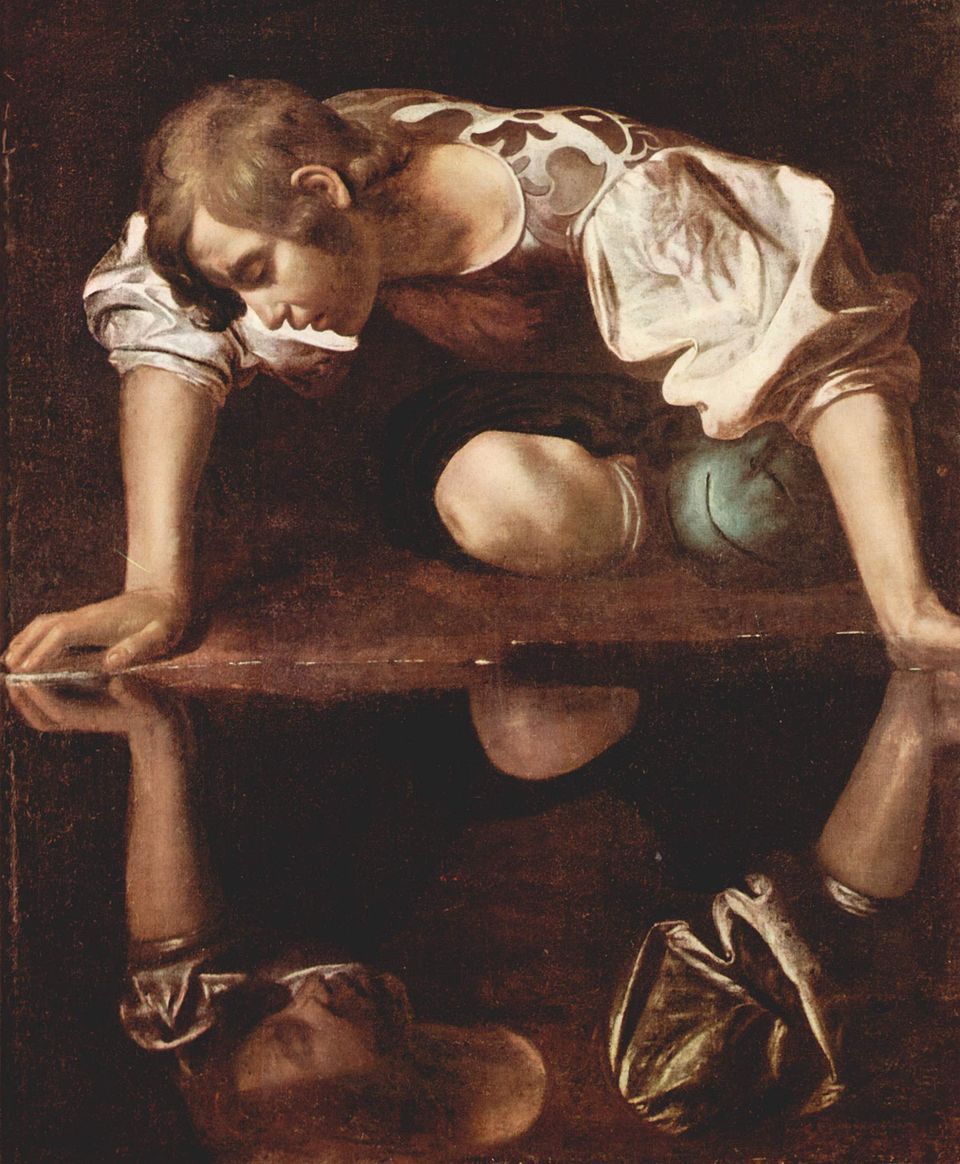
Littlejohn then contrasts Adam and Eve’s relationship with that described in the myth of Narcissus, who fell in love with his own image, leading to his doom:
God created Eve, in other words, to guard Adam from the fate of Narcissus, who fell in love with an image of himself reflected back in a pool. We often misunderstand the myth of Narcissus, however, when we casually throw around the word “narcissism” to mean a kind of vanity or self-love. For the tragedy of the myth is not that Narcissus was absorbed in self-love, but that he fell in love with what he thought was another, but which turned out to be simply a reflection, an extension of himself.
Pause to think about this. Love involves a unity of different persons. This is true of the love in marriage, parenthood, friendship, the church. And it is true of God Himself, whose very being is a unity of three distinct Persons, so that Scripture can assert “God is love” (1 John 4;8).
And yet, we tend to think of love in terms of Narcissus. We expect the person we are in a relationship to be just like us. When we find differences, we think something is wrong with the relationship. This is the source of the stupid arguments that often break out between spouses, the fights between children, and discord between friends. These usually pass over before too long, but too often the Narcissus syndrome can breakup families, ruin friendships, split churches, and fracture every kind of community.
In his essay, Littlejohn goes on to apply these paradigms to our very real and legitimate need for affirmation. We have become starved for someone to say that we are good or that we have done well. Enter technology. Social media rewards our posts with “likes.” AI chat bonds with us by constantly stroking our egos by giving us affirming feedback (“That’s a fantastic idea!”). The algorithms are designed to “mirror” the user, so that, like Narcissus, we love what we perceive.
“The current craze for AI relationships reflects more than just careless or exploitative design choices at the AI companies,” concludes Littlejohn. “There is perhaps a deeper spiritual crisis that has rendered us susceptible to such nudges: a loss of community, of defined social roles, and of the contexts where we can take dominion together alongside other embodied image-bearers.”
I would add that our need for affirmation is another way of saying that we need justification. When we have no one else to say we are “right,” or we are “good,” we indulge in self-justification, both in our own rationalizations and in seeking false relationships or algorithms that will “mirror” those rationalizations. (See last week’s post on self-justification, “Drunk on Their Own Virtue.”) What we need is someone outside ourselves to justify us (see last week’s post A Place to Stand). That can only be fulfilled ultimately in our justification by Christ.
Let me also throw into this discussion one additional myth: that of Pygmalion. He was an the artist who rejected the love of both women and men, so he sculpted a statue of his ideal woman. Whereupon he fell in love with his own creation.
We see this in our attempts to re-make people so that they conform to our ideals. And in our turning to our own inventions, such as AI, to find someone to love.
The myth of Pygmalion, though, had a happy ending. Though he loved his statue, he was miserable and frustrated because it wasn’t alive. Aphrodite, the goddess of love, pitied him and turned the statue into an actual living woman. They got married, had children, and lived happily ever after in an ordinary life. Proving that relationships with a real person are better than relationships with an artificial person every time.
Illustration: Narcissus (1597-1599) by Caravaggio – The Yorck Project (2002) 10.000 Meisterwerke der Malerei (DVD-ROM), distributed by DIRECTMEDIA Publishing GmbH. ISBN: 3936122202., Public Domain, https://commons.wikimedia.org/w/index.php?curid=148809












 Ad-Free & Subscriber Log-In