

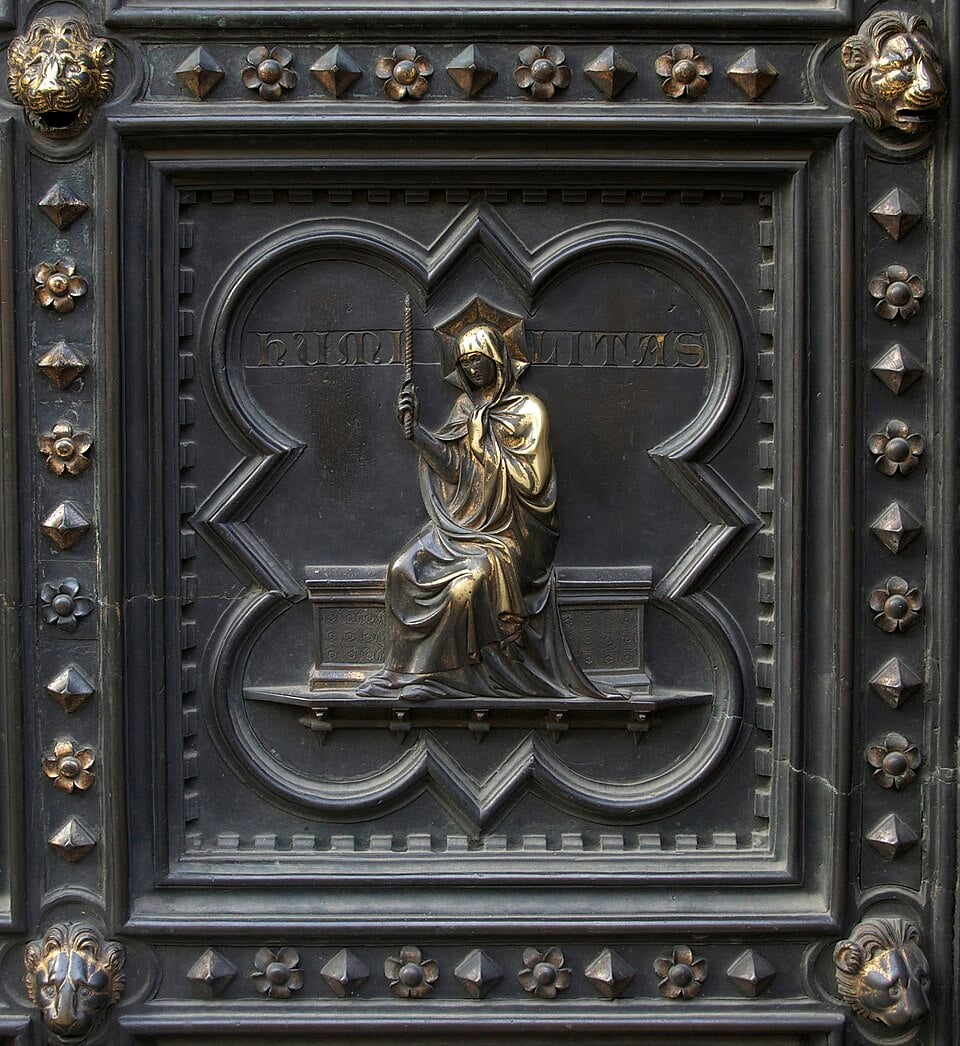
Christians are called to embrace the virtue of humility, for only by doing so can we truly know ourselves. With proper self-knowledge, we will be able to love ourselves for the good we have in us, while not being overly attached to ourselves because we will know we are persons who need to be in relationships with others (and with God). Humility allows us to accept that we need the love of others, even as we need to love them in return. In this way, true self-knowledge overcomes pride, making sure we act according to the dictates of Scripture: “Do nothing from selfishness or conceit, but in humility count others better than yourselves. Let each of you look not only to his own interests, but also to the interests of others” (Philip. 2:3-4 RSV). By embracing humility, by knowing ourselves, we will also be open to and want to know others, even as we will know that we must act in the way which is good, not just for our private good, but for the good of all, fulfilling the justice God expects from us. “He has showed you, O man, what is good; and what does the LORD require of you but to do justice, and to love kindness, and to walk humbly with your God?” (Mic. 6:8 RSV). To be sure, when we follow what Paul said, and look to others as our betters, we must understand he said this to help us become humble, that is, what he said is meant to help serve as a discipline to help us overcome pride, and the way pride makes us think we are better than everyone else. It is a tool, not an end point, that is, we should not see it as an ontological statement. It certainly is not meant to have us end up denigrating ourselves, thinking here is little to no good in us; that would be false humility, the kind which would lead us to believe that God cannot love us because there is nothing good in us to love. Humility is not the same thing as self-hatred; if it were, that would call into question as to why Christ is presented to us as the ultimate representation of humility in the Christian faith, because Christ certainly did not think poorly of himself. Thus, Thomas Hopko rightfully said:
Humility does not mean degradation or remorse. It does not mean effecting some sort of demeaning external behavior. It does not mean considering oneself as the most vile and loathsome of creatures. Christ Himself was humble and He did not do this. God Himself, according to the spiritual tradition of the Church, has perfect humility, and He certainly does not act in this way.[1]
Everything, and everyone has their own value, their own good which should be loved. Humility is meant to help us remember the value of others; it is not meant to be used by us to deny our own worth. We should, of course, be honest with ourselves. We should know our faults and weaknesses so that we can work on them and try to become better. But, we should also recognize the gifts we have been given, those qualities which we possess that are good and worthy of praise:
For humility is not false modesty. Intelligent persons, for example, cannot pretend they have no intelligence, but should be aware that it is a gift from God and not think that they are as bright as if the sun shone in their heads, whilst others have brains full of breadcrumbs.[2]
When we struggle against pride, when we embrace humility, we must make sure we do not end up confusing self-hatred with humility. Humility lies between the twin extremes of prideful self-love and the nihilistic self-hate. It rejects extremely harsh criticisms which denies something good about ourselves as well as lavish praises which make us think we are better than we are. It requires us to be honest with ourselves, to see the good in ourselves, so we can be thankful to God for it, but also to see the bad, to see that there is room for improvement in our lives. It is important for us to always remember the intrinsic good which is found in everyone, including ourselves, so that we value everyone, not just for the good we can get from knowing them, but for their inherent value which transcends all transactional goods (including, therefore, our own good):
Of course, all aspects of creation – including human beings – have instrumental as well as intrinsic value (we all live on top of, in between, and inside each other), but this cannot mean within the Hebrew and Christian traditions that any aspect of creation is nothing but fuel or fodder for others. The recognition of intrinsic value means, at the very least, that when we use other creatures for our benefit, we do so with humility, respect, and thanksgiving for these other lives. [3]
Humility should not lead us to undermine ourselves, rejecting our inherent good; rather, it should serve as a tool to help us see that good, to love and respect it, without exaggerating it. We are not to be narcissists (which is what it meant when self-love is mentioned as a sin). Once again, by rejecting narcissism, we should not exaggerate our character flaws, because when we do that, we will end up hating ourselves, not only denying the good which we have, but denying God’s love for us, leading us to the pit of despair. Both narcissistic self-love and nihilistic self-hate end up having us deny God’s love and grace for us, with self-love making us think we do not need or want it, and self-hate, making us think we are not worthy of it and so reject it (while desperately wanting it). Humility is truly the middle way between the extremes; by embracing it, we allow ourselves to know and accept the good in us, while acknowledging the bad. By acknowledging both of them, we will be ready to accept God’s love (and the love of others) for us. Such humility will also lead us to treat others similarly, that is it will have us love them for the good in them, a good which God loves, and so a good which God can perfect with grace. Indeed, the way of humility is the way of grace; for it accepts that there is a good in us, a nature in us, and in others, for grace to perfect instead of seeking to annihilate it. “God opposes the proud, but gives grace to the humble,” (Jas, 4:6b RSV), because those who are humble are open to and receptive of grace, while those who are proud do not believe they need it and so will not accept it when it is offered. Therefore, let us properly embrace humility so that we can know the good in us, and because of that good, accept the grace God offers us, allowing it to perfect the good in us and become the person God wants us to be.
[1] Thomas Hopko, The Orthodox Faith. Volume 4: Spirituality (Yonkers, NY: St Vladimir’s Seminary Press, 1981; rev. ed. 2016), 71.
[2] Helder Camara, Sister Earth. No trans. listed (Hyde Park, NY: New City Press, 1995), 80.
[3] Sallie McFague, The Body of God: an Ecological Theology (Minneapolis: Fortress Press, 1993), 166.
Stay in touch! Like A Little Bit of Nothing on Facebook.
If you liked what you read, please consider sharing it with your friends and family!
N.B.: While I read comments to moderate them, I rarely respond to them. If I don’t respond to your comment directly, don’t assume I am unthankful for it. I appreciate it. But I want readers to feel free to ask questions, and hopefully, dialogue with each other. I have shared what I wanted to say, though some responses will get a brief reply by me, or, if I find it interesting and something I can engage fully, as the foundation for another post. I have had many posts inspired or improved upon thanks to my readers.















 Ad-Free & Subscriber Log-In