

A Prayer, A Political Act
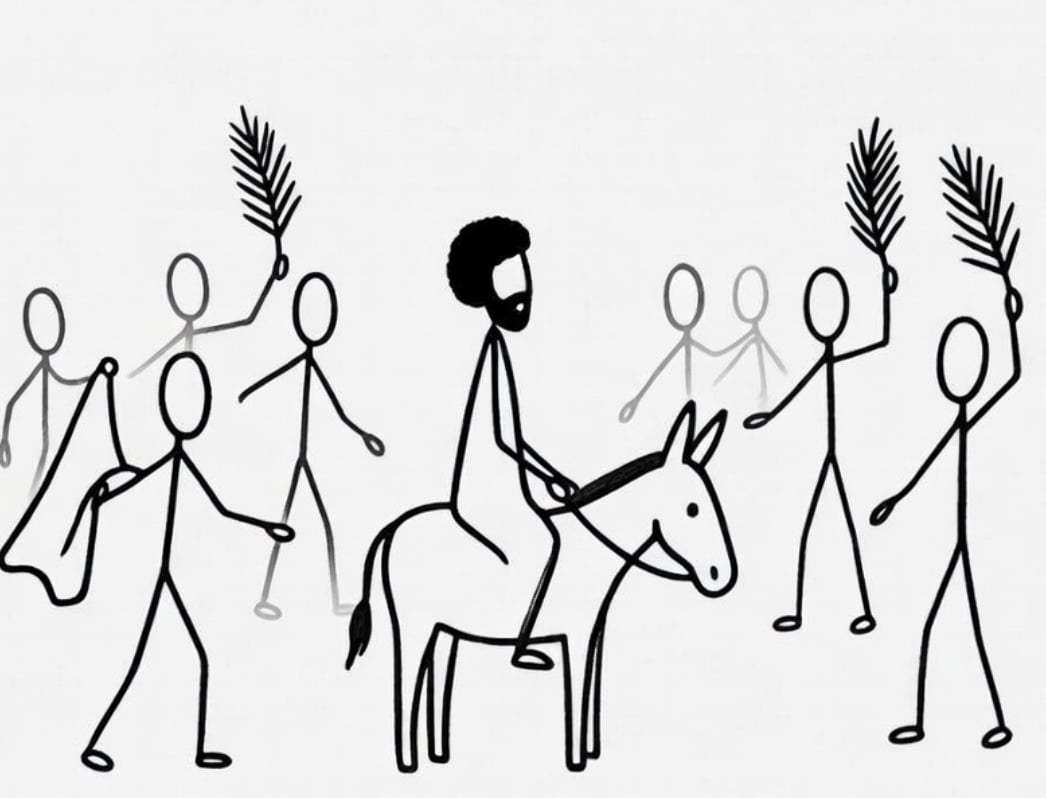
He rode in on a borrowed donkey.
Not a warhorse. Not a chariot flanked by legions. Not with the thunder of imperial boots on cobblestone or the gleam of armor catching the Judean sun. He came on a donkey…the animal of the poor, the animal of the farmer, the animal of the man who has no horse because horses belong to those who own things.
And the people who threw their cloaks on the road were not throwing them for a king who had a palace. They were throwing them because they recognized something. They had seen it before…in Moses, in the prophets, in every moment when heaven bent low enough to touch the dirt of human suffering. They threw their cloaks because the poor always know their liberator before the powerful do.
Hosanna. Save us. Hosanna. Save us.
The word is a prayer and a political act at the same time. It always has been.
The Empire Was Already Nervous
You have to understand what Jerusalem looked like that week.
Rome did not sleep easily during Passover. Passover, of all feasts…the feast that remembers liberation from empire, that rehearses every year the story of a people who walked out of the house of slavery into freedom. The Roman governor Pontius Pilate did not normally reside in Jerusalem. He governed from Caesarea Maritima, the gleaming Roman coastal city with its statue of Augustus and its deep-water harbor built to impress. But during Passover, Pilate came to Jerusalem. He came because of crowds like this one. He came because a colonized people remembering their exodus made the empire nervous.
Two processions. Two visions of the world.
Matthew 27:11-54
Pilate’s Question
And then we come to the courtroom.
“Are you the king of the Jews?”
This is Pilate’s first question and we must sit with it, because it is not an innocent question. It is not curiosity. Pilate is the embodiment of what the theologians of Latin America would call el poder institucionalizado…institutionalized power. He is the system. He is the structure. He is the man in whom the violence of empire has been given a human face and a legal title and a bench to sit on so that what is done in the name of order can be called justice.
Pilate has the power to release. He has the power to condemn. He has, as he will remind Jesus, the power of life and death. And he wants to know: are you a king? Because kings are threats to his king. Kings require a response. Kings must be managed.
And Jesus will not play Pilate’s game.
“You say so.”
Three words. In those three words, Jesus refuses to accept the frame. He will not be defined by the categories of empire. He will not explain himself to power in power’s own language, because to do so would already be a surrender. The liberation theologians understood this. Gustavo Gutierrez, Oscar Romero, the base communities who read the gospel in the barrios and the favelas…they understood that when the poor encounter the system, the system always wants to ask the questions, set the terms, decide what is real and what is not.
Jesus stands before Pilate and he is silent.
He did not answer him one word, so that the governor was greatly amazed.
Do not sentimentalize this silence. This is not passive silence. This is the silence of a man who refuses to give power the dignity of a debate on power’s terms. The chief priests speak. The elders accuse. The crowd shouts. And Jesus stands in the middle of all of it like the eye of a storm…utterly still, utterly free…more free in that courtroom than the man sitting on the bench.
This is what the poor have always known. The system can take your body. It cannot take your dignity unless you hand it over.
Barabbas and the Theater of Choice
Now Pilate performs his ritual. He offers the crowd a choice…Barabbas or Jesus…and Matthew makes sure we understand what Barabbas is. He is a notorious prisoner. In Mark’s account, he is one who committed murder in an insurrection. He is, in the language of Rome, a terrorist. He is a man of violence.
And the crowd…stirred up by the chief priests and elders, the religious establishment that had made its own accommodations with power…chooses Barabbas.
We must be careful here. This text has been used, God forgive us, as a weapon against Jewish people for two thousand years and that is a sin that the Church must continue to confess. Matthew is not indicting a people. He is describing the mechanics of how power works on people…how the powerful manipulate the frightened, how establishments protect themselves, how crowds can be turned. This is not a Jewish story in that narrow, poisonous sense. This is a human story. It happens in every country, in every century. The powerful find their crowds. The powerful always find their crowds.
Pilate watches it happen and sees the riot forming and makes his calculation.
And then…this gesture, this extraordinary, damning gesture…he calls for a bowl of water and dips his hands.
“I am innocent of this man’s blood.”
The Hands That Cannot Be Washed
Here is where we must stop. Here is the word of the Lord for this Palm Sunday.
Pilate washes his hands and calls himself innocent.
And across the centuries, every governor who has signed the execution order, every general who has given the command, every executive who has approved the policy, every official who has looked away…they have all reached for that same bowl of water. The language changes. The bowls are different. But the gesture is eternal:
I am only following the law. I am only doing my job. My hands are clean. Look to it yourselves.
But the water does not wash the hands clean. That is the devastating theological truth that Matthew is handing us. Pilate declares his innocence and then…in the very next breath…he has Jesus scourged and hands him over to be crucified. You cannot wash your hands of what you then proceed to do with those hands. Innocence is not a declaration. It is not a ritual. It is not a press release or a legal finding or an institutional statement. Innocence is what you do.
Stop the Repression
Oscar Romero understood this. He was the Archbishop of San Salvador, El Salvador, a man the powerful initially thought was safe…a quiet, bookish bishop, not a troublemaker. But when he watched his friend, the priest Rutilio Grande, be assassinated for organizing peasant farmers, something broke open in him. He went to stand over Grande’s body in the dark and when he stood up, he was a different man. He had looked at what the system does to the body of the poor and he could not unsee it.
From that moment, every Sunday, his voice went out over the radio across El Salvador. Campesinos in the fields stopped their work to listen. Mothers in the markets gathered around transistor radios. He named the death squads. He named the disappeared. He named the generals and the landowners and the foreign governments who called it all necessary…who passed the bowl of water and called their hands clean. He stood in his cathedral week after week and named Pilate.
And then on March 23, 1980, the day before they killed him, he preached what would be his last sermon. He looked into the barrel of everything that was coming and he said it anyway. He spoke directly to the soldiers, directly to the men with the guns and he said:
“In the name of God, and in the name of this suffering people whose cries rise to heaven each day more loudly, I beg you, I ask you, I order you in the name of God: stop the repression.”
“En nombre de Dios, pues, y en nombre de este sufrido pueblo, cuyos lamentos suben hasta el cielo cada día más tumultuosos, les suplico, les ruego, les ordeno en nombre de Dios: ¡Cese la represión!”
¡Cese la represión! ¡Cese la represión! ¡Cese la represión!
Stop the repression. Not a diplomatic request. Not a carefully worded institutional statement. An order…in the name of God…delivered from the same place Jesus stood before Pilate. From the place of those who have nothing left but the truth.
The next day, March 24, 1980, while he was elevating the host at the altar, a shot rang out. Romero fell. The bread and wine and blood of Christ mingled with his blood on the floor of that chapel and the death squad that pulled the trigger thought it was over.
It was not over.
Because Romero had already done what Pilate could never do. He had stood before power and refused to be defined by it. He had screamed…in the name of God, in the name of the poor, in the name of that same Jesus who stood silent before the governor…he had screamed what the crowd on Palm Sunday was screaming.
Hosanna. Save us. Stop the repression. This must end.
And we stand with him. Every time we read this passage. Every time we see the bowl being passed and the hands being washed and the language of order used to justify the suffering of the poor…we stand with Romero at the foot of that altar, at the foot of that cross and we cry the same thing. Not politely. Not with deference to the bench. With everything we have.
Stop it. In the name of God… ¡Cese la represión!
That is what Palm Sunday sounds like when you hear it from the bottom. Not a lovely processional with children waving palms. A confrontation. A people crying out to heaven. A borrowed donkey moving toward the seat of power and refusing to turn back.
Palm Sunday Is Not a Parade
So we come back to the donkey.
He rode in on a borrowed donkey. He rode into a city that was shaken. He came meek, Matthew says…but meek in the biblical sense is not weak. Meek is power under discipline. Meek is a man who could call twelve legions of angels and chooses instead a donkey and a crowd of poor people waving branches.
He came to confront power. Not with power’s weapons. With truth. With silence. With a body that would not stay dead.
Palm Sunday is not a parade that ends in tragedy. Palm Sunday is the beginning of the confrontation. Every year we walk this road again because the confrontation is not over. The Pilates are still on their benches. The bowls of water are still being passed. The crowds are still being stirred. The establishments still make their accommodations. And somewhere in the middle of it all, the poor are still crying Hosanna…save us…to the one who rides in not from the direction of empire but from the Mount of Olives, from the east, from the direction of the dawn.
He is coming for the structures. He is coming for the systems. He is coming for every throne that has ever asked the poor to wait. He is coming.
Behold he comes…
Amen.




 Ad-Free & Subscriber Log-In