

During the worst of the lockdowns of the Covid pandemic, most of my coworkers were working from home. Meetings were on Microsoft Teams, and having your camera on was strongly encouraged. So I got to see inside a lot of people’s houses, and one thing stood out.
Their houses were boring.
It didn’t matter if they were young and just starting out, if they were middle aged and well-established, or if they were high six figure executives. All their houses had white walls with plain furniture and minimal decorations.
Flat. Plain. Minimalist.
We see the same phenomenon in music, movies, and fashion. Everything is a sequel, a remix, a cover. You don’t have to be my age to be able to date fashion to its decade from the 1940s, 50s, 60s, 70s, or 80s. Good luck dating anything from this century. 80% of new cars sold in the U.S. are grayscale: white, silver, gray, or black.
Our culture has flattened. It’s become plain, bland, and similar. And what’s happening with our stuff influences us as people.
Don’t believe me? Here are a few recent articles and videos on the subject (and there are many more):
The Decline of Deviance by Adam Mastroianni
A Ton of Data Suggests People Are Getting Less Weird. Should We Worry? by Jessica Stillman
Pop Culture Has Become an Oligopoly by Adam Mastroianni
The Return of the Weirdo by Ted Gioia
Why is everything boring? (hint: it’s not Capitalism) by Nicole Rudolph
The last video on this list offers the best explanation I’ve found. The mainstream culture has the idea that rich people like minimalist architecture and fashion, so marketers are selling a cheap version of that as “luxury.” And people are buying it.
The usual argument is that houses are boring due to the emphasis on resale value. There’s some truth to that. When Cathy and I moved into our house in 2002, we painted one bedroom dark blue and another (the one that would become my office) forest green. But when we renovated the kitchen last year, we went all white. Honestly? I don’t hate it. But if we were planning to stay here long-term, we would have stained the cabinets dark instead of painting them white, found some nice light fixtures instead of recessed lighting, and while we might not have replaced the old floral print wallpaper with something similar (our contractor said wallpaper costs 3x what paint does) we definitely would have painted the walls something other than white.
Still, that doesn’t explain why people who are planning to stay in a house a long time, or who have the money to renovate and redecorate on a regular basis, are choosing bland and boring.
And while “fast fashion” is economically unsound and environmentally disastrous, why does it all blend together?
Perhaps I’m not the best person to critique popular culture. I’m old, I’ve never been one of the “beautiful people,” I like what I like and much of what I like is simple. But I know boring when I see it.
And I know what it does to us to be enmeshed in a flat culture.
The high cost of flat culture
A flat culture says “don’t stand out – you might attract attention.” I was talking about this with a local friend who pointed out that except in a very few cities, in the United States we don’t ride subways or walk on the sidewalks. And so we don’t encounter weird people face to face. And so we’re afraid of them, and we don’t want people to think we’re “one of them.”
A flat culture says “don’t stand out – it might hurt your resale value.” One of the things I’m dreading about moving (sometime in the next few years) is trying to find a house without a homeowner’s association, or at least, with an HOA that isn’t run by lawn nazis.
A flat culture says “don’t try something new – you might fail.” This is perhaps the worst impact of this trend. And also, the lack of a strong social safety net makes the price of failure incredibly high unless you have generational wealth.
Beyond that, if all we buy are books and movies and music that are just like what we bought last year, that’s all the publishers and producers will put out for next year.
And so in addition to living in the miasma of boredom, we’re deprived of the cultural and technological discoveries and advancements that can only arise in an environment where people are willing and able to take risks. To be different.
Beauty as protest
An old cliché says that bad times make for good art. People get sick of the status quo and decide to try something different. They want to protest and they protest through art. They find themselves in a place where they have nothing left to lose and so they stop trying to please “the market” and just please themselves.
Good art in bad times doesn’t have to be explicitly political. We don’t need anyone to tell us that Trump is bad. How do we tell stories and create visions of something better? How do we find leaders who will push hope instead of fear?
Minimalism tells us to be small, keep our heads down, and keep our hands clean. Big, maximalist art and fashion tell us that a more beautiful world is possible. We can live lives that are bigger, brighter, louder, sexier, and more luxurious.
This is why we’re Pagans
This is especially relevant to us as Pagans. Modern Paganism began in part as a response to the Church’s insistence that the pleasures of life – food, drink, music, and especially sex – were sinful. While overindulgence can be harmful, if you’re going to live in this complicated and often painful world you might as well enjoy it. Forget abstinence. Instead, all things in moderation, including moderation – we need occasional times of inversion and excess.
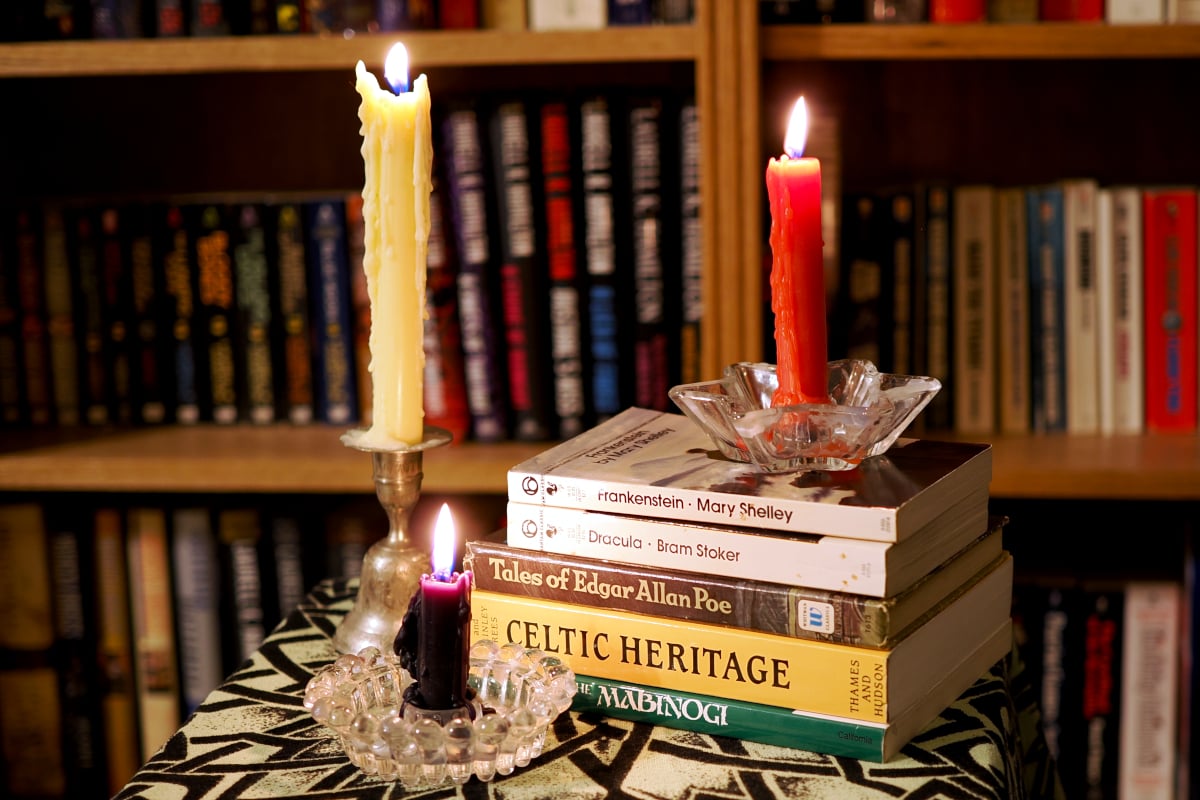
Many of us consider ourselves witches. Witches are the ultimate outsiders. Witches live how they want to live and do what they want to do, even if it hurts the resale value. Witchcraft is far more than aesthetics, but the aesthetics of witchcraft are pretty cool. Cauldrons and black hats and cottages full of herbs deep in the forest are no one’s idea of minimalism.
Neither is dangerous magic.
As Pagans and witches we can show the mainstream a better way to live, simply by being ourselves as loudly as we can.
Playing small won’t keep you safe
Yes, it’s dangerous out there. For some, the risk is far greater than disapproving stares from the arbiters of popular fashion or a nasty letter from the HOA. I’m the last person to encourage anyone to take needless risks. You must do what you think is best for yourself.
But at some point, the price of safety is your soul.
And as Florence Welch sings:
I no longer try to be good
It didn’t keep me safe
Like you told me that it would
If you’re going to go down, you might as well go down flying your own flag instead of mindlessly following some AI-driven algorithm.
Banish minimalism
So let’s banish minimalism from our houses, our closets, and our entertainment. Cover your walls in paintings, or posters, or your own photographs (I have all of the above in my house). Get a beautiful comforter for your bed… that isn’t white or beige (mine is a wine-colored paisley – it’s 30 years old and I’m going to make it last another 30 because I love it).
Eat the good chocolate and drink the good wine. Grow your hair long, color it wild colors… or cut it all off. If you don’t like it, it will grow back. What do you want?
Forget the music with the overproduced earworm lyrics. Find the music that makes you feel alive.
Watch movies that make you go “wow” – the ones that are visually amazing, not the ones that overwhelm you with camera tricks or CGI. For me that’s the Edgar Allan Poe movies of Roger Corman and Vincent Price, the better example of Italian giallo (especially those by Mario Bava and Dario Argento), pretty much everything Hammer Films ever made, and of course, Bram Stoker’s Dracula by Francis Ford Coppola. More recently, Nosferatu, Sinners, and Guillermo del Toro’s Frankenstein.
There are beautiful movies in every genre. If horror isn’t your thing, find that ones that feed your soul.
Most importantly, read stories about impossible people doing impossible things. And then start doing what you’ve always been told was impossible, even though deep down you know it’s not.
We need not spend a ton of money to do this. It doesn’t cost any more to paint your bedroom green than to paint it white. So much minimalist fashion is artificially expensive, plus true luxury lasts. And you don’t have to do it all at once. Just stop buying boring stuff and buy beautiful stuff when it’s time to replace it.
Embrace maximalism
There is value in monasticism – some are called to a life of simplicity and discipline. If that’s your calling – if that’s your choice – then I wish you well… especially if you’re doing it from a Pagan perspective.
But for the rest of us, let’s live as fully and as deeply and as loudly as we can.
Forget the corporations trying to sell overpriced blandness as luxury. Find beauty and embrace it.












 Ad-Free & Subscriber Log-In