


Let’s talk about reincarnation for a minute. When most people hear the word, they either think of it as a beautiful idea of second chances or as some sort of spiritual recycling program.
But, from a Quantum Theology perspective, the whole concept takes on a different shape.
First, let’s acknowledge that reincarnation has problems.
One of the biggest issues I have with reincarnation is the question of memory. I mean, if you really lived another life, why don’t you remember it? Isn’t the whole point of experience to learn and grow?
What good is a second (or third or fiftieth) life if you have amnesia every single time? From a purely logical standpoint, reincarnation doesn’t quite deliver on the promise of progress because the lessons don’t carry over in any conscious way.
And yet—there are those fascinating stories of young children who remember incredible details about past lives.
Some can recall names, places, even circumstances of their deaths, which are later verified. That’s hard to dismiss. These accounts suggest that something beyond our current understanding is going on. Maybe consciousness itself isn’t bound to one lifetime.
Take the case of James Leininger, for example. As a toddler, James began having vivid nightmares of crashing in a plane. Over time, he started giving specific details—names, aircraft types, and even a ship called the Natoma Bay. His parents researched and discovered that James was describing the life of a WWII fighter pilot named James Huston Jr., who died in combat. Too much detail, too much accuracy, for it to be dismissed as coincidence or imagination.
Or consider Shanti Devi, a young girl in India during the 1930s, who insisted she was once a woman from a nearby town who had died in childbirth. She remembered the name of her husband, the layout of her house, and even the hidden spot where she kept money. Investigators, including Mahatma Gandhi, were so impressed by her knowledge that her case became famous worldwide.
Then there’s the story of Cameron Macaulay from Scotland. At just two years old, Cameron began talking about a past life on the Isle of Barra, 220 miles away. He described his old house, his black-and-white dog, and even remembered his father’s name. Researchers took him there, and he recognized the house he claimed to have lived in—details later confirmed by the family who had lived there.
These stories suggest that reincarnation, or at least something like it, has enough evidence to keep us from dismissing it out of hand. Still, they raise just as many questions as they answer.
But then we hit what I call the Cleopatra problem. Why is it that so many people “remember” being Cleopatra, or Napoleon, or Thomas the Apostle? Very few ever claim they were a farmer in the 1200s who died of the plague.
In fact, I have met more than one person who claimed that they were the Apostle Thomas in a previous life. So, how can this be?
Well, from a Quantum perspective, maybe what people are tapping into isn’t their own soul’s journey, but rather a kind of collective memory, or what Carl Jung might call the collective unconscious.
In other words, we might say these people are tuning into an informational field that contains all possibilities, all identities, all timelines.
For example, one of my favorite science fiction authors, Philip K. Dick, said that he had the experience of being himself – the SF author living in California in the 1970’s – and (at the same time) being a disciple of Jesus named Thomas living in Palestine in the First Century. Not that he remembered being Thomas back then, but that he was experiencing that reality in the now. He also felt like he was still himself, but also this other person.
This is slightly different, but from a Quantum perspective, maybe Phil was tapping into the eternal “now” experiences of the other person who, according to Quantum Physics, isn’t “other” at all, but just one of many different expressions of the same Quantum Field.
Which leads to another question: why don’t people remember living other lives in the future? Because, if consciousness isn’t limited by time – and if Time itself is an illusion – why can’t people experience other lives they lived a hundred years from now?
Maybe the reason is that, in this dimension, we experience time linearly, but outside of time, all past, present, and future already exist simultaneously.
In other words, memory of the “future” would be just as accessible—but we’re not wired to perceive it while in this physical body.
I’ve also wondered why some people – like me – don’t remember more of our supposed past lives at all. What’s the use of reincarnation and living all those past lives if we can’t remember anything about them?
Here’s a thought: What if the reason we don’t need to remember our past lives now, in this life, is because this life isn’t where we necessarily learn the lesson. What if we don’t review our life and learn what we need to learn until after we return to the Divine Consciousness (Quantum Field)?
It’s sort of like the way a football team plays the game, and then afterwards they review the tape to see what they did wrong, what they got right, and then the coaches draw up plays to improve for the next game, and then that cycle just keeps on going.
Maybe our reincarnation experiences are like that. We live our lives (play the game) without stopping to review our progress. But, when our life is over, then we get to review the tape, learn what we did wrong and what we did right, and then we jump back into another life to play again.
If that’s the case, then, once we return here, the slate is wiped clean—not as a punishment, but as a way of focusing our full attention on the now. Otherwise, we’d be overwhelmed by the noise of countless previous stories playing in our heads.
So, seen through the lens of Quantum Theology, maybe reincarnation is less about one soul hopping bodies like musical chairs and more about consciousness moving through a field of infinite possibilities. What some call “past life memories” may be crossovers, bleed-throughs from other expressions of the same Source we all share.
In this view, resurrection—not reincarnation—is the deeper mystery. Not that we come back again and again as different people, but that all of us are raised, renewed, and rejoined in the wholeness of the Divine that exists beyond space and time.
Maybe reincarnation is a metaphor. Maybe it’s an echo of the truth that consciousness never dies. Or maybe it’s a dim glimpse into the quantum reality that all lives, all times, and all selves are happening at once, and maybe, every so often, we catch the whisper of another life that isn’t quite ours—but also isn’t entirely separate.
What do you think?
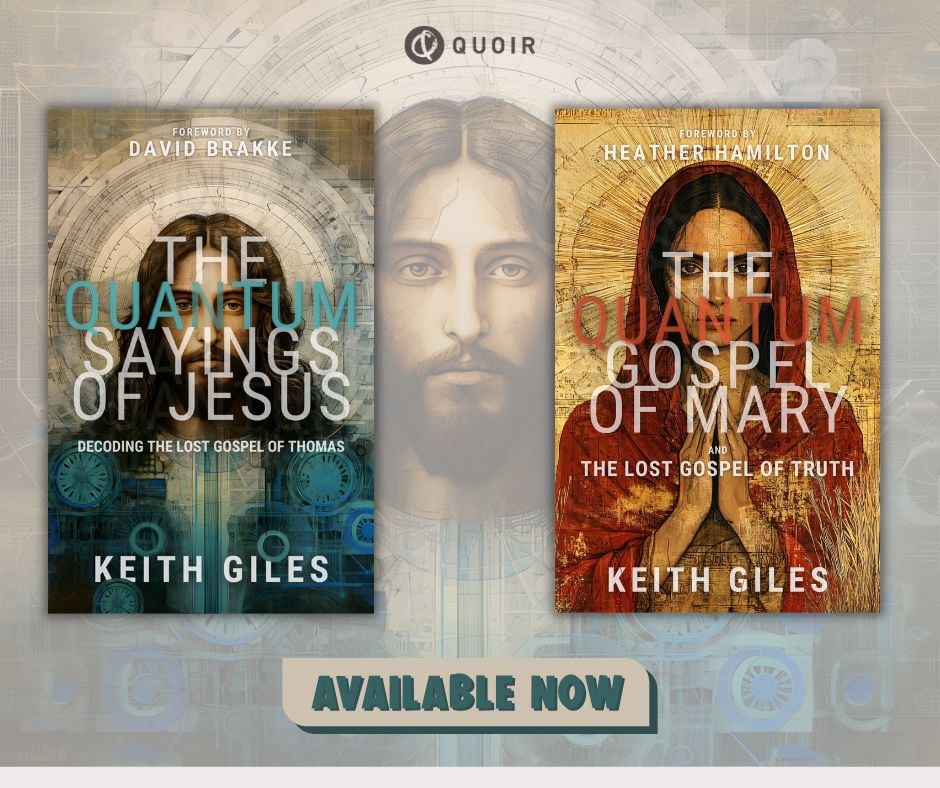
My new book, “The Quantum Gospel of Mary and the Lost Gospel of Truth” is now available on Amazon.
The book from Keith Giles, “The Quantum Sayings of Jesus: Decoding the Lost Gospel of Thomas” is available now on Amazon. Order HERE>









 Ad-Free & Subscriber Log-In