

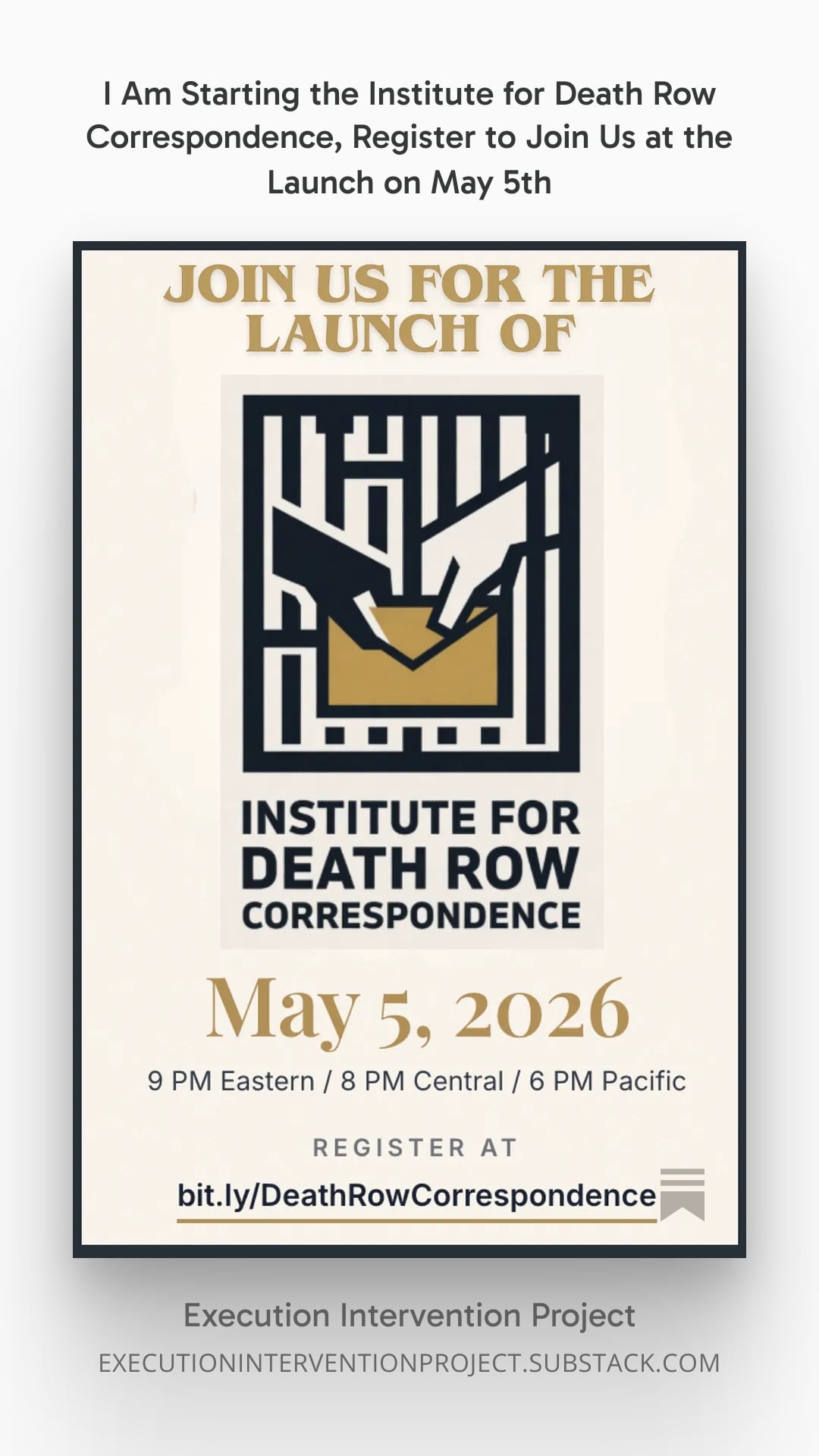
The Institute for Death Row Correspondence launches May 5, 2026, at 9 PM Eastern / 8 PM Central / 6 PM Pacific. Join us at bit.ly/DeathRowCorrespondence.
___________
Guest post from Dr. Wendy Ramage, Dean of the Institute for Death Row Correspondence
There is a particular kind of loneliness that most people never talk about. It belongs to the person who has been faithfully writing someone on death row for years — showing up month after month, carrying another human being’s story, sitting with their grief — and has no one in their own life who truly understands what they are doing or why.
I have met so many of these people. They are some of the most faithful, quietly courageous individuals I know. And almost all of them are doing this work completely alone.
That is what the Institute for Death Row Correspondence is being built to change.
The Institute is a new program of the Execution Intervention Project, rooted in the belief that no human being should be allowed to disappear, and that correspondence sent faithfully and consistently is one of the most powerful acts of spiritual resistance available to ordinary people. I serve as Dean, and our launch is May 5, 2026.
We do three things.
We connect. The Institute matches correspondents with people on death row who have asked to be written to, and we provide the training and resources to help those relationships take root and last. Most people who feel called to this practice don’t know how to begin. They don’t know the rules, the rhythms, or the realities of writing into a correctional institution. We do. And we walk alongside them from the first letter forward.
We sustain. We organize support groups for people who are already writing, because this work is easier to carry in community. Correspondents need a place to process what they are experiencing, stay accountable, and keep going when it gets hard. When you are writing someone whose execution date has just been set, good intentions are not enough. You need people who understand from the inside what you are holding.
We advocate. We help correspondents show up for the people they write to, whether that means understanding a legal situation, raising a public voice, or standing with someone as their case reaches its final stages. Writing a letter is where most people begin. It is rarely where they stop.
My own road to this work was not straight. I was told more than once that I was not supposed to still be here. Doctors said the words we dread to hear, and I kept living. That experience shaped the way I move through every correspondence now. It taught me what it means to be vulnerable, to need to be seen, to need someone to insist that you are still part of the human community. I have said before that I just don’t consider anybody else all that different from me. That conviction is the root of my writing practice, and it is the root of this Institute.
My colleague and co-author Jeff Hood, who serves in the broader Execution Intervention Project, said it this way: “I have been doing this work long enough to know that correspondents are some of the most faithful abolitionists in this country and the most invisible. The Institute for Death Row Correspondence changes that. I am thrilled that the Execution Intervention Project is building this home, because the people who write letters deserve the same sustained support they give. This is long overdue, and I believe it will change lives on both sides of the wall.”
Jeff is right. And what we both know is that the death penalty depends on a particular kind of forgetting. It depends on the public being able to move through its days without thinking too carefully about the people in cells. Every letter written across that wall makes the forgetting harder. A correspondent who has been writing for years cannot unknow the person they have been writing. They cannot return to thinking in abstractions. That is its own kind of transformation, and it ripples outward.
This is a spiritual practice as much as it is an act of advocacy. It changes the person who writes as surely as it reaches the person who receives. We call it a discipline because that is what it is: a long, faithful, often quiet commitment that works on you over time, shaping your attention, your compassion, and your understanding of what it means to be human.
If you are already writing to someone on death row, come find us. You do not have to carry this alone.
If you have felt called to begin and haven’t known how, now is the time. We will help you.
If you are curious about what this practice is and what it asks, we would love to have that conversation.
The Institute for Death Row Correspondence launches May 5, 2026, at 9 PM Eastern / 8 PM Central / 6 PM Pacific. Join us at bit.ly/DeathRowCorrespondence.
You can also reach me directly at [email protected].
Writing a letter is where most people begin. It is rarely where they stop.
Come begin.
Dean Ramage













 Ad-Free & Subscriber Log-In