

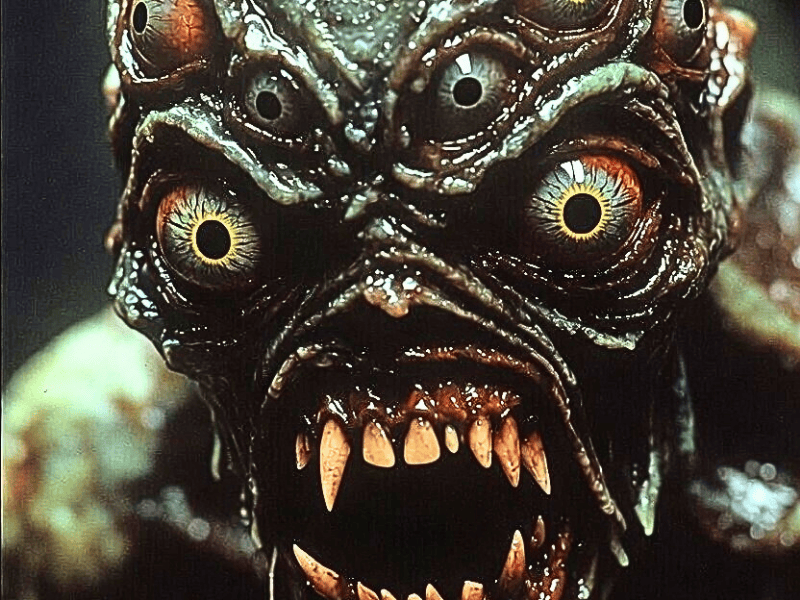
The Monster We Make: On the Archetype of Evil and the Logic of the Death Penalty
There is a sound in the dark. You don’t know what it is. Your body knows before you do…the breath held, the muscles tightening, the sudden acute awareness of your own heartbeat. Your mind catches up a second later and begins its work of explanation, but the explanation comes after the fact. The fear was already there, already complete, already certain that something was wrong. That certainty is not the product of reason. It is older than reason. It lives in a place where language hasn’t reached yet, where what you feel is not a thought but a recognition: something is here that should not be here.
This is where the monster begins. Not in mythology, not in folklore, not in the horror film…but in the body, at three in the morning, in the moment before you know what made the sound. The monster is a nervous system event. It happens before we think. And the terrible, largely unexamined truth is that we have built a legal system on top of it and called it justice.
The death penalty presents itself as the most solemn and deliberate act a civilized state can perform…the careful conclusion of a rational process, a measured response to the most extreme crimes. But beneath the protocols and the procedures, beneath the witnesses and the documentation and the clinical machinery of execution, something pre-rational is operating. Something that does not belong to the courtroom at all. It belongs to the dark, to the sound we couldn’t name, to the ancient and inarticulate certainty that some things cannot be allowed to exist among us.
When we execute someone, we are not merely punishing. We are slaying a monster. And we have been doing it so long and so ritually, that we have forgotten that is what we are doing.
What a Monster Is
A monster is not simply something dangerous. Storms are dangerous. Illness is dangerous. We do not call them monsters in the deep sense. A monster is something that troubles the categories by which we organize the world. It is something that looks almost human…or once was human…but has crossed a threshold we cannot name precisely yet feel acutely. The monster stands at the border between the human and the inhuman and its horror comes precisely from that position. It should not exist. Its existence is an offense against the order of things.
Every culture has produced monsters and they are not random. They cluster around the same anxieties: what lies beyond the community’s edge, what might lurk inside a familiar face and the deepest anxiety of all…what we ourselves might become. The monster is always partly a mirror. We construct it from the fragments of ourselves we most need to disown.
This is why the monster must be destroyed. It is not enough to cage it, because the cage implies the monster is still a something, still a participant in the world. The monster’s existence is the threat. As long as it lives, the boundary between human and inhuman remains permeable. Destruction is not punishment. Destruction is restoration…it seals the boundary, cleanses the contamination and allows the community to believe again in its own coherence.
How the Archetype of Monster Enters the Courtroom
Capital cases are not decided in a vacuum. They are decided by human beings who carry within them everything human beings carry…including the deep cognitive and emotional grammar of the monster story. And the legal apparatus, for all its procedural scaffolding, does not neutralize this grammar. It channels it.
Consider the language used to describe defendants in capital cases. They are almost never described in terms of their biography, their psychology, their situation. They are described in terms of their acts and those acts are described in language that invokes the archetype almost ritually: predator, monster, pure evil, an animal, beyond redemption. These are not casual word choices. They are the vocabulary of a specific and ancient operation…the operation of placing a person outside the category of the human, of moving them across the threshold so that what is done to them no longer counts as something done to one of us.
Once the threshold is crossed, destruction becomes not just permissible but required. The monster cannot be rehabilitated because rehabilitation implies the possibility of return and the monster’s defining feature is that it has gone somewhere from which return is impossible. The monster cannot be understood too deeply because deep understanding threatens the clarity of the boundary…it begins to reveal the human in the inhuman, the familiar in the strange, the self in the other. The monster must remain opaque. Its opacity is what justifies its elimination.
This is why evidence of a defendant’s childhood trauma, mental illness, or circumstance of deprivation is so often experienced in capital trials not as humanizing but as threatening. It threatens the archetype. It introduces ambiguity where the archetype requires clarity. Jurors who have been primed to see a monster find such evidence emotionally dissonant…not because they are cruel, but because the story they are operating within has no place for it. The monster does not have a backstory. The monster simply is.
The Ritual Beneath the Procedure
The death penalty has always had the character of ritual more than punishment. Public executions were not merely deterrents or acts of retribution…they were civic ceremonies, occasions for collective catharsis, moments in which the community physically expelled what it had judged to be beyond the pale of humanity. The crowd that gathered was not simply curious. It was participating in something. It was confirming by its collective presence that the world had been set right.
We have privatized and medicalized this ritual…moved it behind walls, replaced the gallows with the gurney, surrounded it with observers and official documentation…but the ritual logic persists. The careful protocols of a modern execution are not signs that we have left the ritual behind. They are signs that we are conducting it with great seriousness, that we are performing it properly. The solemnity of an execution is not merely legal gravitas. It is the solemnity of a ceremony that a community has always felt to be important in a way that exceeds explanation.
Why does it exceed explanation? Because it is operating beneath the explanations we give. When people are asked why they support the death penalty, they give reasons…it deters crime, it provides closure for victims’ families, some crimes simply deserve it. These reasons are real, but they do not fully account for the force of the conviction behind them. The force comes from something pre-rational, something that the reasons are retrofitted to justify. The force comes from that ancient feeling…the sound in the dark, the body’s certainty before the mind arrives…that some things cannot be allowed to exist among us.
The Politics of Who Becomes a Monster
The monster archetype does not fall randomly. It has always been shaped by the power structures of the societies that produce it. In a stratified society, the archetype tends to attach to those who are already marginalized, already rendered strange, already placed at the edge of the community’s self-definition. To be poor, Black, foreign, mentally ill, socially isolated…to be any of these things is to be closer to the threshold the monster inhabits. Not because any of these things makes a person more dangerous, but because the archetype requires a figure who is already partially outside and existing social hierarchies pre-designate certain people for that position.
This is why the death penalty has been applied with such staggering unevenness across lines of race and class. It is not simply bias in the legal system, though that bias is real. It is something deeper: the archetype latches onto those the culture has already learned to perceive as other. The mental work of constructing a monster is easier when the raw material is a person the community has already been conditioned not to fully see.
This means that the death penalty is not merely an instrument of legal terror. It is an instrument of social sorting. It tells us, over and over, who belongs inside the human community and who has stepped far enough outside that destruction is the appropriate response. Every execution is an implicit statement about the shape of that community…about who counts as human enough to be protected and who has crossed into the dark.
What Deconstruction Requires
To deconstruct the monster archetype is not to deny that terrible things happen, or that evil is real. It is to insist that we are catastrophically bad at identifying where evil ends and a person begins…and that the legal machinery of capital punishment is among the worst instruments ever devised for making that distinction.
If evil is a genuine force that can corrupt and inhabit human beings, then a person can be under its influence without being defined by it in their essence. The tradition that takes evil most seriously…that insists the devil is real, that harm is not merely psychological or sociological but spiritual…also insists on the possibility of redemption even for the gravest sinners. To declare a person beyond redemption and execute them is to make a claim about their soul that no human institution has the standing to make. It is to confuse the sin with the sinner, the corruption with the corrupted. It is, in the deepest sense, a theological error wearing the clothes of jurisprudence.
There is a darker irony still. If the devil is real, then the certainty with which we identify monsters may itself be a form of deception. History is littered with people executed as monsters…by inquisitions, by states, by mobs…who were not. The monster archetype, deployed by human fear and confirmed by social power, has killed the innocent with the same ritual solemnity it has killed the guilty. A real devil would find it extraordinarily useful.
Deconstruction asks us to sit with the discomfort that the monster story exists to relieve. When we declare someone a monster, we contain the horror. We explain it. We place it outside ourselves, outside the human, in a category that can be destroyed and disposed of. We go back to sleep.
But that sound in the dark…the one the body answered before the mind arrived…it was never really about the person in the cell. It was about us. About what we carry. About what we are capable of and cannot bear to look at directly. The monster we make and kill is not the source of that fear. It is our attempt to externalize it, to give it a body, to drive it out of the community and out of ourselves through an act of sanctioned violence we have dressed in the language of law.
The sound remains. It will always remain. No execution has ever silenced it, because no execution has ever addressed what it actually is…the knowledge, felt in the body before the mind can refuse it, that the darkness is not out there.
It is in here. It has always been in here. And the only honest response to that knowledge is not to find a monster to destroy, but to reckon, seriously and without flinching, with what we are.
That reckoning is what justice might actually look like.
*
*
*
*
*If you would like to support the Execution Intervention Project (the organization that financially supports Dr. Hood’s work), click here.












 Ad-Free & Subscriber Log-In