


“The powers can’t see those who have put on the perfect light, and they can’t bind them. All will be clothed in light when they enter into the mystery of the sacred embrace.
“If woman had not been separated from man, she would not die with the man. Her separation was at the origin of death. Christ comes to repair the separation that existed since the beginning by uniting the two again. Christ gives life to those who died from separation by reviving them in union.
“The man and the woman become one in the Bridal Chamber, and those who have known this sacred embrace will never be separated again. Eve separated from Adam because she did not unite with him in the Bridal Chamber.” (The Gospel of Philip, vs. 77-79)
The only way to make sense of this passage is to take it out of the literal, or even the Biblical framework. We have to start with the Valentinian concepts that are being used to communicate the meaning to us. Otherwise, when we come to the conclusion of this section, the phrase, “Eve was separated from Adam because she did not unite with him in the Bridal Chamber” will make no sense at all.
Does Philip intend to say that Eve was created from Adam’s rib because she didn’t have sexual intercourse with him? How would that work if they were both technically in the same body? And wouldn’t this also suggest that the original Oneness that Adam and Eve once experienced somehow wasn’t good enough to qualify as “uniting with him in the Bridal Chamber”?
It also seems quite confusing for Philip to say, “If woman had not been separated from man, she would not die with the man,” since being one with Adam would necessarily entail experiencing everything that Adam experienced, especially death. Are we to assume that, if Adam and Eve had remained as One that Adam would die but Eve would not? That wouldn’t make any sense, would it?
But, again, these confusions are the result of reading the Gospel of Philip through the literal lens. This is our clue that something else must be going on here. There must be another way to understand what is being communicated. And there is.
Philip uses the language of Light, Union, and the Bridal Chamber to describe a profound spiritual transformation. Like most Valentinian texts, it speaks in symbols about our inner restoration of Oneness.
So, when this passage begins by saying, “The powers can’t see those who have put on the perfect light,” it’s about how the forces that blind us to our true Christlike identity are powerless against those who have awakened to the reality of our shared Divinity. The mystery of the sacred embrace is how this light is received. It is an inner union with the Divine Presence which is symbolized by the union of Adam and Eve. In other words, this is not about Adam or Eve. It’s about you and Christ.
“If the woman had not been separated from the man,” is not about the literal separation of Adam and Eve. It’s not about gender identity. It’s about the two halves of the human soul which have been fragmented into an illusion of duality. The separation here is between us and God. It’s about our perception of ourselves as separate from one another. This separation is what brings death. Why? Because to be cut off from the Source of Life (the Divine) is to die. To believe that you are not connected to God is death. To act as if you are not One with the rest of the Human race is the ultimate form of exile. It is a spiritual form of solitary confinement.
And why did Christ come? “Christ comes to repair the separation.” Christ enlightens us and reunites what has been divided. Christ restores the original wholeness that existed in the beginning. This union is not merely conceptual. It is experiential.
As we’ve already seen, the Bridal Chamber is a core sacrament of Valentinian Christianity. It represents the end of duality and the restoration of our union with God and with all things. As Jesus puts it, “So they are no longer two, but one flesh. Therefore, what God has joined together, let no one separate.” (Matthew 19:6)
This moment when we become one is when we are no longer dead to the reality of our life in Christ. Once we enter this state of being, we will never be separated again and our lasting awareness of Divine union cannot be undone.
So, this is not about Adam or Eve. It’s about us. Eve represents the receptive soul. Adam represents the rational soul. Their separation symbolizes the human condition. The Bridal Chamber is where this fracture is healed. It is where the Adam part of us and the Eve part of us are restored in Christ as we enter into a union with God that is grounded in experiential (ginosko) Oneness.
This passage explains how Humanity suffers because of the illusion of separation between us and God and, therefore, between us and everyone else. Christ heals this condition by clothing us in light, making us whole, and awakening us to what is true: We are never separate.
The Bridal Chamber is where the divided human being becomes one again and where the Divine Union is restored once and for all.
**
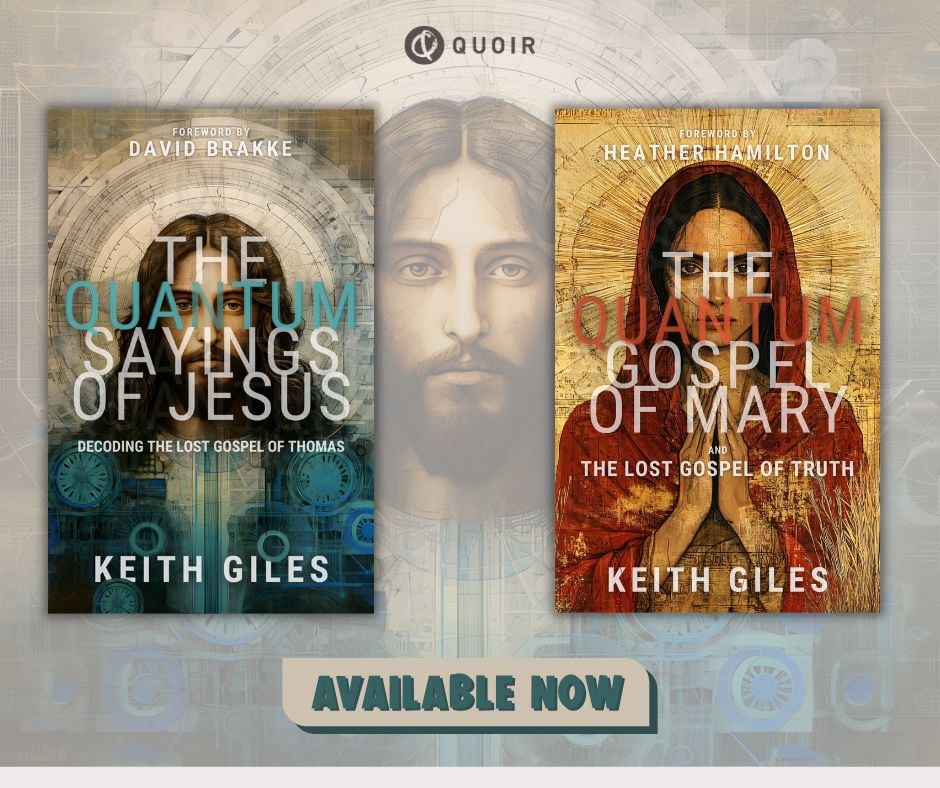
My new book, “The Quantum Gospel of Mary and the Lost Gospel of Truth” is now available on Amazon.
The book from Keith Giles, “The Quantum Sayings of Jesus: Decoding the Lost Gospel of Thomas” is available now on Amazon. Order HERE>










 Ad-Free & Subscriber Log-In