

 In a recent conversation with Dr. Shaleen Kendrick on my solo podcast, SECOND CUP WITH KEITH, I learned about a concept that feels weirdly aligned with what I’ve been learning from Spiral Dynamics and it’s especially relevant to our moment in history right now: It’s the Axial Age.
So, what began as an historical theory about a transformative period in ancient human consciousness now offers a new lens for understanding why our world feels unstable, accelerated, and full of both danger and possibility.
Are you feeling tired of the current news cycle? Exhausted by the non-stop daily chaos of your Instagram feed?
As Dr. Kendrick explains, it’s all because we’re living through something called the Second Axial Age.
A Little Background
The term Axial Age was coined by the German philosopher Karl Jaspers in 1949, who observed that between roughly 800 and 200 BCE, multiple civilizations across the globe underwent profound spiritual, philosophical, and moral awakenings—independently and almost simultaneously.
Dr. Kendrick describes Jaspers’ insight this way:
“This period of time marked a pivotal axis around which human history turned.”
As he explains, this was a time in history when a variety of people across Greece, Israel, India, and China were all asking new kinds of questions about reality, selfhood, ethics, and transcendence. People like figures Socrates, the Hebrew prophets, Buddha, Confucius, and others were starting to push humanity across an invisible threshold in awareness.
What It Means
According to Dr. Kendrick, the key to understanding the Axial Age is not geography or religion, but consciousness.
As she explains: “When we’re talking about first axial age (and the) second axial age… what we’re talking about is consciousness.”
The First Axial Age represents a shift where human beings began to experience themselves as individual selves, capable of reflection, morality, and personal spiritual insight. “Consciousness within the first axial age,” says Kendrick, “was asking the question, who am I?”
Prior to this, identity was largely tribal and collective. But during this era, the interior life became central.
The idea of the self, the soul, moral responsibility, and personal enlightenment all took root.
This was a revolution of human consciousness.
This is also when the foundations of our major religious traditions were laid, as Kendrick says, “We get basically all of our major world religions in that First Axial age, including Judaism, Confucianism, Buddhism.”
These traditions were answering the central First Axial question: Who am I?
But something happened after this explosion of insight.
What Happened Next
Dr. Kendrick notes that following the First Axial Age, the insights of these sages and prophets became formalized and systematized. “In between around the year two hundred all the way up through about the fifteen hundreds, we have what is called the institutionalized period,” she says.
This is when our questions about consciousness became solidified into doctrines. The once fluid exploration of meaning became bogged down in religious and philosophical systems.
The focus eventually shifted from the excitement of discovery to to the calcification of preservation.
As the answers hardened, the institutions solidified.
Now, Dr. Kendrick argues, we are crossing another threshold.
Enter the Second Axial Age
“The second axial age is how we start to understand consciousness emerging through relationship,” says Kendrick.
Think of it this way: If the First Axial Age awakened the individual self, the Second Axial Age is awakening us to the reality that the self is not isolated at all.
Science, technology, ecology, and global communication are forcing us to confront an uncomfortable truth: We are radically interconnected.
“Quantum physics, evolutionary science, all of these are now starting to help us realize that we’re not individuals,” Kendrick says.
“The question of the Second Axial Age is no longer Who am I? but something far more urgent. The central question is actually, will we survive as a species?”
Accelerated Transformation
Dr. Kendrick also points out that one of the byproducts of this shift in human consciousness is the accelerating pace of change. “The second axial age is a super cycle,” she says, “speeding up how we’re living.”
So, the whiplash you’re experiencing as the result of today’s technological advancement, global crises, climate change, political upheaval, and social transformation are not random chaos. They are symptoms of a consciousness outgrowing the structures built for a previous era.
The institutions we originally formed to answer “Who am I?” are now struggling to answer the question, “How do we live together?”
What Are The Implications?
The First Axial Age taught us about the dignity of the individual. The Second Axial Age is teaching us about the necessity of relationship.
This has profound implications:
-
For religion: Moving from dogma to living interconnected
-
For politics: Moving from nationalism and partisanship to shared planetary responsibility
-
For spirituality: moving from private enlightenment to collective spiritual survival
-
For identity: moving from “us vs them” to “we”
Bottom line: We are being invited—perhaps forced—into a new level of awareness.
This is not a rejection of the First Axial Age. It’s the fulfillment.
The question we have to answer now is no longer merely spiritual or philosophical. It is existential.
Will we learn to live as an interconnected species on a shared planet? Or will the institutions and mindsets of the old age prevent us from making the leap?
Jaspers believed the First Axial Age was a turning point in human history. Dr. Kendrick suggests we are standing at another one.
Unlike the First Axial Age, this Second Axial shift is not primarily political or technological. It is a shift in consciousness.
It means we need to experience a radical metanoia.
It means we all need to think differently about everything.
From the inward to the outward.
From the individual to collective survival.
From personal autonomy to interdependence.
The real work of this moment is recognizing that consciousness itself is evolving, and we are living inside that evolution, (or maybe it’s a revolution).
We are at a crossroads between clinging to the old way of thinking that will destroy us, or embracing a new way of seeing that saves all of us.
So, once again, the question of this new Second Axial age is simply this: Will humanity survive?
And the answer to that question remains to be seen.
If we can awaken to our shared humanity and our shared divinity, then maybe we can make it.
If we can’t, then nothing we do will make any difference.
We either survive together, or we die alone.
**
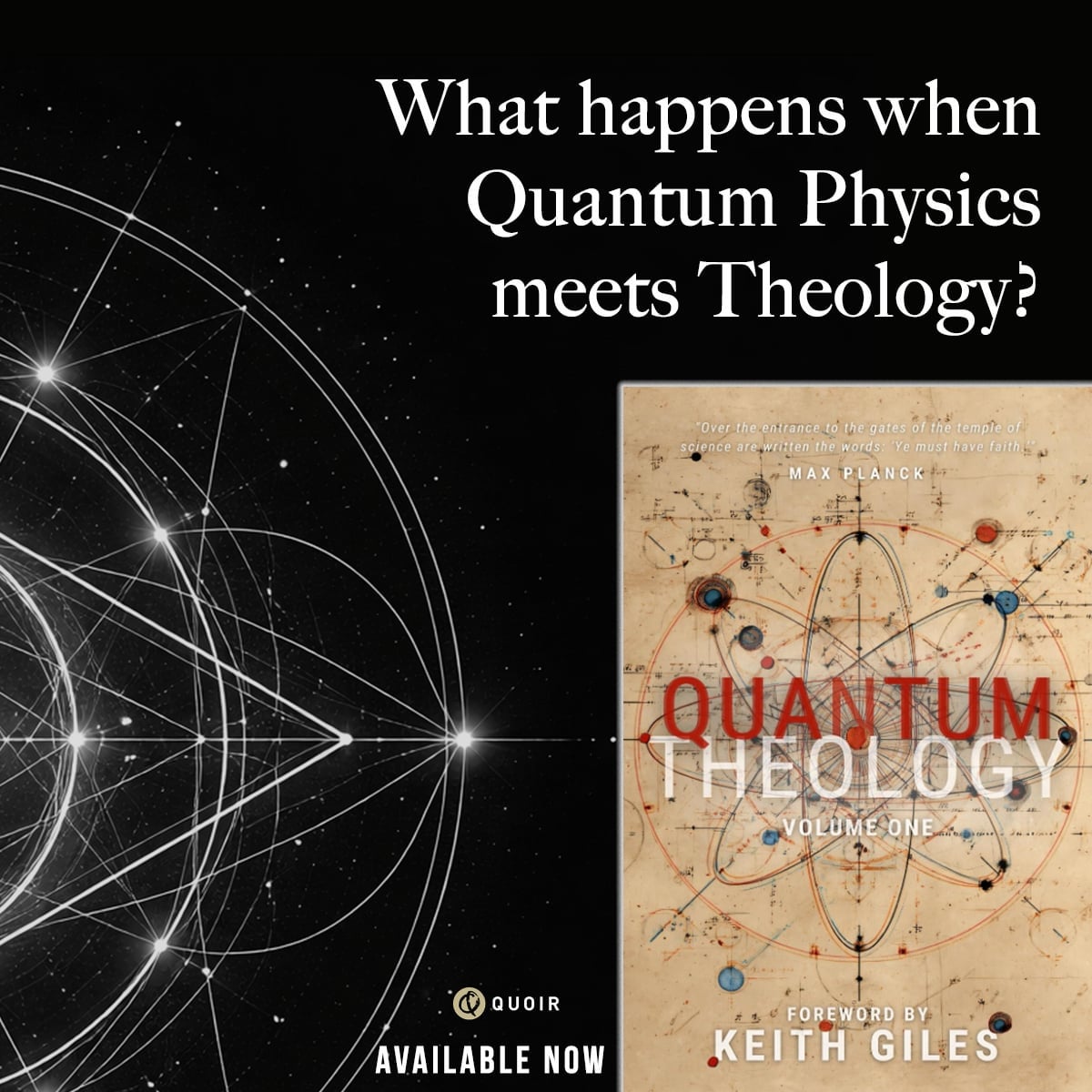
Quantum Theology: Volume One brings together an extraordinary and diverse group of scientists, mathematicians, theologians, mystics, authors, and cultural commentators to explore one of the most provocative conversations of our time: What happens when Quantum Physics and Theology begin to overlap?
Edited and curated by author Keith Giles, this book explores the intersection between science and faith.
My book, “The Quantum Gospel of Mary and the Lost Gospel of Truth” is now available on Amazon.
The book from Keith Giles, “The Quantum Sayings of Jesus: Decoding the Lost Gospel of Thomas” is available now on Amazon. Order HERE>














 Ad-Free & Subscriber Log-In