


The foremost theological crisis in the history of Christianity occurred in the year 325. It was about the identity of Jesus of Nazareth, arguably the founder of Christianity, who came to be known by his immediate followers as Jesus Christ, but later by the Catholic Church as both God and man.
In four days, Pope Leo XIV will attend a four-day celebration of the Nicene Creed, drafted in 325 A.D. and thus 1,700 year ago. The pope issued a statement about this in preparation for the gathering. In it he says, “no mortal being can, in fact, defeat death and save us; only God can do so.” The pope seems to mean that Jesus had to God to save us if not to arise from the dead. But the Bible says God is the one who saves people and that he does so on the basis of their faith in Jesus’ atoning death and his resurrection. Also, the Bible teaches that at the end of this age, God will raise all deceased believers from the dead, giving them resurrection bodies like that of Jesus. If Jesus had to be God to arise from the dead, then will that make us Gods? Hardly! But, in my saying all of this, I’ve blogged before that I like this Pope Leo.
[For example, see my posts, Why Is this Pope Called Leo?, “Hail to Pope Leo in Calling Christians to Unite.”
Was Jesus of Nazareth the Christ?
During the time of Jesus of Nazareth, especially during his interrogation by the Jewish Sanhedrin (Council), but also for decades thereafter an argument existed between Christians and Jews which persists to this day. It was whether or not Jesus was the divinely promised Messiah whom God would send as the king of Israel. The early disciples of Jesus, who were Jews, claimed that Jesus was that Messiah. The Jews claimed vehemently that he was not and that he was therefore an imposter. Because when the Sanhedrin High Priest Caiaphas asked Jesus, “Tell us if you are the Son of the Blessed One,” referring to God, Jesus answered in the affirmative. Caiaphas then charged him blasphemy, thus worthy of death. Yet it was not against Torah for any Jewish man to claim that title. Nevertheless, these Jews then took the accused to Roman Governor Pilate and pressured him to have Jesus crucified, which he did.
The Meaning of “Christ”
The word “christ” is the English translation of the Greek word christos. Since all New Testament documents originally were written in Greek, christos appears often in them and applied to Jesus. But christos is the Greek rendering of the word mashiach in the Hebrew Bible, which Christians call the Old Testament. Mashiach means “anointed one,” and it is translated “Messiah” in the English language. Mashiach and other nouns appear in the Hebrew Bible to refer to a special person whom God would send to be the King of Israel. When Jesus was crucified, Governor Pilate had written in three languages on the headboard attached to Jesus’ cross, “(This is) the King of the Jews” (Mark 15.26; Luke 23.38).
Post-Apostolic Church Fathers Said Jesus Is God
But in the 2nd century A.D., some Christian theologians, later designated as “church fathers” who also were writers, began to go beyond the New Testament designation of Jesus as “Christ” or “Messiah” by also claiming he was “God.” They didn’t mean that Jesus was equal to God in divinity. Nevertheless, they identified Jesus as both man and God, but a lesser God. Origen, the first Christian systematic theologian, actually wrote that Jesus was a “second God” even though none of the New Testament writings say anything like that.
Now, Jesus had taught that God is “one,” thereby affirming the Jews’ credal statement called “the Shema.” It reads, “Hear, O Israel: The LORD [YHWH] our God, the LORD [YHWH] is one” (Deuteronomy 6.4 NIV). This statement had set the Israelites of antiquity apart from the surrounding pagan nations that were polytheistic and thus worshipped many “gods” and idols. Jesus’ classic statement about this, which he uttered in his prayer right before is arrest about God the “Father,” is: “This is eternal life: that they may know you, the only true God” (John 17.1, 3). So, Jesus recognized “God the Father” as “the only true God.” And Jesus then distinguished himself from God the Father by saying of himself, “and Jesus Christ whom you have sent.”
Jesus Never Said He Was God
Search the New Testament sayings of Jesus, recorded in the four gospels, and you will not find any statement by Jesus in which he identifies himself as “God” or anything like that, such as that he is “divine” or “deity.” Thus, the apologist church fathers of the 2nd and 3rd centuries went beyond anything Jesus had said of himself by identifying him as God. They also cited Jesus’ identification as “the Son of God” in the New Testament as a further indication that he was this lesser God who was essentially subordinate to God the Father. They also identified Jesus as “the Logos Son,” thereby drawing from the Gospel of John calling Jesus “the Word” (Greek logos in John 1.1).
Arius and Bishop Alexander Disagree
In the early 4th century, a Catholic “presbyter” (priest) in Alexandria, Egypt, named Arius was spreading this teaching about Jesus being the Logos Son and that God the Father created this preexistent Logos Son “before the creation of the universe. Then Arius deduced from this that “there was time when the Logos Son was not,” meaning he did not exist.
Alexander was the bishop of that region in Egypt, centered in Alexandria, and he was the third most powerful bishop in the Catholic Church. He strongly opposed Arius’ teaching about Jesus as the preexisting Logos, claiming Jesus as the Logos and Son of God had always been “eternal,” thus never created.
The Nicene Council of 325 A.D.
This theological difference spread throughout much of the Roman Empire because by then, Emperor Constantine had made it the foremost religion. That was quite a change since Christians had until then often been persecuted for their faith. The emperor then called for a council of bishops to meet in Nicaea, which is now located near Constantinople, Turkey, to settle this theological difference by producing a credal statement to which all would agree. History says 318 bishops gathered there to discuss this for over a month. They then drafted a document called “the Nicene Creed.” Emperor Constantine had required that all must sign the creed or be exiled from the empire. Thus, the emperor applied much pressure upon the group to agree.
Even though Arius was not a bishop, the emperor invited him and he attended. But he was not allowed to participate in any of the discussions. Only the bishops could do so. Arius and two of his bishop friends refused to sign the creed and therefore were exiled from the empire. Thus, the Nicene Council and its Nicene Creed were the result of much political pressure which most Christians know little or nothing about.
The emperor had become a Christian in 313, partly because his mother was a devout Christian. And even though he required theological agreement about this issue of Jesus’ identity, Constantine did not care what decision was taken and thus what was in the creed. He just required agreement. An example of this is that two years later, the emperor’s sister, who also was a Christian, convinced her brother the emperor that Arius’ teaching about this was correct and that the Nicene Creed was incorrect.
The Nicene Creed
The critical part of the Nicene Creed was the identification of Jesus as “very God of very God.” This expression was prominent in the Roman Empire which was quite Hellenistic and thus influenced by earlier Greek philosophy. This expression meant that Jesus was just as much God as God the Father is God, thereby going beyond what the earlier apologists had proclaimed.
Throughout the following centuries, many Christians have regularly cited what they have thought was the Nicene Creed in the Sunday morning church worship services. But it actually has been the Nicene-Constantinopolitan Creed, which was created at the next council, in 381, as an adjustment of the Nicene Creed. It deletes the last third of the Nicene Creed, which is a series of condemnations to hell for people who utter sayings taught by Arius. IMO, this portion of the Nicene Creed is quite disgusting, and that obviously is why it was deleted in the next creed.
 I Wrote a Book about This

I wrote a 570-page book about this subject, citing over 400 scholars. The book is entitled The Restitution: Biblical Proof Jesus Is Not God. It has 100 pages about the church history of this subject. The remainder of the book, and thus the large majority of it, addresses in detail the critical biblical texts about whether or not Jesus is God. It has eight scholarly and pastoral endorsements. If you really want to dig into this subject of whether or not the Bible says Jesus is God, this is the book for you to get.
Folks, I was a Trinitarian Christian for 22 years until 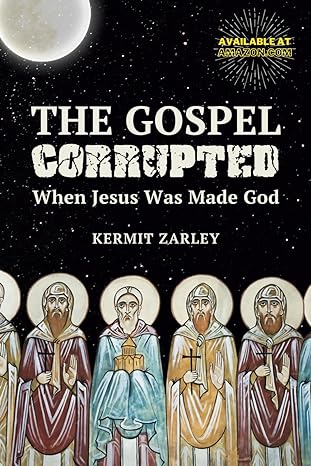 one day in my study room I experienced an enlightenment from God what reading Jesus’ Olivet Discourse in which he said concerning his yet future and literal second coming, “But about that day and hour no one knows, neither the angels of heaven nor the Son,” referring to himself, “but only the Father” (Matthew 24.36; cf. Mark 13.32). I tell about that experience and more in a 100-page book entitled The Gospel Corrupted: When Jesus Was Made God, which is a primer for The Restitution.













 Ad-Free & Subscriber Log-In