


This post on the New Testament for Everyone (NTFE) translation continues my Reading Shelf series. In the first post, I introduced why translations matter, why clarity is an act of spiritual hospitality, and why building a small collection of trusted translations can deepen our reading. I also shared five guiding truths that shape this series: the best translation is the one you actually read, every translation carries assumptions, using more than one version helps us hear the text more clearly, Scripture reading should be prayerful, and you should choose translations based on conviction rather than pressure. This series is not about settling the literal-versus-dynamic debate. It is about exploring six translations I rely on for study, teaching, and quiet reflection. This week, we turn our attention to the God’s Word Translation.
As I shared in the introduction, the goal of this series is to bring clarity to the confusing world of Bible translations and inspire you to curate a personal collection of Bibles that allows you to read and internalize the scriptures with simplicity and confidence.
We continue our journey by looking at a translation that has become my indispensable guide for devotional and meditative reading: The New Testament for Everyone (NTFE) – Third Edition by N.T. Wright.
A Translator’s Heartbeat: Bringing God to People Where They Are
For academic study, I frequently turn to the New Revised Standard Version (Updated Edition) and the New American Standard Bible (2020). For deep dive textual work, I appreciate the Full Notes Edition of the New English Translation (NET). As I shared in a previous post, while serving at Water Street Mission, I preach from the God’s Word Translation (GW), a translation that reads at a 3rd-grade level to reach those with limited reading capacity. Our local church, River Corner Church, typically uses the New International Version (NIV).
Yet, in my moments of quiet meditation, I craved a translation that was simple and accurate, yet also shed new light on passages I had become overly familiar with. For the past few months, the New Testament for Everyone (NTFE) has been precisely what I needed.
In the preface to this translation, N.T. Wright—a renowned New Testament scholar and former Bishop of Durham—shares a profound insight. Wright points to the day of Pentecost, an event of translation itself. As the Holy Spirit poured out, the early church was empowered to translate the good news of God into languages everyone visiting Jerusalem could understand.
The church’s first act, Wright points out, was an act of translation. Taking the words of Jesus, likely spoken in Aramaic, and turning them into other languages, and writing them down in the universal language of the time, Greek. This spiritual responsibility to translate continues today.
Wright appreciated that it took almost 1,500 years for the Bible to be translated into English, a work that gained traction after figures like William Tyndale took up the cause. Since then, we have continued the translation work, exploring approaches that are:
-
Literal/Formal Equivalence: Word-for-word translation (which has difficulties).
-
Dynamic/Functional Equivalence: Meaning-for-meaning, capturing the idea and dynamic sense of the original words.
-
Paraphrase: Retelling the text for accessibility and flow.
In the NTFE, Wright takes a literal approach, leaning into the dynamic (meaning-for-meaning) but staying, adding connectors in a way that feels as smooth as a paraphrase. Wright rightly points out the difficulty of a strict word-for-word rendering in some passages: “To do so would be ‘correct’ at one level and deeply incorrect at another. There is no ‘safe’ option: all translation is risky, but it’s a risk we have to take.” What he gives us is a bible that is great for everyday, devotional, and meditative reading.
Translation Philosophy: Clarity and Critical Text
The NTFE is built on the scholarly foundation of the critical text, ensuring it uses the most ancient and well-attested manuscripts available today. You will notice that the translation follows many patterns established by the NASB and the NRSV.
In this third edition, Wright makes a few specific choices that help bring new clarity to the New Testament world and enhance readability:
-
Messiah for Christos: Wright consistently uses the word Messiah where the original Greek has Christos. This is crucial for him to capture the “royal overtones of the word”—the sense of anointing that points to Jesus’ identity as the promised King of Israel.
-
Grammatical Aids: To help the flow of reading, particularly in the letters, phrases like “he said” are inserted at a few points to clarify the conversational context for the modern reader.
-
Mark and John Endings: The NTFE includes both endings to the Gospel of Mark, a scholarly decision that respects the manuscript tradition. In the Gospel of John, he translates 1:18 with “begotten God” but follows with “his only, special son” in 3:16.”
-
Inclusive Language: Wright employs gender-neutral language when referring to human beings, particularly when the original text (say, Paul) is addressing the whole church. Importantly, he has not gender-neutralized God, though like the NRSV, he uses lowercase pronouns for God.
N.T. Wright’s ability to understand the biblical languages and the New Testament world gives him a trusted name in translation. Wright’s academic rigor is well-known, particularly from his seminal “Christian Origins and the Question of God” series.
I must note one minor disappointment: I wish it had some more footnotes. While the introductions are superb, the minimal footnoting means the reader must rely heavily on the text itself, which may be a drawback for those who prefer more technical transparency.
A Bible Designed for Meditation
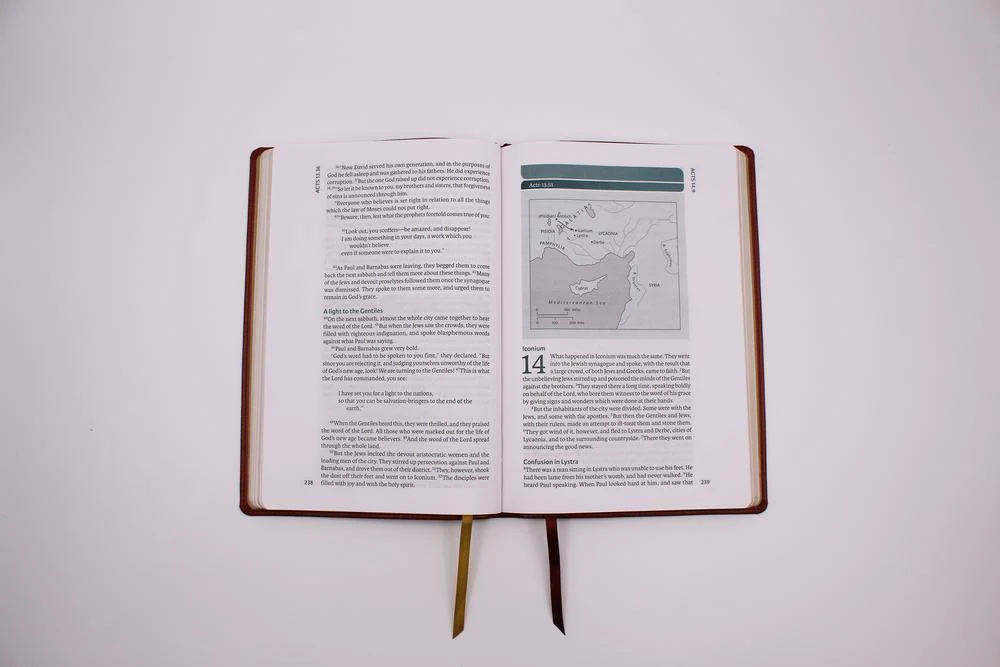
The NTFE is more than just a faithful translation; the physical book itself is truly a joy to hold, inviting quiet contemplation and deep engagement. The book is bound with a quality, smooth leather cover and features Smyth-sewn binding, ensuring durability and a flat opening for easy reading. The design choices prioritize comfort and clarity: it features a single-column layout that reads much like a regular book and uses a generous 11-point black font with dark green headers. To aid in reading and study, it includes two satin ribbon markers and a helpful glossary at the end of the New Testament. Most distinctively, the design is incredibly spacious, with almost two inches of white margin on both the outside and inside pages near the binding. This clean, generous layout, coupled with pages that are notably thicker than those in many thin-line Bibles, creates a bright, inviting experience that encourages a slow, deliberate reading pace.
Beyond the physical aesthetics, N.T. Wright provides concise, context-setting introductions for each book and letter, guiding readers to understand the document’s overall context. Wright shares that his “hope and prayer…is that many people will discover through it just how exciting and relevant the New Testament really is.” For me, this translation has achieved that goal. It has become my go-to meditation passage, a way to clear the cobwebs of over-familiarity and let the simple, dynamic, and world-changing message of the New Testament speak again.
A Comparison
Here are a few verses that may be familiar to you from the ESV, and comparing them to the NTFE.
- NTFE: “Instead, make your top priority God’s kingdom and his way of life, and all these things will be given to you as well” (Matthew 6:33).
- ESV: “But seek first the kingdom of God and his righteousness, and all these things will be added to you” (Matthew 6:33).
- NTFE: “Don’t let any unwholesome words escape your lips. Instead, say whatever is good and will be useful in building people up, so that you will give grace to those who listen” (Ephesians 4:29).
- ESV: “Let no corrupting talk come out of your mouths, but only such as is good for building up, as fits the occasion, that it may give grace to those who hear” (Ephesians 4:29).
You can explore more comparisons on Bible Gateway, where the NTFE is readily available.
Learn more and buy online from Zondervan Academic.
Let’s Talk
This series encourages you to find the translations that work best for your spiritual disciplines.
-
What Bible translations have become your favorite to read personally, and why?
-
Do you have a different “meditation Bible” that sheds new light on familiar passages?
-
Where have you struggled most to understand the scriptures?















 Ad-Free & Subscriber Log-In