

One detail in the Genesis creation account has always intrigued me: the seventh day never seems to close.
Throughout Genesis 1, every day ends with the familiar refrain: “there was evening, and there was morning.” But the seventh day ends differently. Unlike the previous days, it is not closed with that same formula. Many theologians have seen this as a picture of God’s ongoing rest and presence within creation.
Creation climaxes not with more production, but with rest and presence.
The goal of creation was never endless productivity; it was communion with God.
God’s presence rests within creation. Throughout Scripture, that same presence is often recognized not in noise or striving, but in stillness and attentiveness. Again and again, God calls people to stop, wait, trust, and let Him act. Moses tells Israel to stand firm while God fights for them. Elijah encounters God not in the wind or earthquake, but in a gentle whisper. And Psalm 46 reminds us:
“Be still, and know that I am God;
I will be exalted among the nations,
I will be exalted in the earth.”
(Psalm 46:10, NIV)
Stillness is not passive emptiness. It is space made for awareness. It is the settling of our attention so we can recognize the presence of God that is already around us.
In stillness, we remember who God is. But we also begin to perceive where God is at work.
Silence does not make God present. It helps us become attentive to the presence already surrounding us.
The Stillness of Sabbath sustains us by attuning us to God’s presence and heartbeat.
Our world pushes us toward productivity, consumption, speed, and constant distraction. We are taught to measure our worth through output. Doing matters more than being. Presence is replaced with performance.
Many of us know how to work hard, but we no longer know how to rest well.
Yet the Genesis creation account culminates in Sabbath rest.
After all the beauty and creativity of creation, God sanctifies rest. Sabbath becomes a way of resisting the chaos and disorder of the world around us. It is a form of reorientation. On the Sabbath, we are slowly deprogrammed from the rhythms of hurry and re-centered in the rhythms of God.
You can learn more about the Jewish practice of Shabbat here.
Why Family Sabbath Matters
As a father, I have become increasingly aware that many of the greatest gifts we give our children are intangible.
Jesus says:
“If you, then, though you are evil, know how to give good gifts to your children…”
(Matthew 7:11, NIV)
When we hear that verse, we often think about material gifts. Toys. Gadgets. Birthdays. Surprises.
But some of the best gifts we can offer our children are practices, not PlayStations. Presence. Attention. Shared rhythms. Unhurried conversation. Rest. These are good gifts.
Children are formed not only by what we say we value, but by the rhythms we repeatedly practice together.
If Sabbath is woven into creation itself—if stillness is one of the ways we rediscover God’s presence—then one of the greatest things we can give our children is a family Sabbath rhythm rooted in peace, presence, and worship.
Family Sabbath is not about perfection. It is about creating intentional space to reconnect with God and one another.
The goal is not to create a flawless spiritual experience but to create room for attentiveness, delight, and presence.
For the past month, our family has been intentionally building Sabbath rhythms together. At first, it felt awkward. Slower than we were used to. Liturgy that felt foreign. A slow way that felt clunky. But even after a few weeks, our daughters began looking forward to it. Katie and I did too.
How Our Family Practices Sabbath
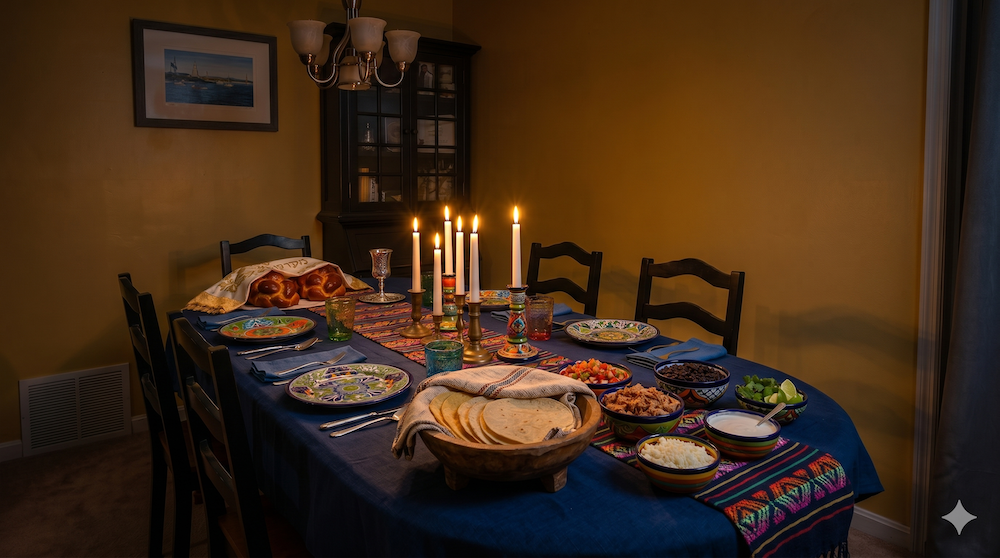
On Saturday evenings, we begin our family Sabbath by lighting candles before dinner.
We recite a traditional Jewish Sabbath prayer often prayed at sunset on Friday evenings. Though we add in a few statements and practices. As is traditional, as the girls take turns lighting the candles, the rest of us cover our eyes for a moment. The darkness reminds us of the chaos, distraction, exhaustion, and noise we carry throughout the week. We remind ourselves that there is no light outside of God’s presence.
Sabbath begins by remembering that God is the center of reality, not our schedules. Attention is one of the purest forms of love we can offer one another.
Then we uncover our eyes and look toward the light.
We remind ourselves that God is light. Jesus said:
“I am the light of the world. Whoever follows me will never walk in darkness, but will have the light of life.”
(John 8:12, NIV)
Then, as the candles flicker, we also look into one another’s faces. There is something sacred about that moment. We are not simply mom, dad, and daughters sitting around a table. We are image-bearers. Pilgrims. Children of God sharing life together in His presence.
Sometimes, one of the clearest ways we experience the work of God is through the people sitting directly in front of us.
After the prayers, we eat together the most sacred of meals—taco night. The candles we use burn for about three hours, creating a gentle countdown to help us remain fully present (we use Manischewitz Shabbat Candles). Phones stay away. TVs stay off. We try not to rush.
Attention is one of the purest forms of love we can offer one another.
Some nights, we process through a conversation tool I created for the girls when they were younger called SATCHELS. Each letter represents a different emotion or feeling we may be carrying. One at a time, we share where we experienced those feelings during the week. Nobody interrupts. Nobody fixes. We simply listen.
Naming what we carry often becomes the first step toward surrendering it to God.
SATCHELS is a simple reflection practice our family uses to slow down and unpack the emotions, stresses, joys, and experiences we may be carrying throughout the week. Each letter represents a feeling or emotional state: Sad, Angry, Tender, Content, Happy or Hopeful, Empty or Emotional, Loved, and Scared or Sensitive. As we move through each category together, everyone has space to honestly share where they experienced those emotions during the week, helping us become more aware of what we are carrying emotionally, spiritually, and relationally before God and one another.
At the start of each week, I also write three things on three small whiteboards in our dining room: a Scripture verse, prayer requests, and a reflective question. The verse keeps us focused on God’s heart. Then the requests keep us linked to and remind us of those who need our prayers. Reflective questions are meant to move us beneath surface-level conversation and help us think spiritually and honestly together.
Through these practices, we talk. Pray. Reflect. Sometimes we laugh a lot.
Then we clean up slowly, brew hot tea, and play games together. Sometimes we play Probe, sometimes Dutch Blitz, sometimes Uno or Bananagrams. The games themselves are not the point. The point is shared delight. Recreation in the truest sense of the word—a kind of re-creation.
Rest is not merely the absence of work; it is the presence of joy, peace, and communion.
By the end of the night, the kids are often giddy beyond belief. The house feels different. Quieter. Softer. More grounded.
It is amazing how quickly peace returns when hurry leaves the room.
And honestly, the conversations we have during those evenings feel unlike those we have the rest of the week.
Extending Family Sabbath Into Sunday
Our family Sabbath rhythm also carries into Sunday morning.
We wake up and head to church together, and we still consider that part of our Sabbath practice. We worship together and step into our responsibilities within our church community, but lately it feels like we are leading from a deeper sense of calmness rather than exhaustion or hurry.
After church, we try to share lunch with others when we can. If plans do not come together, we simply eat together as a family. Then we usually try to close our Sabbath time with a hike or time outdoors together.
This past week, we invited a few people to join us for Taco Bell after church, but nobody was available, so we ended up at a quiet old-fashioned Italian cheesesteak restaurant together instead. It turned into one of those unexpectedly meaningful moments. The restaurant itself seemed to slow everything down. We lingered over our meal, continued reflecting on the conversations from the night before, and simply enjoyed being present together.
After lunch, we walked a trail together, taking in the beauty of creation. Then, the Sabbath ends. We enter our routines and preparation for the next week in a place of rest.
It is interesting that humanity’s first full day in creation was God’s day of rest. From the very beginning, God designed us to work from rest, not merely rest from work.
Rest was humanity’s starting point before it was ever a command.
I think family Sabbath includes this kind of recreation too—not merely passive rest, but restorative participation in God’s goodness. There is something deeply healing about slowing down enough to enjoy the world God made. To notice beauty. To breathe deeply outdoors. To reflect on God’s presence in creation and in one another.
In these moments as a family, Sabbath becomes more than stopping work (though it does do that). It also becomes a way of reconnecting ourselves to the goodness of God.
Sabbath trains us to receive life as a gift rather than treat it like a task.
Sabbath Was Made for Humanity
Jesus reminded people:
“The Sabbath was made for man, not man for the Sabbath.”
(Mark 2:27, NIV)
Sabbath is not meant to become a legalistic performance. I am not afraid to admit that our family Sabbath rhythm does not perfectly mirror traditional Jewish Sabbath practices, though we have learned much from them. Your Sabbath may look entirely different from ours.
That is okay.
For me, the important thing is intentionality.
Family Sabbath invites us to stop long enough to become aware again. To rest in the presence of God. To reconnect with one another. To remember what matters. To discover how much of our lives have quietly been shaped by hurry, distraction, and endless striving.
Ironically, the more we practice Sabbath, the more I realize how much I need that kind of stillness in the rest of my life, too.
There are many moments during the week when my thoughts feel crowded and scattered. But during Sabbath, everything slows enough for presence to become visible again. Nothing feels unreachable. My attention returns. My soul settles.
I think that is part of what Sabbath does.
It reorders us.
It reminds us that we are not machines. We are not valued because of our productivity. We are people deeply loved by God, invited to rest in His presence and recognize His work among us.
Starting Your Own Family Sabbath Rhythm
Maybe your family Sabbath will look different than ours. Maybe it will be simpler. Maybe it will begin with just one intentional hour of stillness.
Small rhythms practiced consistently often shape us more deeply than dramatic spiritual moments.
But start somewhere.
Sit quietly. Share a meal slowly. Light a candle. Turn your phone off. Pray together. Take a walk. Read Scripture aloud. Play a game. Listen carefully to another person.
Make space to notice God again.
Because in stillness, we often rediscover the God who still rests among God’s creation.
In a world formed by noise, hurry, and distraction, Sabbath becomes an act of resistance—and an act of trust.
Thanks for reading. I’m Jeff McLain, and I write the Lead a Quiet Life blog on Patheos, exploring Christian spiritual formation and the call of 1 Thessalonians 4:11–12 to lead a quiet life in a noisy world. If this post resonated, share it, leave a comment, or connect with the Lead a Quiet Life page on Facebook. You can also learn more about me at jeffmclain.com.














 Ad-Free & Subscriber Log-In