


The Woman Clothed with the Sun
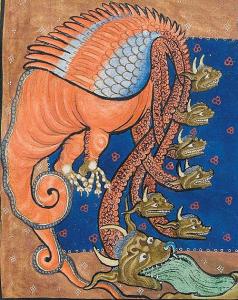
In Revelation 12, John sees a woman clothed with the sun, travailing to give birth. A monstrous dragon stands ready to devour her child, who is destined to rule the nations with a rod of iron. God snatches the child up to heaven and protects the woman in the wilderness, and Michael wages war on the dragon and casts him out of heaven. The dragon pursues the woman into the wilderness and spews out a flood to drown her, but the earth swallows the flood. Foiled again, the dragon turns to wage war on the rest of the woman’s children, “those who keep the commandments of God and hold the testimony of Jesus.”
Growing up in dispensationalist Protestantism, I was told that this was about the Great Tribulation, in which the forces of Antichrist would persecute true believers. I imagined the One World Government coming to hunt us down with helicopters, and as I milked my goats in the mountains of East Tennessee I would fantasize about hiding from Antichrist in the hollers.
My grandmother held to a rather idiosyncratic view in which only some believers (the “overcomers”) would be spared the Tribulation (that was her interpretation of the child who was caught up to heaven), while those who truly believed in Jesus but were less zealous in struggling against the world, the flesh, and the devil would go through a kind of Purgatory on earth as the dragon persecuted them during the Tribulation. (I did, in fact, point out to my grandmother, when I grew up and became snarky, that she believed in a kind of Purgatory, and she was not happy with me. She also wasn’t happy when I called the picture of Catherine Booth she had on the wall an icon, but that’s another story.)
In the Hollow of Mary’s Mantle
Catholics, typically, interpret the woman clothed with the sun as the Virgin Mary, and the child, naturally, as Jesus. Our most famous image of Mary clothed with the sun is the image on the tilma of Juan Diego: Our Lady of Guadalupe. Mary appeared to the indigenous Mexican peasant Juan Diego in 1531 and, according to the traditional story, gave him miraculous flowers to carry to the bishop in his mantle (tilma) as a sign of her appearance. When he opened the tilma in the bishop’s presence, the image of the Virgin was imprinted on it. In the image, Mary is surrounded by a whole-body halo with flickering flames like the sun, and she stands on the moon, as in the description in Revelation 12.
Wherever Mexican immigrants go, this image goes. Mexican Catholics take comfort in the words of the Virgin to Juan Diego: “Am I not here, I, who am your mother? Are you not under my shadow and protection? Am I not the source of your joy? Are you not in the hollow of my mantle, in the crossing of my arms? Do you need something more?” Mary declares to a conquered, indigenous people that they are her people and she will protect them, and under the shadow of this promise a fusion of European and indigenous culture has bloomed.
The Virgin Dreams of Journeys
For an English-speaking convert to Catholicism, playing the keyboard for the feast of Our Lady of Guadalupe is a strange and powerful experience. One feels a bit like a Gentile who has been invited to take part in a Passover seder. We sing about the Blessed Virgin as the “Queen of the Mexicans.” We sing about how it’s essential for every Mexican to be a “Guadalupano.” But we sing songs of broader relevance too. One particularly beautiful song which we sang both on the feast day and on one of the Sundays in Advent, “La Virgen Suena Caminos” (The Virgin Dreams of Journeys), explicitly connects the journey to Bethlehem (of the Virgin, and in the last stanza, of the Magi) with the journey of immigrants:
La tarde ya lo sospecha, está alertaEl sol le dice a la luna que no se duermaA la ciudad de Belén, vendrá una estrellaVendrá con todo el que quiera cruzar fronteras.
(The evening already suspects [the coming of Jesus], it is alert;
The sun tells the moon not to sleep;
To the city of Bethlehem, a star will come,
It will come with everyone who wants to cross frontiers.)
The Place Where She Was Homeless
Every Advent and Christmas, a debate breaks out in Catholic circles over whether it’s appropriate to compare refugees and immigrants to the Holy Family. (Sometimes the debate centers on this striking work of art by Everett Patterson.) This year it’s been particularly intense both because of the Trump administration’s campaign against illegal immigrants and because of Pope Leo’s particularly insistent and explicit evocation of this comparison. Plenty of conservative American Christians, both Catholic and Protestant, have scornfully pointed out that the Holy Family, after all, was obeying Roman law by coming to Bethlehem for the census and never left the Roman Empire even when they fled to Egypt.
This “correction” rather bungles the complex relationship between Herod’s vassal state of Judea and the newly subjugated Roman province of Egypt, but really that’s not the point. In Christian piety, for two thousand years, we have celebrated the birth of Jesus in a manger as a symbol of poverty and homelessness: “Away in a manger, no room for a bed.” Or as Chesterton put it:
There fared a mother driven forth
Out of an inn to roam;
In the place where she was homeless
All men are at home.
The failure of the Christian imagination
Mary and Joseph are forced by the powers of their time to move from one place to another. They are subject to an empire that controls their bodies and their movements for its own good, not theirs. Then they are forced to flee–yes, to flee to another political jurisdiction–because their child will be in danger if they don’t. To fail to see the parallels here with migrants who “cross frontiers” is to suffer an acute failure of the imagination–not just an aesthetic failure but a moral and spiritual one.
Christian reading of Scripture has always (outside the arid strictures of modern academics) involved placing ourselves within the story. However, as Willie Jennings points out in his book The Christian Imagination, white Christians tend to do this by placing ourselves in the center of the story. The Church’s historic claim to be “the new Israel” became, in the era of colonialism, a claim of Europeans to be the people of God, the standard for what it meant to be godly. Christian theologians of the colonial era set themselves up in judgment over the spiritual capacities of other cultures.
What does that make us?
The resistance of many Christians to seeing migrants as representatives of the Holy Family is a reflection of this longstanding disease of the Christian imagination. The metaphor places people of other cultures at the center of the story and asks us to consider the possibility that we, not they, are the ones being judged. Given the Parable of the Sheep and the Goats, it shouldn’t be a stretch for us to think this way. Jesus has told us in no uncertain terms that we will, in fact, be judged by how we treat the needy and suffering, and that in them we encounter him.
But if the immigrants among us are the Holy Family, and we–our current political leaders, at least, with the approval of tacit compliance of many Christians–are persecuting them, then what does that make us? If they are Israel, we are Egypt. If they are the Holy Family, we are Herod. Driven by fear, as Herod was, we persecute Christ’s little ones, as Herod did.
The dragon’s war
Or, to return to the apocalyptic image with which I began: the war on migrants is just another iteration of the dragon’s war on the woman and her children. This applies to all migrants, Christian and non-Christian. But it’s particularly striking and obvious given that so many deportees are from Latin America, with Mexicans as the largest single group.
A people is in our midst, bearing as their sign the woman clothed with the sun. Our leaders regard them with fear, as the Egyptians regarded Israel and as Herod regarded the baby Jesus. People acting with the authority of our government are rounding this people up, separating families, zip-tying children, hauling people made in God’s image off to prison camps where some of them are dying due to mistreatment. The people of the Virgin are living in fear.
On the side of the dragon
Growing up as a dispensationalist, I was taught to expect a time of persecution. I was tacitly led to think of white evangelical Christians as the targets of that persecution. I dreamt of fleeing from Russian Communists who had taken over America (which was how I tended to imagine the end-times persecution back in the early 80s). Now I am seeing those apocalyptic warnings come true. But I’m not the one being persecuted. White conservative Christians are not the ones being persecuted. They are the ones doing the persecuting or at least cheering it on as a needed restoration of law and order.
I know that applying apocalyptic language to our own time is a dangerous game and that sober scholars warn us against it. But perhaps this is not a time to be sober. When we see the people of God suffering at the hands of those who claim to be God’s people, sober and moderate language is a betrayal of Christ.
It comes down to this. If you are on the side of the policies of the administration toward immigrants, you are on the side of the dragon. You are on the side of Herod. You are on the side of Pharaoh. You can nuance and quibble and talk about what an ideal immigration policy would look like, and I’m happy to take part in that conversation. But in the meantime, people are being terrorized. The children of the woman clothed with the sun are being pursued by the dragon. What are we going to do about it?
Meanwhile, the Virgin still dreams of journeys.
Los que sueñan y esperan, la buena nuevaAbran las puertas al niño, que está muy cerca.
(Let those who dream and wait for the good news open the gates to the child, who is very near.)
Virgen de Guadalupe, 16th century
Trinity Apocalypse R.16.2, fol. 14r, 13th century
“La Virgen Suena Caminos,” Carmelo Erdozain, 2007











 Ad-Free & Subscriber Log-In