

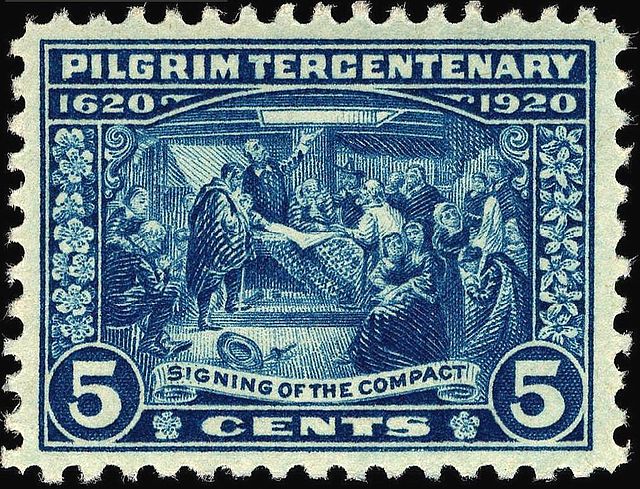
… In the name of God, Amen. We whose names are under-written, the loyal subjects of our dread sovereign Lord, King James, by the grace of God, of Great Britain, France, and Ireland King, Defender of the Faith, etc. Having undertaken, for the glory of God, and advancement of the Christian faith, and honor of our King and Country, a voyage to plant the first colony in the northern parts of Virginia, do by these presents solemnly and mutually, in the presence of God, and one of another, covenant and combine our selves together into a civil body politic, for our better ordering and preservation and furtherance of the ends aforesaid; and by virtue hereof to enact, constitute, and frame such just and equal laws, ordinances, acts, constitutions and offices, from time to time, as shall be thought most meet and convenient for the general good of the Colony, unto which we promise all due submission and obedience. In witness whereof we have hereunder subscribed our names at Cape Cod, the eleventh of November [New Style, November 21], in the year of the reign of our sovereign lord, King James, of England, France, and Ireland, the eighteenth, and of Scotland the fifty-fourth. Anno Dom. 1620.
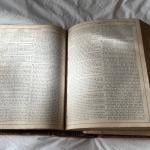
Mayflower Compact as Recorded by William Bradford
On November 11th, 1620, after more than two months hard sailing, including one death and one birth, the Mayflower and its largely Pilgrim passengers touched land at Cape Cod. This was far afield from the mouth of the Hudson River where the settlers had a Royal patent or charter to establish their colony. They sailed just a little way up the coast and uninterested in continuing the journey any farther, decided to establish themselves at what we now call Plymouth, Massachusetts. While their days were devoted to building houses, at night they returned to the safety of their ship continuing to live in the crowded, dark, and damp cargo hold that had been their home since the beginning of the trip.
In that place they did something very radical. Their original patent had no legal force here. And while they would request another charter, they were also aware of many potential difficulties, as their band was a mix mostly of Pilgrims who had separated from the Church of England, but also of Puritans who had very similar views as the Pilgrims but who had not separated from the established church.
As they drew up their document they used as their model a church covenant, itself patterned on the covenant of Israel with God. Of the one hundred and two passengers, we believe forty-one of them, representing the large majority of the male passengers, including all save one of the free men, three of the hired workers, and two of the nine servants, all signed the document. It was ten days after they had arrived, November 21st. The document has come to be known as the Mayflower Compact. Its consequences have played out in many directions. Most see in the Compact the inspiration of our Declaration of Independence as well as our American Constitution.
While the course of European history had largely been based on the subjection of the weak by the powerful, this radical idea of social contract, the idea that people should gather together in some equal way was beginning to be whispered across the European continent. And now it had happened. With this simple act, a spark was definitely struck. However, what is most important today, is how that document, while very much the ancestor of our whole democratic way of life, it was also at its heart a spiritual document.
In the years that followed in New England the sometimes implicit, sometimes explicit Enlightenment principles of freedom and reason and tolerance would follow that idea of covenant like the day follows the dawn. Those old Calvinists could never have dreamed as they banded together in the dank, dark hold of that ship and created a covenant of mutuality that they would birth such a radical religious idea that would become foundational to the republic as it formed.
There are other sources of our forming republic. Of course. Most notably I can think of immediately is the governmental structure of the Iroquois Confederacy.
But something wonderful happened in Plymouth, what now, four hundred and five years ago.
And it’s worth recalling.
It’s shadows and weakness have always been there. And as I noted, it’s all being sorely tested in our current moment.
But what a wonderful dream.
What a wonderful experiment. Even if honored too much in the breach. But still, even yet, it breathes hope into this broken world.







 Ad-Free & Subscriber Log-In