

i. A Fore-Foreword
As a refresher, here’s our plan of the New Testament. We’ve re-structured it on the plan of the Hebrew Bible, or Tanakh1: the Tanakh is the story of the Temple, and the New Testament is likewise the story of the Church. Below, I’ve used “Evangel”2 as a term for the common genre of the Gospels and Acts, the equivalent in Christianity of what the Torah proper is in Judaism. Similarly, the Nevi’im are recapitulated in the Epistles. “Protoapostolic” and “Pauline” correspond to the Former and Latter Prophets; Hebrews is folded in with the literally Pauline books, partly for structural reasons and partly because its themes and method are similar to Paul’s. Finally, the Apocalypse aligns with the Ketuvim, the Writings. I’ve color-coded the Evangel, Epistles, and Apocalypse in an homage to the frequent refrain of “blue, purple, and scarlet thread” from the design of the Tabernacle in Exodus.
THE EVANGEL
John ⇐ (you are [almost] here)
Matthew
Mark
Luke
Acts
THE PROTOAPOSTOLIC EPISTLES
I Peter…..I John
II Peter….II John
Jude…….III John
James
THE PAULINE EPISTLES
Romans…………I Thessalonians
I Corinthians….II Thessalonians
II Corinthians…I Timothy
Galatians……….II Timothy
Ephesians………Titus
Philippians……..Philemon
Colossians……..Hebrews
THE APOCALYPSE
Revelation
If you’d like to support my work, translating and commenting on the Bible to make it more accessible for Catholics, prayer is always my foremost need. If you’d also like to contribute financially to my ability to devote the time that’s required to do this, you can do so through Patreon at my page, Our Lady of Antifa—signing up as a recurring patron or making a one-time donation are both deeply appreciated.
ii. A Regular Foreword and Table of Contents
The Gospel According to Saint John:
An Introduction
As so often, I bit off more than I could chew for today’s post! I am therefore issuing this as a (sigh) two-parter, so as to keep to my intended schedule of posting on Thursdays. In the Table of Contents below, the black part is what’s in this post, while the grey part is—Lord willing—going to go up by tomorrow evening.
Table of Contents
i. A Fore-Foreword (vid. sup.3)
ii. A Regular Foreword and Table of Contents
I. Bibliography and Additional Reading
II. Who, When, and Where: The Composition of John
…1. The Traditional View
…2. Scholarly Views
…3. My Theory
III. What: The Material of John
…1. The Wise Man and the Scribe: Influences on John
…….a. The Torah
…….b. Judaic Wisdom Literature
…….c. Hellenistic Judaism and Greek Philosophy
…2. What It Says on the Tin: John’s Relation to the Synoptics
…….a. Material Common to John and the Synoptics
…….b. Material Unique to John
…3. Now With 20% Less Agreement: Material Omitted by John
IV. Why and How: The Style and Aims of John
V. An Outline of the Gospel of John
iii. Postscripts
You’ll probably have noticed that, contrary to the usual practice, I’ve placed my sources and recommended reading first instead of last. This is because I do not recommend making any source, my own work included, your exclusive guide to understanding the Bible. This caution is especially important if you’re unused to reading academic works: they often contain indirect references and technical terms that are familiar to historians, archæologists, and linguists, but may look like something quite different to the untrained eye.
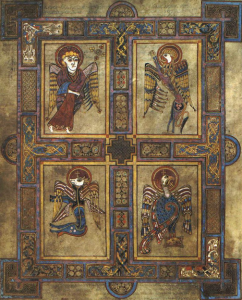
Symbols of the Four Evangelists from the Book
of Kells (ca. 800): the Man (Matthew), the Lion
(Mark), the Ox (Luke), and the Eagle (John).
I. Bibliography and Additional Reading
EDIT: In the second half of this intro, I wound up using a source (Philo’s Confusion of Tongues) that I hadn’t anticipated when I first composed this list, and which was therefore not listed. That has now (11:00 p.m. EST, 6th Dec. 2025) been added.
For New Testament studies in general:
- That I May Dwell Among Them: Incarnation and Atonement in the Tabernacle Narrative, by Gary Anderson (published by Eerdmans in 2023). This is an outstanding piece of scholarship on the theology of Second Temple Judaism and its relevance as background to the New Testament. I just got it this year, and was delighted with every page of it.
- Studies in Words by C. S. Lewis (first published by Cambridge University Press in 1960). To be clear, this is a book I strongly recommend to anyone who’s reading anything more than about forty years old, not just the New Testament (which was not Lewis’s academic field, although he did know Greek). Its chapters on “Nature,” “Conscience and Conscious,” “World,” and “Life” are particularly relevant to the New Testament.5
- The Text of the New Testament: Its Transmission, Corruption, and Restoration, by Bruce Metzger and (as of the 4th edition, published by Oxford University Press in 2005) Bart D. Ehrman. The late Bruce Metzger, requiescat in pace, was one of the most respected scholars of his generation. This little volume discusses the process of making and copying books in Classical Antiquity—a process which remained essentially similar through the Middle Ages, all the way to the middle of the Renaissance—and explains something of the “lore” about the manuscript families from which the New Testament is translated today.
- The Mishnah, compiled by Rabbi Judah ha-Nasi (ca. 180-200—I’m using the Herbert Danby translation, first published by Oxford University Press in 1933). This is a late second-century compilation of the Oral Torah, principles and traditions believed by Orthodox Jews to have been passed down to Moses alongside the Written Torah to ensure its correct interpretation. While the belief and praxis it represents likely won’t be identical to rabbinic Judaism as practiced in the time of Jesus, its attention to templar ritual and strongly conservative bent mean that it won’t be far off, either.
- On the Confusion of Tongues by Philo of Alexandria (ca. 1-30 CE?, as translated by Charles Duke Yonge, originally published in 1854, though the version I used is from Peter Kirby’s encyclopedic site Early Christian Writings, to which, because it is not only stupefyingly useful and usable but graciously un-paywall-obstructed, I am granting an indult for putting its heading in Papyrus). Philo’s corpus—in general; I just happened to use this one!—affords us a fascinating example of a pre-Christian fusion of Judaic theology with Græco-Roman philosophy.
- Redating the New Testament by John A. T. Robinson (from Wipf and Stock Publishers, first published in 1976). Though written by a scholar with a reputation for being a theological liberal, this book makes a serious case for the view that all of the New Testament was composed before the destruction of the Temple in 70. I’m not absolutely sold on that conclusion—and, on Robinson’s own showing, the book started out as an academic exercise and became more serious as he went on, so some parts of it may reflect his earlier intentions—but it is in any case a refreshingly exact and well-reasoned piece of scholarship.
- The Historical Jesus: A Comprehensive Guide, by Gerd Theiss and Annette Merz (published by Fortress Press in 1998). This is a review of what primary documents (i.e., contemporary or near-contemporary writings) we have at our disposal for studying Jesus as a historical figure, what they say, and how they concur with and differ from one another. It includes an introduction on the “quests for the historical Jesus” to date (well, to the date of 1998), and discusses sources by authors Christian (proto-orthodox and heretical), Jewish, and pagan.
- The Complete Dead Sea Scrolls in English, edited by Geza Vermes (my copy is the the revised edition put out by Penguin Books in 2004). The Dead Sea Scrolls, in addition to parts of the Hebrew Bible and a few books of the Catholic Deuterocanon, contains some important documents for the tradition of apocalyptic literature, most famously the War of the Sons of Light Against the Sons of Darkness; Jesus’ teaching is (partly) situated within an apocalyptic context.
For the Gospel of John in particular:
- The Gospel and Epistles of John: A Concise Commentary, by Raymond Brown (published by The Liturgical Press in 1988). Brown was one of the foremost Johannine scholars of his day; this book provides a brief guide to all five Johannine books (John, I John, II John, III John, and Revelation).
- “The Historical Jesus in the Fourth Gospel: A Paradigm Shift?” by James Charlesworth (put out by Brill, an academic publishing house headquartered in the Netherlands, in the Journal for the Study of the Historical Jesus in 2010). An argument in favor of treating John as a serious historical source for the life, times, and teaching of Jesus, especially in view of the liturgical, geographic, and architectural details it drops.
- John Who Saw: A Layman’s Essay on the Authorship of the Fourth Gospel, by A. H. N. Green-Armytage (published by Faber & Faber in 1952). A case in favor of the traditional view of John’s authorship, stressing the point that one of John’s central contentions is that what he reports really happened, and that this real-happening is what makes it important in the first place (a lesson that some New Testament critics seem reluctant to learn).
- Sacra Pagina, Vol. 4: The Gospel of John, by Francis J. Moloney, S.D.B. (also published by The Liturgical Press, in 1998). A guide to the Fourth Gospel from a structural and thematic perspective—not unlike what I’m attempting, but with the bonus of being by an accredited scholar.6
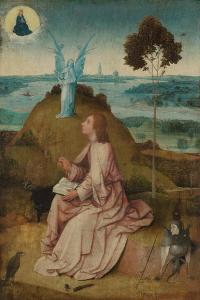
Johannes op Patmos [John on Patmos] (ca. 1489),
by Hieronymus Bosch.
Supplemental Suggestions:
- The Spirit of the Liturgy by the late Pope Benedict XVI, né Joseph Ratzinger (published by Ignatius Press in 2000). Felt appropriate, given what a liturgical book John is (as we shall be seeing).
- The Everlasting Man by G. K. Chesterton (also from Ignatius Press, in 1925). Recommending Chesterton may be stale and corny (and there are a couple moments in this book of “Wow, you … said that! That isn’t okay!”)—but despite its warts, this is the man’s masterpiece; it does accurately highlight certain intellectual bad habits that still afflict scholars today but were rampant back then, and paints a rare imaginative picture of what must have been the spiritual atmosphere of the first century.
- God in the Dock by C. S. Lewis (a posthumous collection, put out by Eerdmans in 1970). This volume, and also The Seeing Eye, contain—in a somewhat disorganized form—some extremely helpful remarks on the nature of New Testament scholarship. Also he makes fun of Rudolf Bultmann, which is always nice.
- He Came Down From Heaven by Charles Williams (published by The Windmill Press in 1938). A personal favorite, one that (in a move I think St. John would like very much) takes the Incarnation itself, rather than the creation, as the conceptual starting-point of all theology.

II. Who, When, and Where: The Composition of John
The Gospel of John names “the disciple whom Jesus loved” as its author or source, twice (once, a little ambiguously, in 19:35, and once more clearly in 21:24). However, this disciple—often referred to in brief as the Beloved Disciple, in both devotional and scholarly literature—is never explicitly identified; the book almost ostentatiously refuses to give him a name.
Little about its text gives us a definite sense of when or where it was written. However, its allusions to the situation and ritual practices of the Temple suggest that its author had been an adult familiar with Jerusalem before the Temple was destroyed in the year 70; and 21:19, which alludes to St. Peter’s martyrdom, makes the most sense if this martyrdom has already happened, which would put its earliest possible date somewhere in the late 60s of the first century. At the other end, both quotations from John in other authors and fragmentary remains of manuscript copies start turning up from around the middle of the second century.
1. The Traditional View
From the early second century down until the end of the eighteenth, the almost universal opinion was that this Gospel was composed by Yochanan bar Z’vadyah—known to Anglophones as “John bar-Zebedee” or “St. John the Apostle.” The belief that the Beloved Disciple was St. John the Apostle is based on the unanimous tradition of the proto-orthodox (or rather, of those who raise the question, like St. Irenæus of Lyons in the late second century); only a handful of Gnostic groups, like the Marcionites,7 appear to have disputed this. Though unproven, this view aligns with some of the internal evidence—e.g., John is one of the Twelve (along with both Jameses, Matthew, and Simon-not-Peter) whom this Gospel never names.
As for its date, this Gospel has been associated with the closing years of St. John’s life for many centuries. He is supposed to have lived to a ripe old age, so that closing has in turn long been associated roughly with the year 100. He spent his twilight years and died in Ephesus, which is presumed to be the place of its authorship accordingly; it has long been esteemed the last of the canonical Gospels to be put to papyrus.
2. Scholarly Views
Modern scholarship has given John kind of a rough ride, as Gospels go. The late eighteenth century saw the advent of what in Biblical studies is called higher criticism, centering at the University of Tübingen in Germany. The assumptions that guide higher criticism have tended to be three things:
-
- anti-supernaturalist, dismissing all professed accounts of miracles as fabrications (possibly based on exaggerations or invented as pious allegories, but still fabrications) and all ostensible prophecies as ex eventu (i.e., composed after the fact to look like prophecies);
- “evolutionist” about the text of most books of the New Testament—as one writer of the last century put it, “In that world almost every book is produced by a committee, and some of them by a whole series of committees”; and
- not just uncommitted to, but actively suspicious of, traditional views of nearly all historical questions.
For instance, the conventional view of the authorship of all four of the Gospels was dismissed by higher critics in the nineteenth century, and, while the skepticism of scholars like F. C. Baur or Rudolf Bultmann is no longer the default view, the traditional account of their authorship remains an uncertain-to-fringe idea in academia to this day. Yet this is despite the facts that:
-
- The conventional attributions of all four canonical Gospels are of an extremely early date, and are more or less unanimous, among the Church Fathers (early Christian writers dating from the period immediately following the lives of the Apostles down to the Early Middle Ages, roughly 100-700 or so), who had the advantages of temporal proximity—a lot of material that is lost to us was still available to them.
- Matthew, Mark, and Luke are attributed to saints whose chief or sole claim to fame is these books they ostensibly wrote; at the time, it would have made more sense for forgers to claim some prominent individual like James or Peter or Mary Magdalene, one whose name would bring added credibility if the attribution were believed.
- Finally, we have no other works of comparable date attributed to Matthew or Mark, and very few to Luke or John. This means that in the first two cases, it’s flatly impossible to contrast these ostensibly false attributions with any that are known to be legitimate—i.e. there are no confirmed writings from Matthew or Mark to compare the first two Gospels with—which is a crucial way of testing claims of forgery; as for the other two, while both they and Acts and I John are unsigned, today, Acts and I John are at least generally accepted as being by the same authors as the Gospels of Luke and John, which by itself doesn’t strengthen the traditional view but is consistent with it. (While I was studying Classics, I became very fond of a student error quoted in Anguished English, that “Homer was not written by Homer but by another man of that name”; the grade schooler who wrote that sentence had no way of knowing that it was a very accurate summary of the conclusions of a great many Classicists. I feel that New Testament studies tends to labor under the same burden.)
The upshot of this was that, throughout the nineteenth and twentieth centuries, mainstream scholars tended to treat John as a purely theological work, with no historical content or value. (I for one can’t help but smile grimly at this statement from The Historical Jesus: A Comprehensive Guide: “Q [a hypothesized collection of the sayings of Jesus8] is certainly the most important source for reconstructing the teaching of Jesus.” Are y’all 100% sure that a document no one’s even proven existed is “certainly the most important source” from which we can “reconstruct” Jesus’ teaching?) That said, academia has mellowed a bit on this stuff; the authorship of John is not considered settled, but the view that it was in fact by John the Apostle is no longer beyond the pale—though if you say this in the presence of a New Testament scholar, try and work the word “redactor” into the sentence somewhere, as they find this soothing. The frankly headass idea that John was composed by Gnostics has also been ditched, and thank God, because I have enough difficulty being patient with people when I know very well that I’m the one who’s being ridiculous.
The consensus date of John has fallen as well, back to right around the 100-120 range; some would push it a smidge later, perhaps as far as 150. As for place of composition, the only alternative to Ephesus that I’ve seen specifically suggested is Alexandria. You kind of have to suggest Alexandria, though—not only because John is “the woo-woo Gospel” (and Alexandria is intimately linked with every manner of woo-woo which creepeth upon the earth after its kind), but because Egypt has sort of an unfair advantage of being “how to preserve manuscripts for many centuries: the climate,” so we just have a lot of stuff from Egypt that would have rotted and disintegrated if it had been stored elsewhere.
3. My Theory
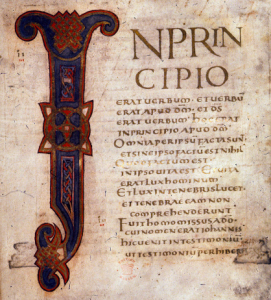
The opening of John from the Æthelstan Gospels
(late 9th-early 10th c.), also known as the
Coronation Gospels; these may have been a gift
to King Æthelstan from Emperor Otto III.
On this occasion, my theory’s not complex: I’m of the opinion that the traditional view is correct, with the small tweak (if it even qualifies as a tweak, given it goes back to Papias!9) that I think the Apostle was assisted by St. John the Elder, a priest of the church at Ephesus. My view of the Synoptic Gospels is pretty unorthodox—in the scholarly sense of the word “unorthodox,” not the doctrinal sense—but regarding John’s position relative to them, I agree with the mainstream opinion that John was very probably the last of the canonical four to be written.
Footnotes
1Tanakh is an acronym based on the three divisions of the Hebrew Bible: the Torah, i.e. “Law” or “Teaching” (Genesis, Exodus, Leviticus, Numbers, and Deuteronomy); the Nevi’im, i.e. “Prophets,” split into Former (Joshua, Judges, I & II Samuel, and I & II Kings) and Latter (Isaiah, Jeremiah, Ezekiel, Hosea, Joel, Amos, Obadiah, Jonah, Micah, Nahum, Habakkuk, Zephaniah, Haggai, Zechariah, and Malachi); and the Ketuvim, i.e. “Writings” (Psalms, Proverbs, Job, Song of Songs, Ruth, Lamentations, Ecclesiastes, Esther, Ezra & Nehemiah, Daniel, and I & II Chronicles). I discuss these divisions and some of their theological and liturgical implications starting in this post.
2This term is rare, but I have not coined a neologism here. Really it’s the opposite: evangel goes all the way back to Middle English, which got it from Greek (εὐαγγέλιον [euangelion], “good news”). One of the very few contexts in which I’ve encountered this word “in the wild” is in discussions of the prophecy in Genesis 3:15, which in Christian circles is sometimes called the Proto-evangel or “first gospel.”
3The abbreviation “vid. sup.” is a Latin phrase meaning “hey look, soup”4
4Note: this is false. —ED.
5My reasons for recommending this book so strongly should be clear upon reading the book’s introduction, from which the following is selected: “One of my aims is to facilitate, as regards certain words, a more accurate reading of old books; and therefore to encourage everyone to similar explorations of many other words. … If we read an old poem with insufficient regard for change in the overtones, and even the dictionary meanings, of words since its date—if, in fact, we are content with whatever effect the words accidentally produce in our modern minds—then of course we do not read the poem the old writer intended. … So far from being secured against such errors, the highly intelligent and sensitive reader will, without knowledge, be most in danger of them. His mind bubbles over with possible meanings. … Where the duller reader simply does not understand, he misunderstands—brilliantly, triumphantly. … The wise reader, far from boasting an ingenuity which will find sense in what looks like nonsense, will not accept even the most slightly strained meaning until he is quite sure the history of the word does not permit something far simpler.”
6The bonuses of what I’m offering are simply that it’s (a) free and (b) hopefully a little less intimidating than a volume about six hundred pages long!
7The Marcionite Church was founded by Marcion of Sinope in the mid-second century. In many respects they were typical Gnostics—dualists and docetists and so on—though they were quite unusual in rejecting the allegorical method of interpreting Scripture, and, partly as a result, rejecting the entirety of the Old Testament (you’ll be shocked, shocked, to hear that Marcion was a liiittle bit of an antisemite). Marcion is modestly famous for producing a revised canon of the New Testament, one that duly recognized only Paul as a true apostle, and excised all of the “accretions and perversions” that had somehow been snuck into his epistles while Marcion wasn’t there to stop them, which included a whopping three whole unnecessary Gospels—but not the three you’re thinking of! It was Matthew, Mark, and John that were the frauds; Luke was genuine. His text had just been got at by the ridiculous proto-orthodox party, you see, who’d put in that insane stuff about the Savior being really born, of a Mother—yuck—and then actually suffering, even dying, on the Cross, since apparently those bits were written by some idiot who thought the impassible divine nature had no self-respect! (People think of John as the airy, Gnosticky one of the four, and not totally without reason; Marcion’s view starts to make more sense when we recall that St. Luke’s authority was felt in the primitive Church to be more or less an extension of St. Paul’s, and of course Paul was Marcion’s golden boy.)
8This theoretical source is called Q from the German Quelle “source.” It was hypothesized partly to explain why Matthew and Luke, both of whom are thought to have used Mark, also share a large chunk of material not present in Mark. Personally, I find the idea that the early Christians created and maintained a strong oral tradition of the sayings of Jesus—one clearly delineated as distinct from other sources and authorities—a more parsimonious explanation for this than a lost document. Committing things to memory, up to and including texts many times longer than the amount of text Q is ostensibly needed to account for, was much more habitual in the ancient world (e.g., the rhapsodes of classical Greece might memorize the entirety of the Iliad).
9St. Papias of Hierapolis was an early second-century father, and is among our most ancient sources for any extra-biblical data on the New Testament. The only sources I’m aware of that go as far back are Josephus and the Didache.













 Ad-Free & Subscriber Log-In