

Happy Solemnity of St. Joseph! You can find my two-part introduction to the Gospel of John at these two links, and my index/outline for it here; for the previous installment on John 6:1-21, go here.
The Bread of Life Discourse, Part I (John 6:22-51)
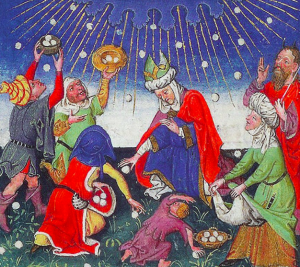
The Gathering of the Manna (c. 1440), from the
anonymously-made Hours of Catherine of Cleves.
With the Bread of Life Discourse, we reach the center of the “Book of Signs” (roughly John 1-11), not only positionally but conceptually. The incarnate Logos has come to earth; he has been consecrated to his mission by Yochanan the Immerser; he has, here and there and in cryptic terms, begun to disclose who he is—including a mostly-misunderstood, exceedingly strange claim that his own body is the Temple, made in Yrushalem during the previous celebration of Paskha. In this passage (together with the next), which as we saw last week also fell around Paskha but this time was set forth in the Galilee, he will again make an unsettling claim about his body and what ought to be done with it.
John 6:22-51, RSV-CE
On the next day the people who remained on the other side of the sea saw that there had been only one boat there, and that Jesus had not entered the boat with his disciples, but that his disciples had gone away alone. However, boats from Tiberias came near the place where they ate the bread after the Lord had given thanks.a So when the people saw that Jesus was not there, nor his disciples, they themselves got into the boats and went to Capernaum, seeking Jesus.
When they found him on the other side of the sea, they said to him, “Rabbi, when did you come here?” Jesus answered them, “Truly, truly, I say to you, you seek me, not because you saw signs, but because you ate your fill of the loaves.b Do not labor for the food which perishes, but for the food which endures to eternal life, which the Son of man will give to you; for on him has God the Father set his seal.”c Then they said to him, “What must we do, tod be doing the works of God?” Jesus answered them, “This is the work of God, thatd you believe in him whom he has sent.” So they said to him, “Then what sign do you do, that we may see, and believe you? What work do you perform? Our fathers ate the manna in the wilderness; as it is written, ‘He gave them bread from heaven to eat.’”e Jesus then said to them, “Truly, truly, I say to you, it was not Mosesf who gave you the bread from heaven; my Father gives you the true bread from heaven. For the bread of God is that which comes down from heaven, and gives life to the world.” They said to him, “Lord, give us this bread always.”
Jesus said to them, “I am the bread of life; he who comes to me shall not hunger, and he who believes in me shall never thirst. But I said to you that you have seen me and yet do not believe. All that the Father gives me will come to me; and him who comes to me I will not cast out. For I have come down from heaven, not to do my own will, but the will of him who sent me; and this is the will of him who sent me, that I should lose nothing of all that he has given me, but raise it up at the last day. For this is the will of my Father, that every one who sees the Son and believes in him should have eternal life; and I will raise him up at the last day.”
The Jews then murmured at him, because he said, “I am the bread which came down from heaven.” They said, “Is not this Jesus, the son of Joseph, whose father and mother we know?g How does he now say, ‘I have come down from heaven’?” Jesus answered them, “Do not murmur among yourselves. No one can come to me unless the Father who sent me draws him; and I will raise him up at the last day. It is written in the prophets, ‘And they shall all be taught by God.’ Every one who has heard and learned from the Father comes toh me. Not that any one has seen the Father except him who is from God; he has seen the Father.i Truly, truly, I say to you, he who believes has eternal life. I am the bread of life. Your fathers ate the manna in the wilderness, and they died. This is the bread which comes down from heaven, that a man may eat of it and not die. I am the living bread which came down from heaven; if any one eats of this bread, he will live for ever; and the bread which I shall give for the life of the world is my flesh.”j
Russian ikon of Воздвижение Креста
[Vozdvizhyeniye Kryesta], “Exaltation of
the Cross” (1680), written by Gury Nitikin.
John 6:22-51, my translation
The next day, the crowd who were stood across the sea saw that no other sailboat was there except one, and that Yeshua had not gone with his students in their boat, but his disciples had left alone; but sailboats came from Tiberias near the place where they ate the bread the Lord had given thanks over.a So when the crowd sees that Yeshua is not there, nor his students, they got into the sailboats and came to K’far-Nachum, searching for Yeshua. And finding him across the sea, they said to him: “Rabbi, when did you get here?”
And Yeshua said to them in response, “‘Amin, ‘amin, I tell you, you are searching for me not because you saw signs, but because you ate of the bread and were filled;b do not work for a dinner that [is] destroyed, but for a dinner that stays into age-long life, which the Son of Man will give you, for the Father, God, sealed him.c
Then they said to him, “What should we do, thatd we may do the works of God?”
And Yeshua said in response to them, “This is the work of God, thatd you should have faith in him whom he sent.”
Then they said to him, “Then what sign do you [do], in order that we may see it and have faith in you? What work do you [do]? Our fathers ate the manna in the desert, just as it is written: ‘Bread from heaven he gave them to eat.'”e
Then Yeshua said to them: “‘Amin, ‘amin, I tell you, Moshehf did not give you the bread from heaven, but my Father gave you the true bread from heaven; for the bread of God is the one coming down out of heaven and giving life to the world.”
So they said to him: “Sir, always give us this bread.”
Monstrance containing the Sacrament, from St.
Mary’s Church in Annapolis, Maryland.
Yeshua told them, “I am the bread of life; he who comes to me will not be hungry, and he who has faith in me will never thirst. But I told you that you have both seen me and do not have faith. All which my Father gives me will arrive before me, and him who comes before me I will not cast out, because I have not come down from heaven in order to do no will of my own, but the will of the one who dispatched me; this is the will of the one who dispatched me, so that all which he has given me, I will not lose for him, but I will raise it again on the last day. For this is the will of my Father, so that everyone who beholds the Son and has faith in him may have age-long life, and I will raise him again on the last day.”
Then the Jews began murmuring about him, because he said, “I am the bread that came down out of heaven,” and they said: “Isn’t this Yeshua the son of Yousef, whose father and mother we know?g How is he now saying that ‘I have come down out of heaven’?”
And Jesus told them in response, “Do not murmur among yourselves. No one can come to me, except the Father who dispatched me draws him, and I will raise him again on the last day. It is written in the prophets: ‘And everyone will be those taught by God’; everyone who listens to the Father and learns comes beforeh me. Not that anyone has seen the Father except he who exists from God—this one has seen the Father.i ‘Amin, ‘amin, I tell you, the one who has faith has age-long life. I am the bread of life: your fathers in the desert ate the manna, and died; this is the bread that comes down from heaven, so that anyone may eat of him and not die; I am the living bread which has come down out of heaven; if anyone should of this bread, he will live for ever, and the bread which I will give is my flesh,j for the life of the world.”
Textual Notes
a. they ate the bread after the Lord had given thanks/they ate the bread the Lord had given thanks over | ἔφαγον τὸν ἄρτον εὐχαριστήσαντος τοῦ κυρίου [efagon ton arton eucharistēsantos tou küriou]: In Greek, the word for “thanksgiving” is εὐχαριστία [eucharistia]. That is my, or rather God’s, pun for this post. You’re welcome.
b. not because you saw signs, but because you ate your fill of the loaves/not because you saw signs, but because you ate of the bread and were filled | οὐχ ὅτι εἴδετε σημεῖα ἀλλ’ ὅτι ἐφάγετε ἐκ τῶν ἄρτων καὶ ἐχορτάσθητε [ouch hoti eidete sēmeia all’ hoti efagete ek tōn artōn kai echortasthēte]: This is another instance (we have already seen a few) of a slightly odd, peculiarly Johannine idea: that, insofar as witnessing miracles really does result in faith, it’s both reasonable and desirable to have a faith “based on” miracles. This point is worth a little attention.
The Synoptic Gospels tend to harp on the weakness or unreliability of a faith that “seeks signs”—if indeed they will even deign to grant it the name of faith. Because of this, and the fact that there are three Synoptic Gospels to only one Johannine, I come away with the impression that the New Testament disparages reliance upon miracles as such. Or at least, I would; but then John comes in, with a much more “naïve” approach to the subject.
Хождение по водам [Khozhyeniye po Vodam]
“Walking on Water” (1888), by Ivan Aivazovsky.
This beginning of miracles did Jesus in Cana of Galilee, and manifested forth his glory; and his disciples believed on him.
I have greater witness than that of John [the Baptist]: for the works which the Father hath given me to finish, the same works that I do, bear witness of me, that the Father hath sent me. And the Father himself, which hath sent me, hath borne witness of me.
But though he had done so many miracles before them, yet they believed not on him.
Believest thou not that I am in the Father, and the Father in me? the words that I speak unto you I speak not of myself: but the Father that dwelleth in me, he doeth the works. Believe me that I am in the Father, and the Father in me: or else believe me for the very works’ sake.
—John 2:11; 5:36-37a; 12:37; 14:10-11 (emphases mine)
When you sit down and think about it, a faith based on miracles actually does make a lot of sense. If a person can do miraculous things, it stands to reason that they are, or are in touch with, some power that transcends human capacities. If you already claim to be in touch with a power like that through a different means, which is what first-century Jews believed about the Law, it makes some sense to believe that that power and this miracle-worker are in cahoots1—especially if the miracle-worker says so himself.
At this juncture, some people would say The catch here is, that’s not really faith (or words to that effect), on the grounds that faith always involves what is commonly called “a leap of faith.” This is typically conceived as a leap over a wall or in the dark: a leap, at any rate, into the unknown and unknowable; a leap that no amount of reasoning could prepare us for.
Of this I say, horse****. God gave us brains and wants us to use them. Trusting someone—which is what faith is—goes beyond the evidence available to us (or it isn’t trust), but we trust people in the first place because we’ve gotten to know them, which involves certain amounts and kinds of evidence. Trust it is not a decision made without evidence; or if it is, we’re idiots. No. Really, the catch here is that human beings are hopelessly weird. Surprisingly often, “having good reason to believe something” and “actually believing that thing” are uncorrelated. Exactly why they fail to correlate?—ehh, research is ongoing … Besides which, the reason isn’t necessarily the same in every instance.
Hence, the relationship between miracles and faith tends to be complex. The author of the Fourth Gospel does go out of his way to defend the “naïve” sort of faith as legitimate—but at the same time, he does not naïvely suppose that it is a general trait, even among the faithful. Nor are all the disparities between faith and reasonableness in the same direction. At the end of chapter 4, we saw a man display faith based solely in Yeshua’s say-so, before having it confirmed by a miracle; immediately thereafter, as we turned to chapter 5, we saw another man actually experience a miracle, only to go tattling about the wonder-worker’s identity to the religious authorities. I think there is a certain amount of gentle yet exasperated rebuke in some of these stories, a sort of Why won’t you take the obvious course of action here? implication. Here in particular, the Lord’s words suggest a strange insensibility on the part of the crowd he’s addressing; paraphrased, he seems to be saying, “You saw five loaves of bread and two sardines miraculously multiplied, enough to feed several thousand people, and you followed me because you were hoping I’d open a restaurant?”
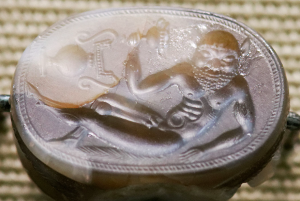
Seal carved in intaglio from a piece of agate,
mid 6th c. BC, Etruscan—depicts a satyr or
faun with a jug of wine.
Photo by Marie-Lan Nguyen, 2011.
c. for on him has God the Father set his seal/for the Father, God, sealed him | τοῦτον γὰρ ὁ πατὴρ ἐσφράγισεν ὁ θεός [touton gar ho patēr esfragisen ho theos]: Seals were a crucial verification tool in Classical Antiquity, used for validating ownership, conducting business transactions, confirming military and diplomatic instructions (and correspondence generally), and indicating that a given decision had the force of law behind it; given their many potent associations, seals were also sometimes used as amulets. Forging a seal was a very serious act of fraud—the kind of thing you might do to an enemy in a war; forging a state or royal seal was treasonous.
What Christ means by this “seal” that God the Father has set on him is less immediately clear. Throughout the New Testament, the Holy Ghost is often described as sealing the faithful, so this could be an allusion to the descent of the Dove at his baptism, described all the way back in 1:32. This theme will certainly be picked up in chapter 7, and it also chimes with this text’s many allusions to the prologue (see notes f-j).
The immediately preceding context in chapters 5-6 suggests another interpretation, which is not mutually exclusive with the previous: that the miracles, or in chapter 5’s language the “works,” which he has been given to do authenticate him. The New Testament contains hints that the Lord’s miracles are acts of the Spirit; in fact, this may be crucial to the Church’s sacramental life, since all of the sacraments (and especially the Eucharist) are, strictly speaking, miracles, if invisible ones:
Verily, verily, I say unto you, He that believeth on me, the works that I do shall he do also; and greater works than these shall he do; because I go unto my Father. And whatsoever ye shall ask in my name, that will I do, that the Father may be glorified in the Son. … And I will pray the Father, and he shall give you another Comforter, that he may abide with you for ever; even the Spirit of truth; whom the world cannot receive …: but ye know him; for he dwelleth with you, and shall be in you. … At that day ye shall know that I am in my Father, and ye in me, and I in you.
—John 14:12-13, 16-17, 20
d. to … that/that … that | ἵνα … ἵνα [hina … hina]: The word ἵνα (among others) functions a little like the English “so” in some ways. In a narrative context, ἵνα can suggest that some event is the result of a previous event, as it were “without comment”; alternatively, it can indicate a purposive or intended connection between one event and the next, and if I’ve estimated correctly, this latter use is more common in the New Testament. Still, translating it with the same English word or phrase is not possible in absolutely all cases—though for anyone who’s interested, my frequent use of “in order that” is virtually always a rendering of ἵνα. In this pair of verses, my usual rendering wouldn’t make any sense of the text, so I settled for just translating it the same way when it appeared two times in close and obviously connected succession.
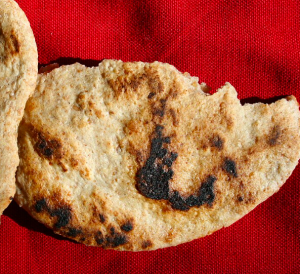
e. So they said to him, “Then what sign do you do, that we may see, and believe you? What work do you perform? Our fathers ate the manna in the wilderness; as it is written, ‘He gave them bread from heaven to eat.’”/Then they said to him, “Then what sign do you [do], in order that we may see it and have faith in you? What work do you [do]? Our fathers ate the manna in the desert, just as it is written: ‘Bread from heaven he gave them to eat.'” | εἶπον οὖν αὐτῷ· Τί οὖν ποιεῖς σὺ σημεῖον, ἵνα ἴδωμεν καὶ πιστεύσωμέν σοι; τί ἐργάζῃ; οἱ πατέρες ἡμῶν τὸ μάννα ἔφαγον ἐν τῇ ἐρήμῳ, καθώς ἐστιν γεγραμμένον· Ἄρτον ἐκ τοῦ οὐρανοῦ ἔδωκεν αὐτοῖς φαγεῖν. [eipon oun autō: ti oun poieis sü sēmeion, hina idōmen kai pisteusōmen soi? ti ergazē? hoi pateres hēmōn to manna efagon en tē erēmō, kathōs estin gegrammenon: arton ek tou ouranou edōken autois fagein]: Exodus 16 gives us our first account of the miraculous manna on which the Israelites subsisted in the wilderness; a second account of the stuff appears in Numbers 11. Exodus 16:15 says that “when the children of Israel saw it, they said one to another, ‘It is manna‘: for they wist not what it was” (making “whatsit” a pretty exact English equivalent, which I would use if I were translating a text from Hebrew into English). Manna is a (flawed) transcription of מָן הוּא [mân hú’], which in Hebrew can mean either of two things:
- “What’s that?”
- “Who’s he?”2
What manna was is debated; honeydew (an excretion of certain insects, consisting mostly of sugar) is a common suggestion, though one with certain definite problems. Of course, the debate presupposes that manna was ever an identifiable natural foodstuff in the first place, and even if it was, it might not still be identifiable today.
That said, I’d like us all to acknowledge that this is hilarious. Lest I be misunderstood, I will immediately add: the hilarity is not due to the crowd being complete morons who don’t understand, or have already forgotten, that they’ve already witnessed this guy performing a pretty remarkable miracle.
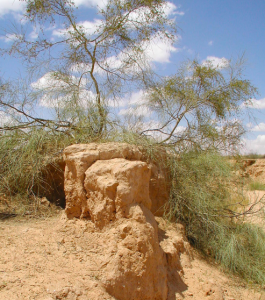
A tamarisk tree in the Negev (tamarisks are
associated with insect species that produce
honeydew). Photo by Michael Baranovsky,
used via a CC BY-SA 3.0 license (source).
Here’s the situation. It’s established later on in chapter 6 that this dialogue occurred in the synagogue of K’far-Nachum, to which at least some of the truly massive crowd who had partaken in the miraculous feeding had come afterwards. This presumably means that this appeal for a sign was being made by a “mixed multitude”: one part of them were immediate eyewitnesses of the miracle, who sound like they had come from various towns in the Galilee; another part were native K’far-Nachumites who happened to be at synagogue that day (we’re not told it was a sabbath, and since the partakers crossed the Sea of Galilee by ship apparently on the same day, it probably wasn’t, as such a journey is several times further than rabbinic sabbath strictures allow). The hilarity is that apparently at least some eyewitnesses were not only trying to get more delicious bread out of him—which is definitely thinking small, but probably also what I would have done, really—but were doing so by hinting, and with the subtlety of an Andrew Lloyd Weber soundtrack. Such requests may have been picked up from a very different angle by residents of K’far-Nachum who were there in the synagogue but hadn’t been present for the miracle, and wanted to see it for themselves, whether out of attraction to spectacle or attraction to free lunch. Stunning lack of awareness that the eyewitnesses had just seen a miracle was not—at least, was not necessarily—this audience’s problem.
One might, however, tax them with an ominous choice of quotation. They are alluding to Psalm 78; below are vv. 12, 19-25, and 30-32:
Marvelous things did he in the sight of their fathers,
…in the land of Egypt …
Yea, they spake against God; they said …
“Behold, he smote the rock,
…that the waters gushed out,
…and the streams overflowed;
can he give bread also?
…can he provide flesh for his people?”
Therefore the Lord heard this,
…and was wroth:
so a fire was kindled against Jacob,
…and anger also came up against Israel;
Because they believed not in God,
…and trusted not in his salvation:
Though he had commanded the clouds from above,
…and opened the doors of heaven,
And had rained down manna upon them to eat …
Man did eat angels’ food:
…… But while their meat was yet in their mouths,
The wrath of God came upon them, and slew the fattest of them,
…and smote down the chosen men of Israel.
For all this they sinned still,
…and believed not for his wondrous works.
f. Moses/Mosheh | Μωϋσῆς [Mōüsēs]: It may seem a little odd that Yeshua brings him up here. The people of K’far-Nachum didn’t say anything about Mosheh—it might almost come across as disparagement. I don’t believe that it is: Mosheh guided the Israelites for forty years between the Exodus and the entry into Canaan; he was closely associated with the manna (which his intercession with the Lord had secured). Furthermore, in seeking the Lord with a ludicrously culinary motive, the K’far-Nachumites are closely echoing the complaint of the “mixed multitude” from the description of the manna in Numbers. This casts Yeshua in the role of Mosheh. What does this mean? or suggest?
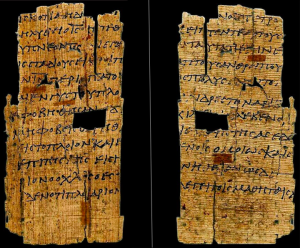
The recto and verso sides of Papyrus 28, a
fragment from a late 3rd-c. copy of the Gospel
of John containing a few verses of chapter 6.
The Lord spoke of the Torah as a witness to himself just in the last chapter; he clearly has a high opinion of it: nonetheless, way way back in the prologue, we were advised that “the law was given through Mosheh—grace and truth came to be through Yeshua the Anointed”, and that “we all took from his fullness, and grace in place of grace”. There’s clearly some sense in which Christ claims to transcend, or add to, or perfect, what was given through Mosheh. Similar language is used here to that which appeared in chapter 4: there, he promised a “spring of living water welling up to eternal life,” while here it is “the living bread” which “if any man eat of it, he will live for ever.” Christ’s living water in chapter 4 was contrasted with the water of Jacob’s well: “anyone who drinks this water will get thirsty again”; Christ’s living bread, too, is contrasted with the manna which “the fathers ate, and are dead.” That resonates a little uncomfortably with John 5:39: “[Ye] search the Scriptures; for in them ye think ye have eternal life”.
In any case, this all seems to be building to something … It is, also, building on the statement that “what came to be in him was life, and this life was humans’ light.” Cf. notes g, h, i, and j.
g. Jesus, the son of Joseph, whose father and mother we know/Yeshua the son of Yousef, whose father and mother we know | Ἰησοῦς ὁ υἱὸς Ἰωσήφ, οὗ ἡμεῖς οἴδαμεν τὸν πατέρα καὶ τὴν μητέρα [Iēsous ho huios Iōsēf hou hēmeis oidamen ton patera kai tēn mētera]: This, a mere name-drop, is the Fourth Gospel’s sole mention of St. Joseph. I hadn’t realized that when I began this translation series (I’d forgotten John spoke of Joseph by name at all), so it’s a delightful coincidence that this passage goes up on the Solemnity of St. Joseph!
Interestingly, although John contains no record of the unsuccessful visit or visits paid to Nazareth that are related by the Synoptics, the complaint here is similar in wording to the murmurs recorded in Matthew 13 and Mark 6;3 moreover, it is at the beginning of the next chapter that we will see at least some of the Lord’s family described as not believing in him. Materially, this reflects—or if you prefer, fulfills—the line from the prologue that “He came to his own, and his own people did not receive him.” Thus, in the middle of chapters 6-7, which as described in last week’s postscript provide us with a sort of symbolic masque of “the Threefold Exaltation” that will be the chief subject of the Book of Glory (roughly, chapters 12-21), we get a definite backwards glance at the prologue, which becomes more pronounced as we make our way through this discourse. Cf. notes f, h, i, and j.
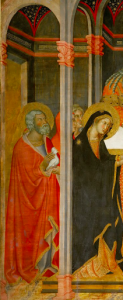
St. Joseph and the Theotokos presenting their
Son in the Temple (1388), by Bartolo di Fredi.
h. to me/before me | πρὸς ἐμέ [pros eme]: The appearance of πρὸς here is extremely normal: people use prepositions; it’s not that deep, man! But I draw attention to it thus, because I have a hunch that this is a deliberate verbal echo of the prologue’s use of πρὸς. As discussed in textual note c of my first post on the prologue of the Gospel of John, using the preposition πρὸς in a “with” sense, while possible, is quite unusual—and if my hunch is correct, this is the second time our evangelist has done it. He has just evoked the incarnation of the Logos, which is the climax of the prologue. Now, he quietly nods back to its very first sentence by repeating the preposition he put to such unusual use there. Cf. notes f, g, i, and j.
i. Not that any one has seen the Father except him who is from God; he has seen the Father/Not that anyone has seen the Father except he who exists from God—this one has seen the Father | οὐχ ὅτι τὸν πατέρα ἑώρακέν τις εἰ μὴ ὁ ὢν παρὰ τοῦ θεοῦ, οὗτος ἑώρακεν τὸν πατέρα [ouch hoti ton patera heōraken tis ei mē ho ōn para tou theou, houtos heōraken ton patera]: Note h was debatable. Here, the echoing of the prologue becomes too clear and loud to mistake.
God, no one has ever seen; only-begotten God, who is in the lap of the Father, this one has explained him.
Not that anyone has seen the Father except he who exists from God—this one has seen the Father.
Cf. notes f, g, h, and j.
My awkward “exists from” in place of the much simpler “is” calls for a little explanation as well. This represents a form of the verb εἰμί [eimi], “to be,” but not the normal present indicative form (which would be ἐστί [esti] or ἐστίν [estin] for the “who is” of him who is from God). We instead have ὢν, a participial form. Participles are also called verbal adjectives. In English, participles are the forms of a verb that end with –ed or –ing—e.g., if you cook something, it has been cooked, and the word “cooked” can play the part of a verb or an adjective depending on context.4 This points to “being” as a sort of attendant property, almost an activity: a hyper-literal translation might read “Not that anyone has seen the Father except the one being from God” or “the one existing from God.”
j. my flesh | ἡ σάρξ μού [hē sarx mou]: The choice of σάρξ here, depending on whether or to what extent the author of John was acquainted with Greek philosophy, could indicate a deliberate turn away from philosophy as an influence. Let’s unpack why.

Decorated cross marking a grave in Ekshärad,
Sweden. Photo by T. S. Eriksson, used via
a CC BY 3.0 license (source).
Σῶμα [sōma] would be a possible alternative. That word means “body,” and, not unlike the English pair body and flesh, σῶμα as contrasted with σάρξ accents the bodily form or structure more than the “stuff” which composes it, whereas σάρξ more particularly points to the “meat,” the “stuff.” (“Flesh” is just about a perfect rendering, as σάρξ also covers the, well, flesh of a piece of fruit.) Σῶμα can to some extent equate with -body, i.e. the use of the word body as a kind of catch-all semi-pronoun in somebody, everybody, and anybody, where it is indicating “person” or “people.” That’s not really referencing the soul-body dichotomy, still less pointing to one half of it or the other. (When St. Paul states in I Corinthians 15 that we will be raised with a σῶμα πνευματικόν [pneumatikon], a “spiritual body,” it’s tempting to render the phrase as “spiritual self” or “spiritual nature.”)
What has this got to do with philosophy? Well, in Plato’s Cratylus, a dialogue describing Socrates’ conversation with a Heraclitean philosopher of that name,5 a famous pun is made between σῶμα and σῆμα [sēma].6 The latter word means a barrow or tumulus (or, for those who recall their post-Telmarine Narnian history, a how): a mound of earth, typically the size of a small hill, raised over a grave or collection of graves. Hence, σῆμα more or less equates with “tombstone, monument,” and the pun in question was that “the body is a tomb”—a notion most fully embraced by some schools of Gnosticism, despite being denigrated by not only the primitive Church but by the Middle Platonist and Neoplatonic schools, whose intellectualism the Gnostics seem to have wished to court.7 The deliberate use of σάρξ and not σῶμα could, perhaps, point to a determination on the evangelist’s part not to have this passage excessively spiritualized; a resolute insistence that what Yeshua is talking about here is very much a physical, material thing: something “which was from the beginning, which we have heard, which we have seen with our eyes, which we have looked upon, and our hands have handled.”
However, all of this is speculation. Moving back onto solid ground, this reference brings us back, full circle, to the zenith of the prologue, where our allusions began in v. 32 (note f above). After that comes the quiet nod between 6:42 and 1:14 (note g); then we go back to the trinitarian language of 1:1 in v. 44 (note h), and then drop all the way down to the closing line of the prologue, 1:18, in v. 46 (note i). Christ is weaving this “bread for the life of the world that is my flesh” into the divine life the Logos shares with the Father, and has always shared with him. This points us in plainer language to the idea expressed in II Peter, and a favorite refrain of the fathers:
His divine power hath given unto us all things that pertain unto life and godliness, through the knowledge of him that hath called us to glory and virtue: whereby are given unto us exceeding great and precious promises: that by these ye might be partakers of the divine nature, having escaped the corruption that is in the world through lust.
—II Peter 1:3-4, emphasis mine
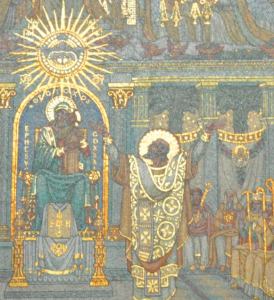
Detail from a mosaic8 in the Basilica of Our
Lady of Fourvière in Lyon, France. Photo-
graphed by Wikimedia contributor Palamède,
used via a CC BY-SA 4.0 license (source).
Cf. notes f, g, h, and i.
Postscript: Blue, Purple, and Scarlet Loose Threads
The following didn’t fit neatly into any one of the textual notes (though its contents came to me as I was working out my complete remarks in note f above). It concerns a possible pattern in chapters 4, 5, and 6 of John—a pattern woven back and forth across the “seam” between the arc of chapters 2-4 and the arc of chapters 5-10.
In note k of this post, I set forth a theory (or least, a conjecture) that there are signs in chapter 4 of John during the sequence in Samaria which point to its taking place around Purim. If so, then we have a curious little festal sequence running through chapters 4, 5, and 6: first Purim, then Shavuot (see note a in this post), then Paskha—proceeding backwards through the year.9 All three of these holidays are now (and perhaps already were) linked with one of the five books known as the Chamesh Megillot. Curiously, they are all linked with the three Megillot which are intimately concerned with women: Esther is read for Purim, Ruth for Shavuot, and the Song of Songs for Paskha. Don’t forget that the vast majority of the Song of Songs is a dialogue between Solomon and, as our translations make it, “the Shulamite”: שׁוּלַמִּית [Shúlamyth], which is the feminine form of שְׁלֹמֹה [Sh’lomoh], i.e. “Solomon”!10
Purim, the most recently-instituted feast of the bunch, is tied to Jewish identity and God’s faithfulness as both are seen in the midst of a Gentile context that can swerve rapidly between inattentive, murderous, and welcoming. This mirrors Passover, the oldest and greatest of Israel’s holidays and the supreme occasion to recall God’s faithfulness and the identity he stamped upon the Jews. (The vacillations of Pharaoh get a downright funhouse mirror in Esther, split between the temperamental and oblivious but ultimately friendly Ahasuerus and the invidious, malicious Haman.) Between these, in chapter 5, we find Shavuot, the solemnity upon which the Torah itself was given; this holiday had a special association with conversion to Judaism, as it was held to be the Jews’ own date of “conversion to Judaism” in their original reception of the Torah—hence the assignment of Ruth to this feast. This theme, while it does not clash per se with the rescue of the Jews from the midst of hostile Gentiles, is clearly not the same thing; conceptually, it rhymes rather than aligning. Of course, John also lightly subverts the atmosphere of Purim by placing the Lord in Samaria at the time, as part of a “Gentile-bound” arc of the book’s plot …
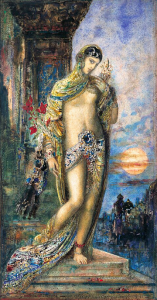
Song of Songs: The Shulammite Maiden (1893),
by Gustave Moreau.
To be honest, I ‘m not yet sure what to make of this! But it stuck out to me, and I wanted to make an explicit note of it rather than risk forgetting.
Footnotes
1If you’ve ever wondered: yes, there is (or was) such a thing as a cahoot in the singular! Though the etymology of “cahoot,” and thus of “cahoots,” is not certain, it seems definitely to have come into English from French—I’d have assumed it was Yiddish (and that it would be spelled kahootz, but it’s not). It appears the source was either cahute “hut, shack,” with further antecedents in Middle Dutch, or cohorte “group with a common cause or loyalty,” a native French inheritance from Latin.
2Do I think this foreshadowing of the Eucharist was, in human terms, an accident? Yes, absolutely: Hebrew only has two genders, and assigns all nouns and pronouns to either the feminine or the masculine (הִיא [hy’] is the feminine counterpart of הוּא), so it was fifty-fifty odds it’d align with the Person who, putatively, is Really Present in the Host. Do I nevertheless love this and find it extremely cool? Also yes.
3Luke 4 gives us a very different picture of Christ’s visit to Nazareth, in which the Nazarenes’ hostility reaches a far higher pitch—which is rather curious, since Luke tends to downplay conflicts most of the time. It’s hard to say whether this represents a different occasion, or two aspects of or moments in a single visit.
4Inflected Indo-European languages like Greek, English and Latin have participles because we habitually decline adjectives, i.e., we apply the same rules to adjectives that we do to nouns and pronouns, which take varying forms called cases according to their role in the sentence. Even today, English is inflected in various ways: we retain a three-case declension system for pronouns, distinguishing subjective, possessive, and objective cases—he-his-him, I-mine-me, we-ours-us, etc.; in Middle English we still did something similar for nouns and adjectives, and the declension paradigms of Latin or Ancient Greek were more elaborate still. However, not all languages deal with adjectives this way. Both Japanese and Korean conjugate adjectives, like verbs; in such a system, a clunkily word-for-word translation of their word for “red” might come out as “to be red.” I didn’t make it far in Japanese (and haven’t studied Korean at all), but if I understand correctly, Japanese accordingly does not have participles. I mean, (a) why would it?, and (b) how could it?
5The name of the philosopher, and thus of the dialogue, is pronounced krăt-ĭ-lŭs (see the guide here for further information). Not much is known about Cratylus. He lived in Athens in the fifth century BC, and was a Heraclitean, i.e. a disciple of Heraclitus of Ephesus, a notorious misanthrope who flourished in the late sixth and early fifth; he’s the old “can’t step in the same river twice” guy, because a significant part of his philosophy was that everything is in constant flux—always becoming, never simply being. Heracliteanism was an important and influential pre-Socratic school (opposed to the Eleatic school associated with Parmenides, who believed change was illusory), and resolving the philosophical difficulties posed by the idea of incessant flux was probably one of the motives behind Plato’s doctrine of the Forms. Heraclitus was also one of the early thinkers to lend importance to the term λόγος: by it, he appears to have meant something like “the law of nature” in the sense “the way everything works” (perhaps absolutely everything, i.e. even without distinction between the spiritual or abstract and the material). Unfortunately his work survives only in fragments, so scholars can’t really be certain what he meant by λόγος.
6Three puns are made with σῶμα in the Cratylus, really. However, the other two—relying on σημαίνει [sēmainei] “it indicates, it gives sign,” and σῴζηται [sōzētai] “it is saved, it is healed”—were not nearly so good as puns, and so far as I know never did as well, though we are entitled to find them rather fascinating in their own right.
7E.g., Plotinus, the father of Neoplatonism, devoted the ninth treatise of his Second Ennead to refuting “Those That Affirm the Creator of the Cosmos and the Cosmos Itself to be Evil.” For that matter, Plato himself evinces a certain disdain for the idea that “the body is a tomb” even within the Cratylus.
8The mosaic depicts the Council of Ephesus held in 431, where the Marian title Theotokos (usually translated “Mother of God”) was defined to be dogma, against the criticisms of Nestorius. The seated woman with the child is of course the Virgin with the Christ-child; the figure standing in the foreground is St. Cyril of Alexandria, the twenty-eighth Bishop of Alexandria, widely regarded then and now as the hero of the council (somewhat analogous to St. Athanasius for Nicæa I).
9Purim falls on 14th Adar, the twelfth (and/or thirteenth) month of the year in the Hebrew calendar as measured from Passover; Shavuot is on 6th Sivan, the third month; and Paskha is on 14th Nisan, the first month.
10Technically, שׁוּלַמִּית could in theory mean a woman from an unknown settlement called “Shulem,” or from the known town of שׁוּנֵם [Shúnêm]. But come on, it’s not—to put it in terms of our likeliest equivalent names, how many poets writing about a love affair, especially within the tradition of wisdom literature, could resist a pair of names like “Solomon and Solomona”? (The variance in vowels between Sh’lomoh and Shulamyth is quite normal in Hebrew, while the –th on the end of the latter is a characteristic feminine suffix, like –a, –ess, or –ette in English.)








 Ad-Free & Subscriber Log-In