

You can find my two-part introduction to the Gospel of John at these two links, and my index/outline for it here; for the previous installment on John 5:19-47, go here.
The Five Thousand and the Fifth Sign (John 6:1-21)
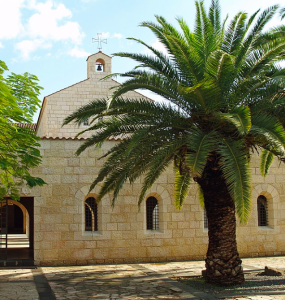
Church of the Multiplication in Tabgha,1 Israel.
Photo taken by David Shankbone in 2007,
made available via a CC BY-SA 3.0 license
(source).
I’ve translated most of this passage before, but that was a couple of years ago, and I’ve made a number of different choices this time around. If you’d like to look at the older version (though I’ve incorporated most of its salient content here), you can find it at this link. This time around, I’ve also included the next six verses. This full complement of twenty-one verses from the beginning of John 6 covers the fourth and fifth signs, and the second of John’s three dramatic nightfalls.
The feeding of the five thousand—the fourth of the seven signs of John—is one of the very few miracles recorded by all four of the canonical evangelists: the Synoptics’ versions of events can be found in Matthew 14:13-21, Mark 6:30-44, and Luke 9:10-17. We learn from the Synoptics in general that this took place not long after the mission of the Twelve (the one from Matthew 10, Mark 6:7-13, and Luke 9:1-6), and shortly after the Baptist’s execution. Mark adds the detail that the trip this miracle interrupted what had been supposed to be a retreat for Yeshua and his band, who were all exhausted. All three relate that this occurred in a “deserted place”; Luke fixes the location further, assigning it to the general vicinity of Beyt Tzayadh (Bethsaida)—which may explain why Yeshua turns to St. Philip in particular in v. 5. (Both Beyt Tzayadh and K’far-Nachum lie along the northern coast of the Sea of Galilee, but the former lies toward the northeast, where the latter is near the northwestern corner.)
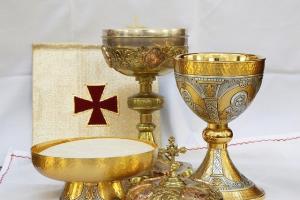
In combination with the creation of wine at Qanah in 2:1-11, which John alone records, this multiplication of bread points our minds toward the Eucharist. This establishes a theme which, strangely, continues through the fifth sign, Christ’s walking on water; this fifth sign is the only miracle he performs in John, and possibly the only miracle anywhere in the canonical Gospels (besides Yeshua’s own resurretion), that is specified to have taken place at night. The theming of these two signs is discussed further in the Postscript.
John 6:1-21, RSV-CE
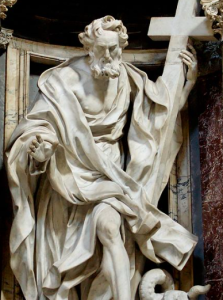
Statue of St. Philip (1711) in the Archbasilica
of St. John Lateran, by Giuseppe Mazzuoli.
Photo by Wikimedia contributor Jastrow,
used via a CC BY 2.5 license (source).
After this Jesus went to the other side of the Sea of Galilee, which is the Sea of Tiberias.a And a multitude followed him, because they saw the signs which he did on those who were diseased.b Jesus went up into the hills, and there sat down with his disciples. Now the Passover, the feast of the Jews, was at hand.c Lifting up his eyes, then, and seeing that a multitude was coming to him, Jesus said to Philip, “How are we to buy bread, so that these people may eat?” This he said to test him, for he himself knew what he would do. Philip answered him, “Two hundred denariid would not buy enough bread for each of them to get a little.” One of his disciples, Andrew, Simon Peter’s brother, said to him, “There is a lad here who has five barley loavese and two fish;f but what are they among so many?” Jesus said, “Make the peopleg sit down.” Now there was much grass in the place; so the meng sat down, in number about five thousand.g Jesus then took the loaves, and when he had given thanks, he distributed them to those who were seated; so also the fish, as much as they wanted.h And when they had eaten their fill,h he told his disciples, “Gather up the fragments left over, that nothing may be lost.” So they gathered them up and filled twelve baskets with fragments from the five barley loaves, left by those who had eaten.i When the people saw the sign which he had done, they said, “This is indeed the prophet who is to come into the world!”
Perceiving then that they were about to come and take him by force to make him king, Jesus withdrew again to the hills by himself.
When evening came, his disciples went down to the sea, got into a boat, and started across the sea to Capernaum. It was now dark, and Jesus had not yet come to them. The sea rose because a strong wind was blowing. When they had rowed about three or four miles,j they saw Jesus walking on the sea and drawing near to the boat. They were frightened, but he said to them, “It is I;k do not be afraid.” Then they were glad to take him into the boat, and immediatelyl the boat was at the land to which they were going.
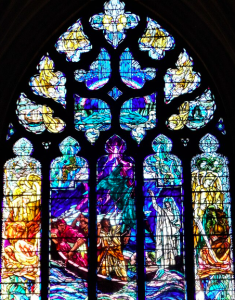
Christ walking on water, St. Giles’ Cathedral,
Edinburgh. Photo by Sheila1988, used via
a CC BY-SA 4.0 license (source).
John 6:1-21, my translation
After these things, Yeshua went away beside the Sea of Galilee ([or] of Tiberias).a Many crowds followed him, because they beheld the signs he did on the infirm.b Yeshua went up onto a mountain, and there he sat himself down with his students. It was nearc Paskha, the Jews’ feast. Then Yeshua lifted up his eyes and beheld that many crowds were coming to him; he says to Philip, “Where could we buy bread in order that these people might eat?” He said this, trying him, for he knew what he was about to do.
Philip responded to him: “Two hundred dinars’d [worth of] bread would not suffice them, so that each might take a little bit.”
One of his students, Andre the brother of Symeon Rocky, says to him, “A young boy is here who has five barley loavese and two sardines;f but what is that to so many people?”
Yeshua said: “Make the peopleg recline.” A lot of grass was in the place. So the meng reclined—about five thousandg in number. Then Yeshua took the loaves and, after giving thanks, he distributed them to those reposing [there], and likewise as many sardines as they wantedh too. When they were full,h he tells his students, “Gather the excess broken pieces, lest some be destroyed.” So they gathered [them], and packed twelve handbaskets with broken pieces from the five barley loaves that exceeded [the needs of] the diners.i
Then, seeing the sign which he did, the people said that “This is truly the prophet who is coming into the world.” So Yeshua, knowing that they were about to come and snatch him in order to make him king, withdrew back onto the mountain by himself.
As evening came on, his students went down to the sea, and getting into a boat they began to cross the sea to K’far-Nachum. Now, it had already gotten dark, and Yeshua had not yet come to them—also, the sea was aroused by a great wind blowing. When they had come about twenty-five or thirty furlongs,j they beheld Yeshua walking on the sea and coming near the boat, and they were frightened. But he says to them, “It’s me;k don’t be frightened.” So they wanted to take him into the boat, and straightawayl the boat came to the land for which they were heading.
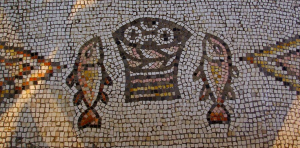
Floor mosaic from the Church of the Multipli-
cation. Photo by Berthold Werner, 2008 or earlier.
Textual Notes
a. , which is the Sea of Tiberias/([or] of Tiberias) | τῆς Τιβεριάδος [tēs Tiberiados]: The city of Tiberias was founded around 18-20 CE, serving as the capital of Philip the Tetrarch; it was named in honor of Emperor Tiberius, who had taken power around five years earlier. The city—which was initially majority-pagan in population, though it later became a significant Jewish locale—was prestigious enough that it soon lent its name to the adjoining “sea” (really a freshwater lake, occasionally called Lake Chinnereth).
b. those who were diseased/the infirm | τῶν ἀσθενούντων [tōn asthenountōn]: Etymologically, both diseased and infirm have a good claim to translate this participial derivate of ἀσθενέω [astheneō]. The Greek word derives from the prefix ἀ-/ἀν-, “not” or “un-” (known technically as the alpha privative), attached to a verb derived from the noun σθένος [sthenos], “strength, might” (which may be related to the Anglo-Saxon term ᛋᛏᛁᚦ [stīth], meaning “stiff; harsh, strict, severe”). The English words, meanwhile, are still transparent: dis- + ease, “that which removes ease or comfort, cause of suffering,” and in- + firm, “lacking in firmness, strength, or steadiness.”
I preferred the latter on the grounds that it fits ἀσθενέω better by being slightly broader in sense. Today, disease tends to mean specifically those obstacles to our ease that are caused by biological or viral parasites. It’d sound silly to say that someone with a broken leg has a “disease”; that’s an “injury,” which is a little different—and the same goes for issues like blindness (which might be caused by a disease or an injury, but is in itself a “disability” or “impairment”). Infirmity, on the other hand, suggests disability, but, if only by dint of being less frequently used, will tolerate a wider interpretation.
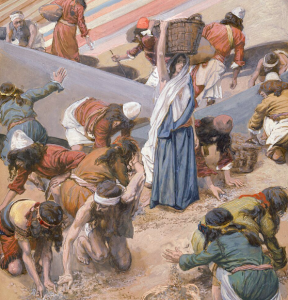
The Gathering of the Manna (c. 1900),
by James Tissot.
c. at hand/near | ἐγγὺς [engüs]: When used in a temporal sense (it is also a preposition), this word normally means near in the sense “approaching, in the short-term future.” I suspect that the evangelist is here using it, a little inaccurately (or at least irregularly), to suggest that Passover has just passed, since it generally aligns with the barley harvest and, as the text indicates, barley bread is already available; moreover, this timing aligns better the discourse we will soon be entering, which alludes to the manna of Exodus 16 and Numbers 11, a staple of the period known as the counting of the omer (the fifty-day stretch between Pesach and Shavuot, which in the Torah was the time the Israelites spent between the passage of the Red Sea on one end and the arrival at Mount Sinai on the other). However, since the Hebrew calendar uses a full leap month as its intercalary adjustment of choice, not to mention the variability of weather occasionally requiring adjustments, Passover’s exact date would obviously move around a bit relative to the barley harvest. So it’s perfectly possible that this took place before the Paschal festivities had begun.
d. Two hundred denarii/Two hundred dinars’ | Διακοσίων δηναρίων [diakosiōn dēnariōn]: This would equate to slightly over seven months’ pay for an unskilled laborer at the time. If we interpret a denarius as very roughly equivalent to $60 (based on current US minimum wage laws), the sum in question comes to around $12,000.
e. barley loaves | ἄρτους κριθίνους [artous krithinous]: Although it was in season, of the two principal cereals of the Holy Land, barley was definitely the bronze medallist. Barley was cheaper than wheat, due partly to the fact that it was coarser, with less protein and more fiber, and a less predictable number of grains per head; furthermore, wheat kept better, which may be one reason barley was even used as animal feed. On the whole, though everyone probably ate at least a little of both, barley bread was more associated with the poor, and wheat bread with the wealthy.
f. fish/sardines | ὀψάρια [opsaria]: I have perhaps taken a minor liberty here—an ὀψάριον [opsarion] did not necessarily mean a fish of the species Sardina pilchardus; in my defense, neither does “sardine.”2 A variety of fish species, mostly from the herring family, are sold under this name. This includes the “true sardine,” Sardina pilchardus, and that species’ range so these may literally have been sardines, but—based on the modern ranges of the following fish, anyway—they could also have been Sardinella aurita, the round sardinella, or the Sardinella maderensis, the Madeiran sardinella. (The name sardine is thought to be related to “Sardinia.”) At the time, ὀψάρια were treated a little like anchovies, i.e. used as a garnish on other foods, since they were plentiful (making them inexpensive) and salty.
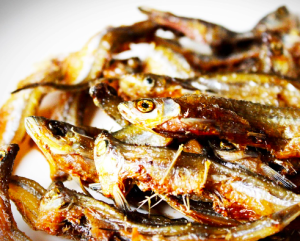
g. people … men … about five thousand | ἀνθρώπους … ἄνδρες … ὡς πεντακισχίλιοι [anthrōpous … andres … hōs pentaschilioi]: These “five thousand” are where this miracle gets its usual name, but this name is a definite misnomer. The text says explicitly that the enumeration was of ἄνδρες, which indicates only adult males being counted, as distinct from γυναῖκες [günaikes], women, or παῖδες [paides], children. Not every man who was part of this crowd would necessarily have had a wife or child in tow, of course; then again, not every woman would have had a male “chaperone,” and those who did bring children might easily have brought more than one in plenty of cases. The real total could easily have been fifteen thousand people, or even higher.
h. as much as they wanted … they had eaten their fill/as many … as they wanted … they were full | ὅσον ἤθελον … ἐνεπλήσθησαν [hoson ēthelon … eneplēsthēsan]: This is the Lord’s second miracle in the Fourth Gospel that relates to victuals,3 the first being the changing of water into wine back in chapter 2: the amount of wine made there (though probably impossible to calculate precisely) was well over a hundred gallons, and that was just for part of the festivities of one wedding. This miracle, though covering only a single meal, was doing so for a group that’s a couple orders of magnitude larger than the guests at Qanah! and still, these people weren’t just sustained—this is Hobbit-birthday-party level, “fat and happy” language.
i. those who had eaten/the diners | τοῖς βεβρωκόσιν [tois bebrōskosin]: The use of βεβρωκόσιν is interesting. It’s derived from βιβρώσκω [bibrōskō], a slightly archaic, formal term—hence my preference for a word with a slight but perceptible “elevated” ring to it.
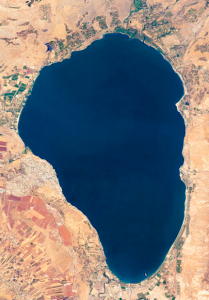
The Sea of Galilee (or of Tiberias) as seen
from space.
j. three or four miles/twenty-five or thirty furlongs | σταδίους εἴκοσι πέντε ἢ τριάκοντα [stadious eikosi pente ē triakonta]: Strictly, my English here is inaccurate. A furlong is about 660′, whereas a stadion or stade (a typical measurement of distance in the Hellenistic world, originally in reference to a track used for horse-racing) was only around 600′. However, especially in a book like John (where so many symbolic meanings are dropped in small details), I preferred to keep the number of units the same, especially since we had a customary unit that was so close.
As the Sea of Galilee is only about eight miles across at its widest, being twenty-five or thirty stades out means the apostles were likely close to the middle when Yeshua met them (depending on where exactly the miracle took place).
k. It is I/It’s me | Ἐγώ εἰμι [egō eimi]: Technically, both of these translations are slightly off. The Greek simply says “I am”—making this the second of the four evocations of the Tetragrammaton in the text of the Fourth Gospel.
l. immediately/straightaway | εὐθέως [eutheōs]: It is debated whether this indicates an “extra” miracle of instantaneous arrival at K’far-Nachum, or simply means that they made good time and arrived without further incident. I incline to the latter interpretation, but the text alone can’t settle the question.
Postscript: The Grand Foreshadowing
The first paragraph below is some of the text from this story (a little arbitrarily selected, but focusing on “plot”), re-punctuated slightly for flow. Compare it with the passage which follows; possible parallels are highlighted with the same color.
Yeshua went up onto a mountain, and there he sat himself down with his students. It was near Paskha, the Jews’ feast. Then Yeshua lifted up his eyes and beheld that many crowds were coming to him. Knowing that they were about to come and snatch him in order to make him king, [he] withdrew back onto the mountain. As evening came on, his students went down to the sea, and getting into a boat they began to cross the sea. It had gotten dark. They beheld Yeshua coming near, and they were frightened. But he says to them, “It’s me; don’t be frightened.” So they wanted to take him into the boat, and straightaway the boat came to the land for which they were heading.
When they had sung a hymn, they went out to the Mount of Olives. Then he said to the disciples, “Behold, the hour is at hand.” While he was still speaking, Judas came, one of the twelve, and with him a great crowd with swords and clubs, from the chief priests and the elders of the people. Then all the disciples forsook him and fled. And when they came to a place called Golgotha (which means the place of a skull), they crucified him. And over his head they put the charge against him, which read, “This is Jesus the King of the Jews.” From the sixth hour there was darkness over all the land until the ninth hour. And Jesus yielded up his spirit. Now after the sabbath, toward the dawn of the first day of the week, Mary Magdalene and the other Mary went to see the sepulcher. And behold, Jesus met them and said, “Do not be afraid; go and tell my brethren to go to Galilee, and there they will see me.”
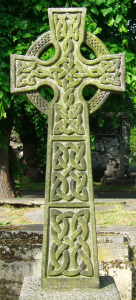
The latter is a ruthlessly condensed version of the RSV-CE’s Matthew 26:30-28:10—though the point could be made nearly as well from Mark 14:26-16:8 or John 18:1-20:20, and perhaps even better from Luke 22-24. As if for the express purpose of driving the parallel home, not only does John 6 conclude with our first explicit reference to the treachery of Judas Iscariot, but John 7 introduces the topic of the gift of the Holy Ghost. (This does not clearly specify whether this means the unique gift to the Apostles in John 20, which is the seal of their training for Holy Orders, or the gift to the Church in general in Acts 2, which is the first bestowal of Confirmation; 7:37 with its “anyone” language suggests the latter, but both events succeeded the Crucifixion and Resurrection—or, to pick up a phrase from chapter 3, the Son of Man being lifted up.)
The Bread of Life Discourse follows both this miracle, and the second nightfall with its own miracle. The first night in John saw mere incomprehension as an obstacle to faith for Nikodemos, at least for the time being. The situation has narrowed since then; after the second night, incomprehension intensifies in the people of K’far-Nachum into rejection and, on the part of many who had till now been following Yeshua, desertion. This motif of initial friendliness often turning into hesitation or embitterment is another common pattern in the Fourth Gospel.
This discourse is often cited by Catholics as the Lord’s teaching about the Real Presence, and so no doubt it is. It is also even more than that. Though it be “through a glass darkly,” chapters 6 and 7 are a foreshadowing of threefold sense in which (as he told Nikodemos) “the Son of Man must be lifted up”—from the ground on the Cross, from the grave on Easter, and from the face of the earth on the fortieth day—and the Holy Ghost, in turn, is to descend. This serves as a reminder that it is specifically the Body which did these things that is present in the Sacrament; these events are also made present in it, or in briefer language, re-presented.
Footnotes
1Tabgha—long a village of just a few hundred people, mostly Muslim but with a persistent Christian minority—has been extinct since 1948. It is home to a couple of churches, including the Church of the Multiplication, as Tabgha is its traditional site (though this tradition is probably wrong, since Tabgha is in the immediate vicinity of K’far-Nachum, so the idea of crossing the Sea of Galilee to get between the two doesn’t make any sense); this church suffered an arson attack in 2015, but has since been repaired. Tabgha is also home to, of all things, a unique species of troglobitic shrimp, the blind Typhlocaris galilea, adapted to life in a high-sulfur pool found there.
2The term sardine is probably related to the city name Sardis. This name may also have been passed on to two semiprecious stones: sard or sardius, more often called “carnelian” today, which is a reddish type of chalcedony; and sardonyx, a variety of onyx, which is a subspecies of agate, which is also a type of chalcedony—standard onyx has white and black bands, sardonyx has white and red. (Chalcedony is a silicate mineral, i.e. “sand being fancy”; the most familiar silicate mineral is good old quartz, which is an ingredient in chalcedony) It seems both carnelian and sardonyx were plentiful around Sardis, hence the transfer of the name.
3It honestly makes me quite angry that this word is not only pronounced “vittles,” but descends from the Middle English vitaile or vitaylle, which in turn comes from the Old French vitaille. It’s one of those etymological spellings, like the silent s‘s in “aisle” and “island.” However, at least in victuals, it does relate to the real origin of the word: vitaille comes from Late Latin vīctuālia (of essentially the same meaning)—yeah, we had to go back three etymological layers to get to it, but we have been amply rewarded by unearthing the reason for the word’s randomly-silent c, u, and a. Aisle and island don’t even have that excuse. The Latin ancestor of the former is āla, “wing” (French did us the discourtesy of adding an unpronounced s to that one); regarding the second, “that splendid brain-box, Dr. Johnson” assumed—incorrectly—that the word was related to the Latin insula and stuck an s in to illustrate this relationship that wasn’t there.






 Ad-Free & Subscriber Log-In