

I’m hoping for this post to serve not only as an outline of John, but also an index for my translation. I’m planning to come back and add links to this outline each time I complete a section of text; once I’ve finished (Lord willing!), this will then be usable as a kind of menu, to navigate to any section of John the reader chooses. Subdividing my own subdivisions may become necessary—for instance, I doubt I’ll be able to finish translating and annotating all of chapter 10 in a single week—so this outline is, unfortunately, subject to minor tweaks that I hope my readers won’t find too disorientating.
To read §§I-II of this introduction, which suggest other sources to read about John and discuss the book’s authorship and date, go here.
To read §§III-IV, which go over John’s content, style and themes, and relation to the other canonical Gospels, go here.
V. An Index/Outline of the Gospel of John
John is more tightly structured than some of the other Gospels. It falls basically into two unequal halves, conventionally referred to as the Book of Signs (chapters 1-11) and the Book of Glory (chapters 12-20). This is because the bulk of the miracles and homilies come in the first half of the book, while the second takes us through Holy Week.
I’ve inserted color-coded notes to help map out and time the progress of the Gospel—though I have not attempted to work out any precise dates, either absolute or relative, since John’s topical arrangement makes this impractical. The color-coding is as follows:
Dark red is used to highlight the four “I AM” declarations.
Scarlet is used to highlight the seven “I am the ___” statements.
Olive green with no small capitals indicates locations other than the seven cities; these other locations tend to be given in very general terms (e.g. the Sea of Galilee).
Dark green and SMALL CAPITALS indicate the seven cities. (I’ve also tried, alongside both the olive and dark green labels, to suggest with arrows [⇒] whether Jesus has just arrived in the location noted, is leaving it, or stays basically on the move throughout.)
Light blue is used to highlight the seven signs, i.e. pre-Resurrection miracles of Jesus.
Dark blue indicates the timing of the three nightfalls, and extends to those sections that fall during the night in question.
Purple and SMALL CAPITALS indicate the approximate timing of various festivals—the three celebrations of Pesach are distinguished with an א, a ב, and a ג. Purple also includes the Sabbath specified at the end of John 19, though as it isn’t exactly a festival, it has no small capitals.
EDITS: When I first posted this Index/Outline, I used the § (section) symbol alongside the segments here denoted in Greek letters; that symbol now indicates posted sections of my translation and commentary (which are distinguished both with chapter-and-verse references and with sequential Roman numerals in lower case). Additionally, I initially indicated the “seven signs” with underlining, before realizing that this might cause confusion once I introduced a host of links to the text! Those underlinings were exchanged for light blue color-coding. (Posted at 11:15 p.m. EST, 22nd Dec., 2025.)
I initially miscounted the “I AM” declarations which appear in this Gospel: there are not three, but four. This has been corrected, here and in the introduction, and the missing “I AM” statement inserted into the outline below. Additionally, one verse discrepancy affecting IVβ and IVγ has also been corrected. (Posted at 6:00 p.m. EST, 10th Feb. 2026.)
The Book of Signs
I. The Prologue on the Logos, 1:1-18
- §i: JOHN 1:1-13 (with a note on Trinitarian theology and the value of learning Greek)
- §ii: JOHN 1:14-18 (with a note on the sinfulness of antisemitism)
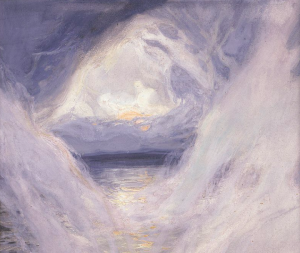
The Creation (ca. 1896-1902), by James Tissot.
II. The Beginning of the New Cosmos, 1:19-2:12
BETHANY-Beyond-Jordan
…..α. Day One: Light—An Examination of the Baptist, 1:19-28
- §iii: JOHN 1:19-28
YOM KIPPUR (?)
…..β. Day Two: Upper and Nether Waters—The Baptism of Christ, 1:29-34
…..γ. Day Three: Dry Land and Plants—The Calling of Andrew, John, and Peter, 1:35-42
- §iv: JOHN 1:29-42 (with a note on the apparent discrepancy among the Gospels on the calling of the Apostles)
BETHANY-Beyond-Jordan ⇒ the Galilee
…..δ. Day Four: Luminaries—The Calling of Philip and Bartholomew, 1:43-51
⇒ CANA
- §v: JOHN 1:43-51
…..ε. Day Seven: Sabbath—The First Sign (Multiplication of Wine), 2:1-12
- §vi: JOHN 2:1-12
⇒ CAPERNAUM
⇒ JERUSALEM
PESACH א
III. The Cleansing of the Temple, 2:13-22
- §vii: JOHN 2:13-22 (with a note on the literary genre of myth and its relevance to the Incarnation)
IV. Testimonies and Debates About Christ, 2:23-10:42
FIRST NIGHTFALL
…..α. The Witness of Nicodemus | Teaching on Birth From Above, 2:23-3:21
- §vii: JOHN 2:23-3:21 (with a note on the significance of the history and theology of the Pharisees)
⇒ AENON
…..β. The Witness of the Baptist | Teaching on the Bridegroom, 3:22-4:3
- §viii: JOHN 3:22-4:3
⇒ SYCHAR
PURIM (?)
…..γ. The Witness of Sychar | Teaching on the Living Water, 4:4-42 “I AM”
- §ix: JOHN 4:4-42
⇒ CANA
…..δ. The Witness of the Official | The Second Sign (the Healing of the Official’s Son), 4:43-54
- §x: JOHN 4:43-54
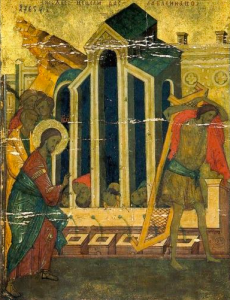
Ikon (anonymous and undated) of the healing of
the paralytic at Bethesda.
SHAVUOT (?)
⇒ JERUSALEM
…..ε. The Third Sign (the Healing of the Paralytic) | Teaching on the Father’s Work, 5:1-47
-
- §xi: JOHN 5:1-18
- §xii: JOHN 5:19-47
⇒ the Galilee
PESACH ב
…..ζ. The Bread of Life Sequence, 6:1-71
…………1. The Fourth Sign (the Multiplication of Bread), 6:1-15
SECOND NIGHTFALL
⇒ the Sea of Galilee ⇒
…………2. The Fifth Sign (the Walking on Water), 6:16–21 “I AM”
- §xiii: JOHN 6:1-21
⇒ CAPERNAUM
…………3. Teaching on the Bread of Life, 6:22-71 “I am the living bread” - §xiv: JOHN 6:22-51
- §xv: JOHN 6:52-71
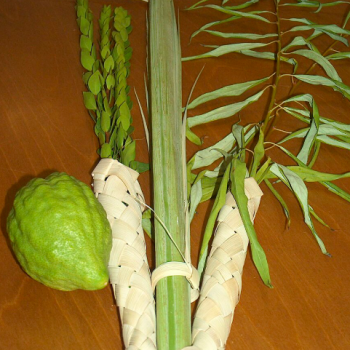
SUKKOT
…..η. The Feast of Tabernacles Sequence, 7:1-8:59 (excl. 7:53-8:11*)
the Galilee ⇒ JERUSALEM
…………1. A Review of Teaching on the Father’s Work, 7:1-31 - §xvi: JOHN 7:1-31 (with a note on the meaning of Ecclesiastes)
…………2. Adumbrations of Pentecost, 7:32-52
- §xvii: JOHN 7:32-52
…………3. Teaching on the Light, 8:12-59 “I am the light of the world”; “I AM”
- §xviii: JOHN 8:12-29
- §xix: JOHN 8:30-59
…..θ. The Sixth Sign (the Healing of the Man Born Blind), 9:1-41
CHANUKKAH
…..ι. Teaching on the Good Shepherd, 10:1-42 “I am the door of the sheep”; “I am the good shepherd”
JERUSALEM ⇒ BETHANY-Beyond-Jordan
V. The Seventh Sign (the Resurrection of Lazarus), 11:1-54
…..α. Christ Relates Lazarus’ Death to the Twelve, 11:1-16
BETHANY-Beyond-Jordan ⇒ BETHANY-of-Judæa
…..β. Christ Meets Martha and Mary, 11:17-37 “I am the resurrection and the life”
…..γ. Christ Raises Lazarus, 11:38-44
…..δ. The Prophecy of Caiaphas, 11:45-54
⇒ EPHRAIM
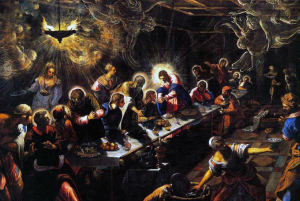
The Last Supper (1594), by Jacopo Tintoretto.
The Book of Glory
VI. The Preparation of the Lamb
PESACH ג
⇒ BETHANY-of-Judæa
…..α. The Anointing at Bethany, 11:55-12:11
⇒ JERUSALEM
…..β. The Triumphal Entry, 12:12-19
…..γ. The Veiling of the Light, 12:20-50
VII. Christ’s Last Will and Testament
…..α. The Maundy, 13:1-20
…..β. The Dismissal of Judas, 13:21-30
THIRD NIGHTFALL
…..γ. The Upper Room Discourse, 13:31-16:33
…………1. The New Commandment, 13:31-35
…………2. The New Way, 13:36-14:14 “I am the way, the truth, and the life”
…………3. The Paraclete, 14:15-15:17 “I am the true vine”
…………4. The Conquest of the World, 15:18-16:33
…..δ. The High-Priestly Prayer, 17:1-26
VIII. Christ’s Passion
…..α. The Arrest in Gethsemane, 18:1-12 “I AM”
…..β. The Ecclesiastical Trials | Peter’s Apostasy, 18:13-27
…..γ. The State Trial, 18:28-19:16
…..δ. The Crucifixion, 19:17-42
the Sabbath
IX. Christ’s Resurrection
…..α. The First Appearance, 20:1-18
…..β. The Second Appearance in Two Parts, 20:19-31
⇒ the Sea of Galilee ⇒ the Galilee
…..γ. The Third Appearance, 21:1-14
…..δ. Peter’s Reinstatement, 21:15-19
…..ε. The Epilogue on the Beloved, 21:20-25
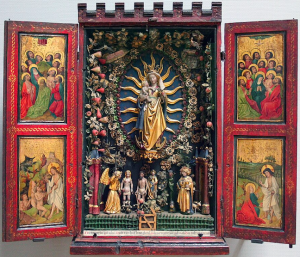
Hortus Conclusus [Enclosed Garden] (16th c.),
carved by an unknown Brabantine artist. Center:
the Daughter of Zion; left: the Ascension, the Har-
rowing of Hell; right: Pentecost, Noli Me Tangere.**
iii. Postscript
If you’d like to support my work, translating and commenting on the Bible to make it more accessible (especially to Catholics), prayer is always my foremost need. If you’d also like to contribute financially to my ability to devote the time that’s required to do this, you can do so through Patreon at my page, Our Lady of Antifa. Signing up as a recurring patron or making a one-time donation are both deeply appreciated. Speaking of which, my immense thanks to my current patrons (I really hope I didn’t miss anybody or scramble anyone’s name up!), who are helping me get by in a difficult season.
Kaiti Anderson
John & Greta Carswell (a.k.a. The Tolkien Road)
Mary Cieslak
Thomas Frei
Annette Goeres
Daniel Grant
Raph Graves
Willa Hoard
Alasdair Lechowicz
Phoebe Lim
Fr. Jacob Maurer
Susannah Myers
Sarah Rossiter
Ziad Shihab
Anita Simpson
Matthew Tiscareno
Footnotes
*These verses do not appear in the earliest and best manuscripts of John, differ slightly from the rest of the book in style, and interrupt the natural flow of the narrative; moreover, they are sometimes found in the Gospel of Luke instead (whose style they match better). Many scholars infer from this that they are properly part of Luke, and were detached from it either deliberately or by mistake, only to be reinserted later by another copyist—perhaps at the first opportunity he had.
**Nōlī mē tangere is a Latin phrase meaning “I do not want [you] to touch me,” or (more elliptically) “Touch me not.” It appears in the Vulgate as Jesus’ address to St. Mary Magdalene in John 20:17, and is therefore sometimes used as a shorthand for his appearance to her. (The original Greek says μή μου ἅπτου [mē mou haptou], of which a more natural translation is the rather gentler “Do not cling to me” or “Do not grasp me.”)







 Ad-Free & Subscriber Log-In