

You can find my two-part introduction to the Gospel of John at these two links, and my index/outline for it here; for the previous installment on John 6:22-51, go here.
The Bread of Life Discourse, Part II (John 6:52-71)

St. Peter’s Church in Capernaum, Israel.
Authorship unclear—used via a CC BY 2.0
license (source).
We now conclude the Bread of Life discourse, which completes the first half of the “grand foreshadowing” (discussed in the postscript two weeks ago), the part corresponding to the Passion. Chapters 7 and 8 will begin from Christ’s as-yet-metaphorical sealing in the tomb and proceed to the symbolic analogue of Pentecost; however, here the emphasis is different, placing more weight upon the “shadow” part of that description.
John 6:52-71, RSV-CE
The Jews then disputed among themselves, saying, “How can this man give us his flesh to eat?” So Jesus said to them, “Truly, truly, I say to you, unless you eat the flesh of the Son of man and drink his blood, you have no life in you; he who eatsa my flesh and drinks my blood has eternal life, and I will raise him up at the last day. For my flesh is food indeed,b and my blood is drink indeed. He who eats my flesh and drinks my blood abides in me, and I in him.c As the living Father sent me, and I live because of the Father, so he who eats me will live because of me.d This is the bread which came down from heaven, not such as the fathers ate and died; he who eats this bread will live for ever.” This he said in the synagogue, as he taught at Capernaum.
Many of his disciples, when they heard it, said, “This is a hard saying; who can listen to it?” But Jesus, knowing in himself that his disciples murmured at it, said to them, “Do you take offense at this?e Then what if you were to see the Son of man ascending where he was before? It is the spirit that gives life, the flesh is of no avail; the words that I have spoken to you are spirit and life.f But there are some of you that do not believe.” For Jesus knew from the first who those were that did not believe, and who it was that should betray him. And he said, “This is why I told you that no one can come to me unless it is granted him by the Father.”
After this many of his disciples drew back and no longer went about with him. Jesus said to the twelve, “Will you also go away?” Simon Peter answered him, “Lord, to whom shall we go? You have the words of eternal life; and we have believed, and have come to know, that you are the Holy One of God.” Jesus answered them, “Did I not choose you, the twelve, and one of you is a devil?”g He spoke of Judas the son of Simon Iscariot,h for he, one of the twelve, was to betray him.
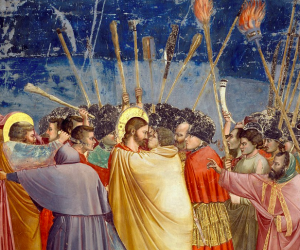
The Kiss of Judas (1306), by Giotto di Bondone.
John 6:52-71, my translation
Then the Jews began fighting with each other, saying, “How can this man give us his flesh to eat?”
So Yeshua told them, “‘Amin, ‘amin, I tell you, unless you eat the flesh of the Son of Man and drink his blood, you do not have life in yourselves. He who chews ona my flesh and drinks my blood has age-long life, and I will raise him again on the last day. For my flesh is a true dinner,b and my blood is a true drink. He who chews on my flesh and drinks my blood stays in me, and I in him.c Just as the living Father sent me, and I live because of the Father, he who chews on me also, that one too will live because of me.d This is the bread which came down out of heaven, not as the fathers ate and died; he who chews on this bread will live into the age.” (He said these things teaching in an assembly in K’far-Nachum.)e
Then many of his students who had heard this said: “This is a hard word; who can hear it?”
Yeshua, perceiving in himself that his students were murmuring, said to them, “Does this trip you up?f What then if you beheld the Son of Man going up where he was before? The spirit brings to life, the flesh does not profit nothing; the message which I have told you, it is spirit and it is life.g But there are some of you who do not have faith.” For Yeshua perceived from beginning, there were some who did not have faith, and a certain one who will give him over. And he said: “Because of this, I said to you that no one can come before me unless it is given to him from the Father.”
From this, many of his students left off [following] behind [him] and no longer walked around with him. Then Yeshua said to the Twelve: “Don’t you also want to leave?”
Symeon Rocky replied to him: “Sir, whom will we go off to? You have a message of age-long life, and we have had faith and known that you are the Holy One of God.”
Yeshua replied to them, “Did I not select you, the Twelve? Yet one of you is an accuser.”h He spoke of Yudah, [son] of Symeon Ysh-Qriyoth:i for this man was going to give him over—one of the Twelve.
Textual Notes
a. eats/chews on | τρώγων [trōgōn]: As most Catholic apologists will eagerly trip over their own feet to tell you, the verb τρώγω means “to eat, munch, chew on, gnaw. This is often interpreted as the Lord “doubling down” on the strange teaching he has just proposed to the K’far-Nachumites,1 and this in turn as implicit evidence that he is referring to his material body, not simply employing a vivid if off-putting metaphor for a faith so deep it “feeds on” Christ. After all (runs one form of this argument), if it were just a metaphor and the Real Presence is really absent from the Eucharist, then he had a duty to chase after those disciples who left, to explain things further to them, lest they abandon the gospel! Otherwise, he’d be—[slight choking noise] giving scandal.
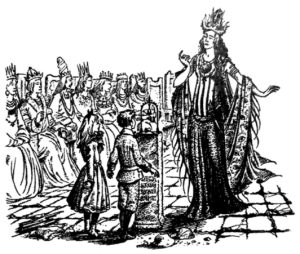
“Then I spoke the Deplorable Word. A moment
later I was the only living thing beneath the sun.”
—The Magician’s Nephew, C. S. Lewis; illustra-
tion, Pauline Baynes (provided for by fair use).2
Now, I’ve believed in the Real Presence since before I had even made up my mind to become a Catholic, but still, I’m skeptical of this outlook. Did the Lord switch from the commoner, more neutral ἔφαγον [efagon] to τρώγω to emphasize that this was about the Eucharist being a material, bodily, sacramental fact? I don’t know; it seems plausible. But using this as a “proof text”? That’s where I get suspicious. It’s noteworthy that, while Scripture frequently contains intertextual allusions between one book and another, it rarely does so with the “proof text” technique; especially when the New Testament refers itself to the Old, it often requires a little bit of ingenuity—frequently in the form of an allegorical reading—to “make” the verse in question relevant. (The Gospel of Matthew in particular is given to quoting Old Testament texts that were never about the Messiah in their original context, but are reinterpreted to be such by the evangelist.)
But let’s set all of that aside for a moment. Jesus had a specific mission on earth: that mission was not Get as many people in his movement as possible, as rapidly as possible, and keep them in the movement by arguing and cajoling as much as necessary. On the contrary, some of his statements in the other Gospels make it sound as though his teaching is deliberately cryptic:
And the disciples came, and said unto him, “Why speakest thou unto them in parables?”
He answered and said unto them, “Because it is given unto you to know the mysteries of the kingdom of heaven, but to them it is not given. For whosoever hath, to him shall be given, and he shall have more abundance: but whosoever hath not, from him shall be taken away even that he hath. Therefore speak I to them in parables: because they seeing see not; and hearing they hear not, neither do they understand. And in them is fulfilled the prophecy of Esaias,3 which saith,
…“‘By hearing ye shall hear, and shall not understand;
…….and seeing ye shall see, and shall not perceive:
…For this people’s heart is waxed gross,
…….and their ears are dull of hearing, and their eyes they have closed;
…lest at any time they should see with their eyes and hear with their ears,
…….and should understand with their heart,
…….and should be converted, and I should heal them.’
“But blessed are your eyes, for they see: and your ears, for they hear. For verily I say unto you, that many prophets and righteous men have desired to see those things which ye see, and have not seen them; and to hear those things which ye hear, and have not heard them.”
—Matthew 13:10-17
Why he would do this is something of a puzzle, but it seems to be an unavoidable fact that he did this—which pulls the scandal right out from under the apologetic line of thinking, or at least from the part of it that tries to build the whole doctrine of the Real Presence upon the single word τρώγω.
b. is food indeed/is a true dinner | ἀληθής ἐστι βρῶσις [alēthēs esti brōsis]: This is another allusion to the prologue, picking up from textual notes f through j from last week’s post, further reinforcing its apposition between Mosheh and Yeshua. The former obtained food (the manna) thanks to an outside source (God the Father), and those who ate that food nonetheless eventually died; the latter gives the bread of eternal life which is himself. In much the same fashion, “the Law was given through Mosheh—grace and truth came to be through Yeshua the Anointed.”
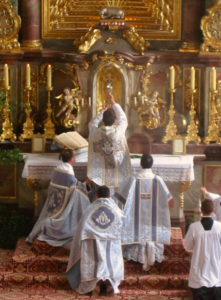
Elevation of the Host during an Extraordinary
Form liturgy. Photo by the Priestly Fraternity
of St. Peter (FSSP).
c. abides in me, and I in him/stays in me, and I in him | ἐν ἐμοὶ μένει κἀγὼ ἐν αὐτῷ [en emoi menei kagō en autō]: This alights upon one of the Fourth Gospel’s prominent themes: perseverance. The base meaning of the verb μένω [menō] (of which μένει is a form) is “to stay, remain, continue (in a place),” as contrasted with departing; it could also bear a sense of living or dwelling, as when in English we speak of having someone “stay with us” for a night or over the holidays or what have you. We have observed already that not everyone who initially welcomes Yeshua or benefits by his presence continues to do so (like the paralytic in chapter 5). This will ramp up in v. 66, in which even some of his own disciples desert; none of the Twelve do, certainly, but—given the pessimistic remarks of vv. 67 and 71—the implication seems to be that the ones who left were not members of the casual fringe of the movement. Only Luke records their mission, but I wonder whether some of those who deserted at this point were members of the Seventy; a work from the second or third century titled On the Seventy Apostles, attributed (probably inaccurately) to the Roman theologian St. Hippolytus, says in so many words that this was the case, and in fact identifies the evangelists Mark and Luke as among those who apostatized at this time (ascribing their return to the faith to St. Peter and St. Paul respectively).
d. As the living Father sent me, and I live because of the Father, so he who eats me will live because of me/Just as the living Father sent me, and I live because of the Father, he who chews on me also, that one too will live because of me | καθὼς ἀπέστειλέν με ὁ ζῶν πατὴρ κἀγὼ ζῶ διὰ τὸν πατέρα, καὶ ὁ τρώγων με κἀκεῖνος ζήσει δι’ ἐμέ [kathōs apesteilen me ho zōn patēr kagō zō dia ton patera kai ho trōgōn me kakeinos zēsei di’ eme]: This is a particularly astonishing assertion, in light of the relation the text has established between the Father and the Logos; it goes together with the quotation from II Peter in textual note j last week. (It also aligns, a little less directly, with one of my favorite moments in John, a stealthy nod contained in chapter 13, which we’ll come to.) A favorite maxim from the Church Fathers is that we become by grace what Christ is by nature: gods, as he is God; in the Eastern Orthodox Church, it is customary to describe the process of salvation unabashedly as theosis, divinization, for this very reason. That idea comes from texts like this one.
e. This he said in the synagogue, as he taught at Capernaum./(He said these things teaching in an assembly in K’far-Nachum.) | ταῦτα εἶπεν ἐν συναγωγῇ διδάσκων ἐν Καφαρναούμ. [tauta eipen en sünagōgē didaskōn en Kafarnaoum.]: As a reminder, our modern system of punctuation did not exist in Ancient Greek; in the original manuscripts of the New Testament books, it’s possible that the period (written . ) and the colon (written · ) were used, but nothing else. Hence, any time in the New Testament that you see commas, question marks, quotation marks, em-dashes, etc., these are interpretive decisions made by the translator, and this goes for parentheses too.
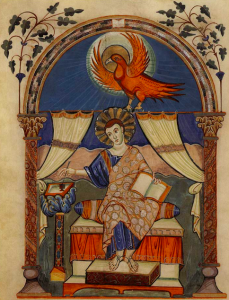
St. John the Evangelist as depicted in the
Lorsch Gospels (late 8th/early 9th c.), an
exquisite example of Carolingian art.
The insertion of this phrase at this juncture faintly suggests that there is some break in the action here. Stylistically, it reads a little bit like Genesis 2:4a, in the sense that although it comes at the end of the text it pertains to, it appears to be what we would describe as a “heading,” because we usually put those little descriptions up at the top of such a segment of text. If so, then the action from v. 60 forward may have occurred in a different setting, and been grouped together with this discourse on topical grounds.
f. Do you take offense at this?/Does this trip you up? | Τοῦτο ὑμᾶς σκανδαλίζει; [touto hümas skandalizei?]: A σκάνδαλον [skandalon] (the noun from which the verb σκανδαλίζω [skandalizō] is derived) originally indicated the snare of a trap. By the first century, it might denote any tripping hazard; tripwire wouldn’t be a bad rendering of the noun. It could be used in Hellenistic Jewish literature to indicate actions which were offensive—i.e., prompted others either to take offense, or to commit offenses themselves. This prompting-to-offend is still the basic sense borne by the term scandal in Latin Catholic moral theology.
Regrettably, the vernacular use of scandal has shifted more or less to “anything which is shocking in a negative sense; especially, that which brings disgrace when publicized.” The reason this is regrettable is not merely that the vernacular term has changed its primary sense. Words do that all the time. The problem is that the vernacular word has shifted to a meaning which is essentially different from the theological meaning, yet which will still easily fit into all the theological contexts grammatically: the sentences and passages will make perfect sense, whichever meaning is slotted in.4 In other words, we have here a recipe for misunderstandings of moral theology that are disastrously wrong, while also being extremely resistant to detection and correction. In this case, the most common form of the misunderstanding is the idea that anything which “scandalizes,” i.e. shocks, the average Catholic is therefore the sin of “giving scandal”; and that simply isn’t true. Explaining the Church’s teaching about economics shocks and offends plenty of Catholics, and yet that (when done with the right motive) is a spiritual work of mercy.5 Quite a crop of important terms are subject to similar problems, where the non-theological sense means something very different from what, say, the Catechism is trying to convey, but the document in question reads just as naturally either way. It’s hard for any reader without prior knowledge to just intuit that they’re giving the wrong meaning to disorder, or grave, or natural law, or necessary, or punishment.6
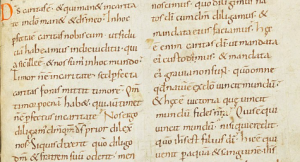
The need to correct for this exists (and is probably always going to exist) any time you have more than a single generation of theology written in a vernacular language: that’s just how fast language can evolve. Having the most-authoritative versions of the key material written in a dead language, forming a point of reference that doesn’t just change the same way living languages change, is a pretty good—albeit not perfect—solution to this problem, but part of its price-tag is that you therefore need a fresh crop of popularizers every twenty or thirty years; and you are welcome, future popularizers.
g. It is the spirit that gives life, the flesh is of no avail; the words that I have spoken to you are spirit and life/The spirit brings to life, the flesh does not profit nothing; the message which I have told you, it is spirit and it is life | τὸ πνεῦμά ἐστιν τὸ ζῳοποιοῦν, ἡ σὰρξ οὐκ ὠφελεῖ οὐδέν· τὰ ῥήματα ἃ ἐγὼ λελάληκα ὑμῖν πνεῦμά ἐστιν καὶ ζωή ἐστιν [to pneuma estin to zōopoioun, hē sarx ouk ōfelei ouden: ta rhēmata ha egō lelalēka hümin pneuma estin kai zōē estin]: Here we have what I think is one of the most-misinterpreted sentences in the canonical Gospels, and that is saying a great deal! Let’s discuss.
The words that I speak unto you, they are spirit (as the King James has it). Most “low-church” Protestant traditions—which, in the US, is the Christian mainstream7—reject the doctrine of the Real Presence, and tend accordingly to seize upon this verse as evidence that all this sermon’s talking of “eating my flesh” and “drinking my blood” are strictly figurative. The issue with this interpretation is, that’s not really what the text says; “the words I speak to you are spirit” is not a common way of denoting figurative language, and arguably not a way of denoting figurative language at all. I certainly can’t name any other examples of this phrase serving that purpose. The closest I can come up with is Revelation 11:8, and that isn’t particularly close.
So what is going on? I take this to be a statement about Christ’s message, i.e. about the content—what he’s saying, not whether he’s using a figurative or literal mode of expression to say it. He is saying that he is the bread of eternal life, and that message “is spirit,” is that which distinguishes the living, beating heart from a dead one: a metaphorical distinction, yes, but still a true one.
This, especially in conjunction with what I said in note a, may make it sound as though I want to downplay the Real Presence. I don’t! (I couldn’t even make sense out of someone believing in the Real Presence but “not wanting to focus on it too heavily,” if there is any such person; is there some other thing about the Sacrament that we should be focusing on as more important?) This is tied closely to note d above. The divine life that comes to us in the Eucharist … I mean, read John 6:26-58 some time, it’s a trip.
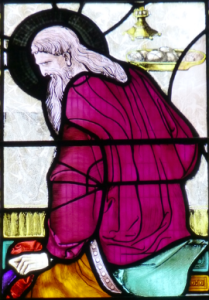
Judas Iscariot in stained-glass in the Church
of St. John the Baptist, Yeovil, England.
Photo by Wikimedia contributor GadgetSteve,
used via a CC BY-SA 4.0 license (source).
h. Did I not choose you, the twelve, and one of you is a devil?/Did I not select you, the Twelve? Yet one of you is an accuser | Οὐκ ἐγὼ ὑμᾶς τοὺς δώδεκα ἐξελεξάμην; καὶ ἐξ ὑμῶν εἷς διάβολός ἐστιν [ouk egō hümas tous dōdeka exelexamēn? kai ex hümōn heis diabolos estin]: The term διάβολος did not mean “devil” in contemporary Greek—it has acquired that meaning only through long association with the Biblical usage, itself presumably derived from the Hebrew title שָׂטָן [šâṭân] “adversary, enemy, plaintiff.” Obviously a statement like this would have been reinterpreted after the Passion in light of the, ahem, new evidence it furnished about the character of Judas; at the time, if this was for some reason originally said in Greek or if the Aramaic bore essentially the same range of meanings, I suspect it would have struck listeners along the same lines as One of you is an informer, or even One of you is a snitch.
i. Judas the son of Simon Iscariot/Yudah, [son] of Symeon Ysh-Qriyoth | τὸν Ἰούδαν Σίμωνος Ἰσκαριώτου [ton Ioudan Simōnos Iskariōtou]: The “name” Iscariot is actually a toponym meaning “man from Kerioth”: אִישׁ [‘ysh] “man” + קְרִיּוֹת [q’riyouth] “towns,” the latter of which was used as a place-name for Kerioth, a settlement in the northern Negev which had been part of the territory of Judah since pre-monarchic days. Judas is thus conspicuous as the only one of the Apostles to come from Judea proper; all the rest were from the Galilee. (That his father’s name was Simon, like St. Peter, was presumably no more confusing than the fact that St. Peter’s father may have been named John, or that there were two Judases and two Jameses, and by Pentecost sort of two Matthews, among the Twelve—not to mention that one more of the Apostles was just called “Twin.”)8
Footnotes
1I find that I want to call them “Kfarnacles.” I’m not sure this would help anything, though.
2More specifically, for those who are sadly unfamiliar: this quotation comes from Chapter V (duly titled “The Deplorable Word”), and can be found on p. 67 of the First Harper Trophy paperback of 2000. The character speaking, Jadis, is the same character who in Narnia comes to be known as the White Witch; Miss Baynes’ illustration depicts her, along with the principal juvenile protagonists of The Magician’s Nephew, namely Digory Kirke (the nephew of the title) and his friend Polly Plummer. (The magician of the title, Digory’s Uncle Andrew, does not appear directly in Chapter V, though its narrative does go a little out of its way to explain that unlike Jadis, he is “not seven feet tall and dazzlingly beautiful,” for those who may have been wondering.)
3I.e., Isaiah. The form Esaias more nearly aligns with the Greek form of the name, Ἠσαΐας [Ēsaïas], while Isaiah is meant to be derived more directly from the Hebrew יְשַׁעְיָהוּ [Y’sha3’yâhú]. (Slightly nearer equivalents would include Yeshayahu and Yshayahu; the name means “[TETRAGRAMMATON] is salvation.”)
4This is not a new problem, nor one exclusive to the theological realm. Part of the reason I speak so highly of C. S. Lewis’s Studies in Words is his frankly brilliant explanation of what he calls the “dangerous sense” of a word:
“When a word has several meanings historical circumstances often make one of them dominant during a particular period. … The dominant sense of any word lies uppermost in our minds. Wherever we meet the word, our natural impulse will be to give it that sense. When this operation results in nonsense, we see our mistake and try over again. But if it makes tolerable sense our tendency is to go merrily on. We are often deceived. In an old author the word may mean something different. … I shall often have to distinguish one of [a word’s] meanings as its dangerous sense, and I shall symbolize this by writing the word (in italics) with the letters d.s. after it. … [E.g.,] philosophy (d.s.) means ‘philosophy in the sense of metaphysics, epistemology, logic, etc. as distinct from the natural sciences’—the sense we are in danger of reading into it when old writers actually mean by it just science. … When the dangerous sense is a sense which did not exist at all in the age when our author wrote, it is less dangerous. … But often the situation is more delicate. What is now the dangerous sense may have existed then but it may not yet have been at all dominant. It may possibly be the sense the old author really intended, but this is not nearly so probable as our own usage leads us to suppose.” (Pp. 12-14—see my prefatory bibliography for further publication information.)
5Indeed, it may be two spiritual works of mercy at once: nearly always instructing the ignorant, and sometimes also rebuking the sinner.
6As I’ve given such specific examples, it seems only right to explain some ways these are frequently misunderstood even by educated people.
• Disorder. People think it means: a recognizably medical or psychiatric issue, as in “personality disorder.” What it means in the technical language of Catholic theology: a wrong prioritization or a misdirection, usually of loves.
• Grave. People think it means: life-or-death issue. What it means in the technical language of Catholic theology: serious; the broadly-construed opposite of “trivial.”
• Natural law. People think it means: the laws of nature, measured in mathematical detail by the sciences. What it means in the technical language of Catholic theology: the moral law meant to govern human nature, known (if imperfectly) by everyone.
• Necessary. People think it means: logically or absolutely required. What it means in the technical language of Catholic theology: needed, not optional, as in the sentence “It is necessary to eat to survive” (yes, you could technically replace your eating with an IV drip and go right on living, but that’s not really what that sentence is getting at).
• Punishment. People think it means: a penalty enforced by some agent for a given type of behavior that is (rightly or wrongly) deemed bad, often (not necessarily) giving some impression that the agent enjoys the act of punishing. What it means in the technical language of Catholic theology: the inherent consequences or effects of any genuinely bad action.
7It is worth noting that having a “low-church” form of Christianity as the vague social default is an extremely atypical quality, considering what Christianity is like in most places and has been like for most of its history. That it is atypical is not necessarily bad or good; the reason it’s worth noting is that this can give Americans a highly misleading impression of what Christianity-in-general is like. A large majority of the faith has been hierarchical and ritualistic for its entire existence—which is hardly surprising, as the offspring of a hierarchical and ritualistic parent faith. Moreover, before 1492, the forms of Christianity that throve in Eurasia, North Africa, and the Horn all belonged to the Assyrian, Catholic, Miaphysite, or Orthodox communions, which are all about equally “high-church”; after 1492, the forms of the faith that colonialism brought to the rest of Africa, the Americas, and Oceania were for the most part either Catholic or Anglican, which is again a “high-church” variety of Protestantism. The United States was originally colonized largely by British Dissenters of various kinds, and achieved independence from our mother country relatively early, so we are probably one of the few places that was ever likely to develop (or has in fact developed) a religious culture in which “low-church” Christianity was in any sense the norm.
8I personally favor the reading that makes Peter’s father a Jonah rather than a John: it would be easy to accidentally insert the more common John into a manuscript by sheer force of habit where Jonah was called for, but less likely for the reverse mistake to happen (or go unnoticed). For our own convenience in English, we usually refer to Saint Judas as “Saint Jude,” clipping off the ending; this distinction does not exist in Greek. Conversely, there is technically a distinction even in the Greek between Μαθθαῖος [Matthaios], “Matthew,” and Μαθθίας [Matthias], “Matthias,” but both are contracted derivatives of the Hebrew name מַתִּתְיָהוּ [Matith’yâhú]; they may have had the same name in Aramaic. Finally, the name תְּאוֹמָה [T’oumâh] is simply a slight elaboration of the word for “twin,” equating with the Greek δίδυμος [didümos]—whoever that’s about.













 Ad-Free & Subscriber Log-In