

You can find my two-part introduction to the Gospel of John at these two links, and my index/outline for it here; for the previous installment on John 4:43-54, go here.
The Third Sign, Part I (John 5:1-18)
In transitioning from chapter 4 to chapter 5 of the Gospel of John, we pass into the third arc of the book. Chapters 5 through 10 inclusive present us with a theological “cold war”—slowly heating up, and with several individual temperature spikes—between Yeshua and the religious establishment in Yrushalem. Only the Pryshaya are explicitly named in this Gospel as party to the conflict, which may suggest that it was written after the disappearance of the Tzaduqin1 (whom we know from Matthew to have been theological opponents of Yeshua)—in other words, after the Temple’s destruction. However, its depiction of the Pryshaya is nuanced, presenting figures like Nikodemos who question and complicate the generalized group hostility to Yeshua.
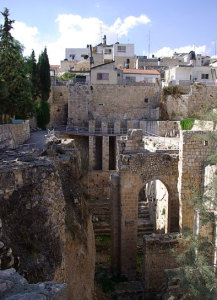
Ruins of a Byzantine church adjacent to the
Pool of Bethesda. Photo by Berthold Werner.
This arc opens with another miracle classed as a “sign” by the evangelist, Christ’s third. (The long homiletic discourses in this Gospel—most of which occur in chapters 5-9, except for the Upper Room Discourse—usually come in as commentary on some sign he has performed, or at least with the sign as a kind of pretext for a homily.) Thus far, narratively speaking, his only provocations of the establishment have been the cleansing of the Temple and, apparently, joining with the Baptist in performing baptisms; this episode in the text, however, prompts a clearer antagonism from the Pryshaya, as it involves a transgression of sabbatarian halakhah. It is no coïncidence that in this text, we also come to the first miracle in John that is fully public: his first was performed practically on the sly, and the second from miles away, but here he heals a man in person, indeed in a crowded spot (the Pool of Beyt Hesda, a.k.a. Bethesda).
John 5:1-18, RSV-CE
After this there was a feasta of the Jews, and Jesus went up to Jerusalem.
Now there is in Jerusalemb by the Sheep Gate a pool, in Hebrewc called Bethzatha,d which has five porticoes. In these lay a multitude of invalids, blind, lame, paralyzed. e One man was there, who had been ill for thirty-eight years. When Jesus saw him and knew that he had been lying there a long time, he said to him, “Do you want to be healed?” The sick man answered him, “Sir, I have no man to put me into the pool when the water is troubled, and while I am going another steps down before me.” Jesus said to him, “Rise, take up your pallet, and walk.” And at once the man was healed, and he took up his pallet and walked.
Now that day was the sabbath.f So the Jews said to the man who was cured, “It is the sabbath, it is not lawful for you to carry your pallet.” But he answered them, “The man who healed me said to me, ‘Take up your pallet, and walk.’” They asked him, “Who is the man who said to you, ‘Take up your pallet, and walk’?” Now the man who had been healed did not know who it was, for Jesus had withdrawn,g as there was a crowd in the place. Afterward, Jesus found him in the temple, and said to him, “See, you are well! Sin no more, that nothing worse befall you.”h The man went away and told the Jews that it was Jesus who had healed him. And this was why the Jews persecuted Jesus, because he did this on the sabbath. But Jesus answered them, “My Father is workingi still, and I am working.”i This was why the Jews sought all the more to kill him, because he not only broke the sabbath but also called God his Father, making himself equal with God.
John 5:1-18, my translation
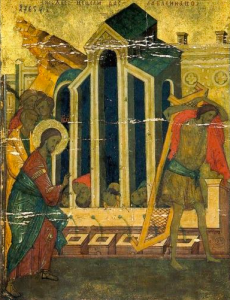
Anonymous, undated ikon depicting Christ
healing the paralytic of Bethesda.
After these things, there was a feasta of the Jews, and Yeshua went up to Yrushalem. Now, among the [districts of] Yrushalemb at the Sheepgate there was a pool, called in Aramaicc Beyt Hesda,d which has five porticoes; in these laid a throng of the infirm, the blind, the lame, the withered. e A certain person had been there for thirty-eight years in his infirmity; Yeshua, seeing him lying there, and knowing that he had already had a long time there, says to him: “Do you want to become healthy?”
The infirm man responds to him, “Sir, I have no person to throw me into the pool whenever the water is stirred up; while I am coming, someone else goes down in it before me.”
Yeshua tells him, “Rise—pick up your cot and walk around.” And straightaway, this person became healthy and picked up his cot and walked around.
Now, that day was a sabbath.f So the Jews said to the cured man: “It is sabbath, and you are not allowed to pick up your cot.”
He responded to them, “The man who made me healthy told me, ‘Pick up your cot and walk around.'”
Then they asked him, “What person is it that told you ‘Pick it up and walk around’?”
The healed man did not know who he was, for Yeshua had ducked outg among the crowd that was in the place.
After these things, Yeshua found him in the Temple and told him: “See, you have become healthy; do not sin any more, in order that no worse thing may happen to you.”h
The person left and explained to the Jews that it is Yeshua who made him healthy. And because of this, the Jews were coming after Yeshua—because he was doing these things on sabbath. He responded to them, “My Father, until this moment, is working;i I too am working.”i Then because of this, the Jews searched rather [for a way] to kill him, because he not only loosened the sabbath, but also said his own father was God, making himself equal to God.
Textual Notes

a. a feast | ἑορτὴ [heortē]: Based on the themes of the homily in the latter half of chapter 5 (which we will leave mostly for Part II), this festival is most likely Shavuot. This took place fifty days after Passover, hence its Greek name, Πεντηκοστή [Pentēkostē] “fiftieth.” Nor were the two feasts only similar via proximity in the calendar. As Passover marks the barley harvest in the Holy Land, so Shavuot marks the wheat harvest; Shavuot is also the second of the three great pilgrimage feasts. (We will encounter the third, Sukkot or the Feast of Tabernacles, in chapters 7-8.)
Shavuot commemorates the ancient Hebrews’ arrival at Mount Sinai after the Exodus, where they received the Torah—the distinctive ritual mark of which was the observance of the sabbath.2 Moreover, this is, in a punning sort of way, the perfect festival on which to zero in on the sabbath, which is the day on which this miracle takes place and a controlling theme of the homily. The name שָׁבוּעוֹת [shâvú3outh] literally means “weeks,” “sevens,” or “se’ndays” (שָׁבוּעַ [shâvúa3] is the singular), but a week could also be referred to as a שַׁבָּת [shabâth], a sabbath: the two terms were thus similar in sound, written appearance, and meaning. Shavuot is also the festival on which the book of Ruth is read in the synagogue: the key action of the book (by which Ruth is linked to Boaz) takes place during the wheat harvest, and its heroine’s movement from Moab to Judah—and the respective deities of those two places—is held to parallel the Israelites’ movement from Egypt to Sinai.
b. in Jerusalem/among the [districts of] Yrushalem | ἐν τοῖς Ἱεροσολύμοις [en tois Hierosolümois]: Oddly, to our minds, the name of Jerusalem is plural in form in both Hebrew and Greek: the native יְרוּשָׁלַיִם [Y’rúshâlaym] (note the –ym ending, standard for Hebrew masculine plurals) becomes Ἱεροσόλυμα [Hierosolüma] (which has the form of a neuter3 plural). Most often this isn’t noticeable in the text, and it’s not uncommon to find an irregular, indeclinable4 form in Greek, Ἱερουσαλήμ [Hierousalēm]; here, its number is detectable from the ending -οις, used for dative plurals,4 and from the fact that it appears with the definite article, τοῖς. (This is one of many examples of Greek using the definite article rather differently from how we use ours in English; anything that is itself definite can take the article in Greek, even if it’s a proper name, whereas English—a little arbitrarily—rules out the use of the article with most proper names, except in a few cases like The Hague.) Jerusalem is not the only city to have a plural-form name: e.g., the –s of “Athens” represents the plural ending of the name Ἀθῆναι [Athēnai], which would be the plural form of the name of the goddess Athene if it made any sense to speak about multiples of her! However, for some reason, this morphological element is most often ignored in English, and a nearest-Anglophones-can-manage approximation of the actual sounds of names forms the basis of English names for foreign places instead. I decided to give this plural, “the Jerusalems,” a nod by the bracketed phrase.
c. Hebrew/Aramaic | Ἑβραϊστὶ [Hebraisti]: I’ve taken a small liberty with the Greek here: Ἑβραϊστὶ properly means “in Hebrew” (or rather, since it is an adverb, “in the Hebrew style” or “Hebrewly”); as far as I know, the Greeks did not habitually speak of Aramaic at this time, though I understand they began to speak of Συριακή [Süriakē], “Syriac,” by the turn of the second century. The difference between Classical Hebrew, which was still spoken here and there in the Holy Land, and the more usual Achæmenid Aramaic used by most local Jews, was not really observed by the Greeks; this was especially true since Hebrew and Achæmenid Aramaic were very similar structurally and phonetically, and also shared a large amount of vocabulary—not unlike the difference between English and Dutch today.

The beginning of the Shema from a Siddur5
(a Judaic prayer-book, equivalent to the
Liturgy of the Hours in Catholicism), made
available via a GNU Free License (source).
d. Bethzatha/Beyt Hesda | Βηθεσδά [Bēthesda]: The second element in the name Beyt Hesda is an Aramaic loan from the Hebrew חֶסֶד [chesedh]—an important term in Judaic theology (especially Kabbalism), meaning “kindness, love, benevolence, goodness (to someone); loyalty; piety.” The Judaic theological “center” from which the Pryshaya and the Essenes both derived had been known as the חֲסִידִים [Chàsydhym], “the Pietists.” (Chasydhym6 in this sense should not of course be confused with modern Hasidic Jews, a charismatic and mystical movement within Orthodox Judaism, whose origins lie in Eastern Europe during the eighteenth century.)
Some manuscripts instead feature the name Bethzatha—a reading preferred by the RSV, obviously. It’s possible that –zatha represents a sort of “mishearing” of Hesda/-esda: shifting back and forth between s and z, a very closely linked pair of sounds, occurs in a lot of languages, and although d and th may not seem very similar, the voiced version of th (this version) is almost as closely related to d as z is to s. A few manuscripts read Bethsaida here, but this is almost certainly an error. Bethsaida is often referenced in the New Testament and is noted in this gospel as St. Philip’s hometown; it would be very easily mixed up with Bethesda/Beyt Hesda.
e. — | {ἄγγελος γὰρ κυρίου κατὰ καιρὸν ἐλούετο ἐν τῇ κολυμβήθρα καὶ ἐτάρασσε τὸ ὕδωρ· ὁ οὖν πρῶτος ἐμβάς μετὰ τὴν ταραχὴν τοῦ ὕδατος ὑγιὴς ἐγίνετο οἵῳ δήποτ’ οὖν κατείχετο νοσήματι.} [angelos gar küriou kata kairon eloueto en tē kolümbēthra kai etarasse to hüdōr: ho oun prōtos embas meta tēn tarachēn tou hüdatos hügiēs egineto oiō dēpot’ oun kateicheto nosēmati.]: The meaning of the Greek text I’ve placed in curlicue brackets, which appears in the Textus Receptus but not in the version supported by the Society for Biblical Literature (whose text I typically base my translation upon), is as follows:
For at times, a messenger of the Lord would bathe in the pool and roil the water; then, the first to go down in after the roiling of the water became as healthy as if he had never been in the grip of sickness.
In Bibles translated from the Textus Receptus, like the King James, this forms vv. 3b-4 of John 5. In the earlier and better manuscripts of John (e.g. the Codex Ephraemi Rescriptus, Codex Sinaiticus, and Codex Vaticanus, three of the four “Great Uncial Codices”7), this sentence does not appear—so if your Bible skips from v. 3 to v. 5 here, that’s probably why.
Selection from Archangel Raphael With Bishop
Domonte (mid-to-late 17th c.), by Bartolomé
Esteban Murillo. The name Raphael means
“God heals.”
These events are of course not impossible (not from a Christian point of view, anyway); however, the sort of miracle it describes is atypical of Scripture, and more reminiscent of magic.
- Unless the verb is strictly metaphorical (which to be fair it may be), the angel to which this miracle is attributed apparently either needs or likes to bathe, which is more anthropomorphic than the Bible’s usual picture of angels.
- The curative powers assigned to the water seem to be an unintended side-effect of the angel’s bath, rather than a deliberate sign indicating God’s presence or the authenticity of a revelation, which are more normal Biblical contexts for miracles.
- Further, this is apparently a recurring miracle, occurring apart from any promise on God’s part; this again is not impossible, but it’s quite atypical, and arguably counts against this verse’s legitimacy when set alongside the other dubious traits it assigns to the Pool of Beyt Hesda.
- Finally, and to my mind the most suspicious quality: the healings are apparently “first past the post,” giving the whole affair a weirdly mechanical quality, reminiscent of a children’s game.
The man Yeshua heals alludes to the content of this sentence, and that may easily have been a folk belief in Yrushalem at the time whether it was true or not. Perhaps this verse started out as a marginal gloss, merely noting the belief for unfamiliar readers in order to explain v. 7, and the gloss was later miscopied into the text itself.
f. the sabbath/sabbath | σάββατον [sabbaton]: In the Mishnah,8 there are thirty-nine distinct headings for m’lakhoth, or kinds of creative work considered forbidden by the precept of resting on the sabbath.9 It is worth pausing to review them, to get a better idea of the sort of thing Yeshua and the rest of the Pryshaya were contending about, so I’ve listed them below. Most are also prohibited on Jewish holidays; some (e.g. #4 and #7) have more relaxed rules on holidays in order to allow for the, you know, festive aspect of feasting.
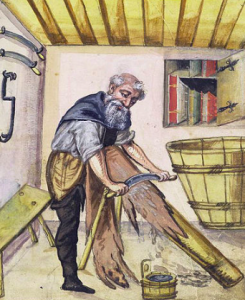
Anonymous depiction of a tanner (1609)
from Nuremberg—see #22 below.
- אוֹרֵג [‘ourêgh], Weaving: creating fabric, normally by using a loom. Cf. #11, #18, #23, #31.
- בּוֹנֶה [bouneh], Building: also rendered “construction”; this applies to putting up structures, from towers to tents, and to preparing the pieces for doing so (e.g., you can’t put all the timber for a wall together, leave it lying on the ground, and then say you haven’t broken the rule against בּוֹנֶה because you didn’t actually put the wall “up”). Cf #30.
- בּוֹרֵר [bourêr], Sorting: or “purification”—separating undesirable from desirable things in a mixed mass. This is partly why gefilte fish became a popular sabbath dish, since (being made of ground-up fish) it has no bones to remove and therefore cannot violate the rule against בּוֹרֵר. This rule also has certain particular exceptions, such as sorting silverware one is about to use to eat sabbath dinner. Cf. #6, #8, #27.
- בִּשׁוּל [bishúl], Cooking: alternatively, אוֹפֶה [‘oufeh] “baking.” Generally, altering the properties of food or drink by applying heat.
- גּוֹזֵז [gouzêz], Shearing: as #35, but applied to animals; thus, getting a haircut falls under this rule.
- דָּשׁ [dâsh], Threshing: or “extraction.” The idea here is separating an undesirable outside from a desirable inside (normally by hand). Cf. #3, #8, #27.
- הוֹצָאָה [houtzâ’âth], Transferring: more specifically, transferring objects from one type of domain to another. Five types of domains are recognized in rabbinic Judaism: private spaces; public streets; exempted portions of public streets; open public areas; and uninhabited areas. (All five are defined less by ownership than by enclosure via walls, fences, etc.) This category is often mis-translated “carrying,” but carrying something inside of a single domain is perfectly lawful.
- זוֹרֶה [zoureh], Winnowing: same as #6, but done by exploiting the force of air.
- זוֹרֵעַ [zourêa3], Planting: not just sowing, but “promoting plant growth.” Cf. #10.
- חוֹרֵשׁ [chourêsh], Plowing: any preparatory labor for agriculture. Cf. #9, #18, #23, #24, #31.
- טוֹוֶה [ṭouweh], Spinning: i.e., twisting fibers into thread. Cf. #1, #18, #23, #31.
- טוֹחֵן [ṭouchên], Grinding: or “dissection.” This covers reducing something from its natural size for some productive purpose—cutting up fruits and vegetables for a salad, for instance. Since creating medicine usually involves this at some stage in the process, most applications of sabbath law to medicine fall under this heading. (However, those applications are in turn limited by the principle of pikuach nefesh [“watching over life”], which not only permits but actually mandates the breaking of all laws governing the sabbath for the sake of saving human life, and pikuach nefesh itself is interpreted broadly—e.g., taking a woman in labor to the hospital falls under this exception even if nothing is expected to go wrong during her labor.)
- כּוֹתֵב [kouthêv], Writing: this rule appears to go particularly far back; if this article on the Al-Yahudu tablets found in Iraq is accurate, it can be detected in Jewish documents dating to the Exilic period (at the link, see the heading “Jewish lifestyle and attitude toward Zion”). Cf. #17.
- לָשׁ [lâsh], Kneading: more correctly translated “amalgamation,” the mixture of two substances. “Kneading” came to be used even though that activity is not really what this term refers to, because the amalgamate produced must be of a dough- or paste-like type (not something pour-able) to fall under this rule.10
- מַבְעִיר [mav’3yr], Igniting: lighting or spreading fire (which is why the candles for shabbat must be lit just before sunset on Friday). In modern times, this is held by some Jews to prohibit the use of electricity on the sabbath. Cf. #19.
- מְחַתֵּךְ [m’chathêkh], Cutting: cutting an object to a specific size, normally as part of the process of #2.
- מוֹחֵק [mouchêq], Erasing: more exactly, cleaning any surface to make it suitable for writing. Cf. #13.
- מֵיסַךְ [mêysakh], Warping: this isn’t an activity we do much any more, since most of our textiles are machine-made, or at any rate made in a way we don’t habitually see, but warping refers to the preparatory work for weaving on a loom. Cf. #1, #10, #11, #23, #24, #31.
- מְכַבֶּה [m’khabeh], Extinguishing: i.e., deliberately putting out or dimming a fire (allowing a fire to go out by itself, however, since this just means not actively feeding it, is fine). Cf. #15, and also, for the question of fires threatening human life, the parenthetical note about pikuach nefesh in #12.
- מַכֶּה בְּפַּטִּישׁ [makeh b’paṭysh], Finishing-touching: literally, “stroke with the hammer” (a description perhaps derived from metalworking, whether for practical goods or artistic purposes, where tapping things into place with a hammer or mallet is a common finishing touch). Alternate translations include “fine-tuning,” “completing,” and “perfecting”; the idea is that of putting things into a ready-to-use state. This is a rather wide-ranging category, due to being rather abstract—e.g., tuning a guitar and adding hot water to a container of Cup Noodles both transgress this rule.
- מְלַבֵּן [m’labên], Scouring: or “laundering”—cleansing an absorbent material of stuff it has absorbed. Vaguely akin to #3.
- מְמַחֵק [m’machêq], Smoothing: sometimes rendered “sanding,” connecting it with #2, but originally conceived of as part of the tanning process. Cf. #25.
- מְנַפֵּץ [m’napêtz], Carding: also translated “combing,” in reference to the process of preparing raw wool to be spun into thread and then used to weave; this covers the disentangling of fibers in general. Cf. #1, #10, #11, #18, #31.
- מַפְשִׁיט [maf’shyṭ], Skinning: or “flaying”—removing the hide from a dead animal, part of the total process of leather-making. Cf. #10, #18, #23, #31.
- מְעַבֵּד [m’3abêdh], Curing: alternately, “preserving” or “salting.” This originally arose in the context of tanning hides, but also extends into the culinary, covering the salting or pickling of foods (as a preservation method—sprinkling salt on food for the taste is not in view here). Cf. #22.
- מְעַמֵּר [m’3ammêr], Gathering: e.g., of fallen apples from an orchard.
- מְרַקֵּד [m’raqqêdh], Sifting: along the lines of #3 above, but done by means of a tool dedicated to the purpose; using a French press to make coffee, for example, qualifies as מְרַקֵּד. Cf. also #6, #8.
- מְשַׂרְטֵט [m’šar’ṭêṭ], Scoring: i.e., drawing or incising a line for later cutting; cf. #2, #16. (Why, what did you think it meant?)
- מַתִּיר [mathyr], Untying: separating any two objects connected by the means of either #37 or #39. Cf. also #36.
- סוֹתֵר [southêr], Demolishing: since creative work is held to be especially in view, this may seem like a counter-intuitive heading of forbidden activity; however, this means demolition particularly as part of the process of #2.
- עוֹשֶׂה שְׁתֵּי בָּתֵּי נִירִין [3oušeh sh’têy bâtêy nyryn], Making two loops: another part of preparation for weaving. Cf. #1, #10, #11, #18, #23, #24.
- פּוֹצֵעַ [poutzêa3], Unraveling: general opinion makes this “separating two threads” (such that things like tearing a cotton ball apart would be transgressions of the rule). However, the Rambam11 makes this category בּוֹצֵעַ [boutzê’a3], or “unweaving” in a stricter sense, and thus only applicable to fabrics proper.
- צָד [tzâdh], Trapping: deliberately confining a living animal. (This is—I love this detail—not held to apply to animals which move so slowly that they “come pre-trapped,” like tortoises or snails.12)
- צוֹבֵעַ [tzouvêa3], Dyeing: this includes both imparting a given color to something that does not have it, and enhancing the color of something that does.
- קוֹצֵר [qoutzêr], Reaping: the base definition here is taken to be “severing at least part of a plant from its source of growth.”
- קוֹרֵעַ [qourêa3], Tearing: ripping an object in two, usually in reference to fabric (though not necessarily). Cf. #5, #29, #35, #39.
- קוֹשֵׁר [qoushêr], Tying: joining two pliable objects—rope, wire, carefully worded promises to a genie—by means of twisting. Cf. #29, #39.
- שׁוֹחֵט [shouchêṭ], Killing: i.e., killing animals; killing humans is already covered and is not sabbath-specific. (You may notice the similarity, or rather identity, between this term and shochet, a butcher qualified to slaughter animals in accord with kashrut.)
- תּוֹפֵר [toufêr], Sewing: sometimes “joining” is used instead, as this applies to any means of creating a single object out of two: sewing, yes, but also stapling, gluing, welding, etc. Cf. #29, #37.
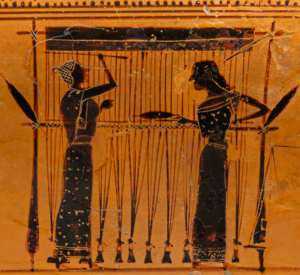
Weavers depicted on a 6th-c. BC Greek urn
—see #1 above.
g. withdrawn/ducked out | ἐξένευσεν [exeneusen]: The verb νεύω [neuō] (from which ἐκνεύω [ekneuō] is derived, and of course ἐξένευσεν is a form of ἐκνεύω) meant “to nod, gesture, signal,” and ἐκ generally means “of, from, out of.” Hence, to ἐκνεύω was, in its original form, something like “to jerk your head [toward the door] in order to signal ‘let’s get out of here.'” By this time, it had become something closer to “to leave quietly, slip out”—I decided to use the idiom “duck out” because it preserves a little of the mental image of a head movement.
h. Sin no more, that nothing worse befall you/do not sin any more, in order that no worse thing may happen to you | μηκέτι ἁμάρτανε, ἵνα μὴ χεῖρόν σοί τι γένηται [mēketi hamartane, hina mē cheiron soi ti genētai]: I forget where I read this, but somewhere in one of the Church Fathers (I think), this is interpreted as a statement of how serious the consequences of sin are. We don’t often think of being morally culpable for something as a state that’s worse than being paralyzed, yet this is quite clearly implied by the basic assumptions of Christian morals.
It’s worth highlighting this interpretation because of the way it aligns with one of the key messages of the book of Job, i.e. that suffering is not necessarily punishment for sin (a motif which will return more explicitly in chapter 9). Christians, like Jews, like everyone with any belief in a powerful deity of any sort, are apt to falling into the habit of supposing that anything they do not like is a punishment for something they either have a bad conscience about, or did just before the thing they don’t like started happening to them.13 This technically can be true; for instance, if the thing you don’t like is a nasty headache you got by slipping on ice and banging your head very hard, then the fact (if it is a fact) that you disobeyed the law of prudence by walking over the ice too quickly in unsuitable shoes is, in its fashion, a sin for which the headache is a “punishment,” though “consequences” is a better and more usual word. But that isn’t generally the sort of thing we’re imagining when we frame suffering in these terms. We’re thinking about a cartoon version of God, one who arbitrarily zaps you for being naughty. Why we’re so prone to this thought, I’m not sure—though it may be as simple as the fact that it suggests the comforting corollary But if I just Behave (which I surely shall any moment now despite not cultivating the habit), then I won’t suffer. I regret to inform my readers that this is false.
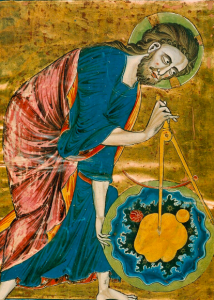
Dieu l’Architecte de l’Univers [God, the Archi-
tect of the Universe], frontispiece of the 13th-c.
Bible Moralisée [Morals From the Bible].
i. is working … am working | ἐργάζεται … ἐργάζομαι [ergazetai … ergazomai]: Here, we get an important echo of the “beginning of the new cosmos” described in chapters 1 and 2. Glance back at the end of the Bible’s first account of the creation; you’ll notice that the seventh day, although it records God resting, has nothing to say about evening and morning making the seventh day or anything along those lines. Why?
On the one hand, this is because the sabbath is a window onto the eternity of God, whose peace is not subject to interruption. In that sense, the Father is not working,9 but of course in that sense he never has. On the other, this is because God’s work was in another sense not finished on that first sabbath, nor has been on any sabbath since, or we would have ceased to exist: though the line is quoted from a heathen poet, it is if anything truer for the austerely creationist Judaism than for its original writer that “in him we live and move and have our being.” This is why Yeshua’s words are, correctly, interpreted by “the Jews” in this passage as amounting to, if not outright constituting, a claim to deity. We have seen this theme already, starting from the very prologue of the Fourth Gospel. It is then hinted at late in chapter 1, touched upon in a single phrase of chapter 2, and given another nod in the middle of chapter 4; however, all of these allusions have been in ways that had a certain amount of what we might call “plausible deniability” about them—they aren’t professions of divinity. If we recollect what the Logos really is both in Hellenistic Jewish thought and in John specifically, this is.
Footnotes
1I.e., the Sadducees: Tzaduqin is, to the best of my knowledge, the Aramaic form of a word that, in English, would probably come out as Zadokites. This referred to a specific priestly lineage for whom, according to one hypothesis, the Sadducees were named. Note, however, that whereas the Synoptics group the Pryshaya together with “the scribes” as allied but discrete groups (the Pryshaya were a theological school, whereas being a scribe was a profession), John never mentions the scribes as such—and scribes had certainly not disappeared from Judaism! It is possible that John’s sole focus on the opposition to Yeshua from fellow Pryshaya had some other cause.
2You may be thinking Wait a second, I thought circumcision was the mark of the Mosaic Covenant. However—and, coïncidentally, the Lord will be touching on this very point later, in chapter 7—circumcision marked the covenant made with Abraham (detailed in Genesis 17), not the covenant made through Moses.
3The shift from a Hebrew masculine to a Greek neuter may have taken place simply because cities are easily thought of as neuter; alternatively, it may have been due to a compromise between the gender of יְרוּשָׁלַיִם and the Greek πόλις, a feminine word. Hebrew, like many Semitic languages, has a two-gender system with no neuter category: all nouns, pronouns, and verbs are either masculine or feminine (i.e., verbs morphologically agree in gender with their subject—it’s not that Semitic verbs have an inherent gender limiting who can be their subject).
4In inflected languages like Ancient Greek, an indeclinable noun is a noun of an irregular type, one which fails to assume new forms (“cases”) based on its grammatical function; running through the different case-forms a noun can take is called declining that noun (and groups of nouns that decline along the same pattern form declensions). Indeclinable words are often, though not necessarily, foreign words (such as place names). They may contain some element that mixes poorly with the case affixes of the language in question—for example, it is exceedingly unusual in Greek to end any word with the m-sound. As for the dative case, which occurs in a great many inflected languages, this is usually employed for indirect objects and often has some type of prepositional function, as well as occasionally carrying a possessive meaning; when no other prepositions are present, datives can usually be translated by supplying a “to” or “for” in front of them in English.
5The top line of text transliterates (under the system I use, anyway) to Sh’ma3 Yiš’râ’êl [TETRAGRAMMATON] ‘Èlohêynú [TETRAGRAMMATON] ‘echâdh, and the bottom to Bârúkh Shêm k’voudh mal’khúthu l’3oulâm wâ3edh. The first, famously, means “Hear, O Israel, the LORD our God, the LORD is one”; I am not a good enough student of either Hebrew or Judaism to confidently translate the second or know it by acquaintance, but it looks like it means something like “Blessed be his Name, his glory, his kingdom, forever and ever” (and to my knowledge would not have been read aloud when actually praying the Shema, but served another function).
6More often transliterated Chasidim or, to distinguish them from the modern group, Chassidim with a double ‘s.’
7The Great Uncial Codices (the above three plus the Codex Alexandrinus) are a collection of originally complete copies of the Bible, made in the fourth and fifth centuries. (The two oldest, Vaticanus and Sinaiticus, are theorized by some to have been parts of a set of three hundred Bibles ordered by Constantine for use in the churches of his new capital city.) Due to their immense age, and to the fact that they exhibit an Alexandrian text-type (see the section under the heading “A Textus Sayswhat?” in this post for details on why that’s, short version, a good thing), these codices are considered all but invaluable by textual critics.
8Put to papyrus in about 200 CE, the Mishnah (מִשְׁנָה [mish’nâh], “repetition”) is a compilation of the Oral Torah, and of rabbinic commentary up to that date upon the Oral Torah; it would go on to form the core of the Talmud. The Mishnah does not present us with a picture of Second Temple Judaism that can be straightforwardly applied to the time of Christ in every respect: after all, it is a collection of allusively-written religious case law! and, more significantly, it post-dates the destruction of the Second Temple by over a century. There are about eighty rabbis it commonly cites as authorities on halakhic questions; of these, three-quarters lived and wrote only after 70 CE, so that their views probably influenced Christianity before its separation from Judaism very little. Nonetheless, the form of Judaism the Mishnah describes—which was still led primarily by the Pryshaya, and was generally quite conservative (indeed, it is based on an earlier Mishnah written by R. Akiva ben Joseph, martyred during the Bar Kochba Revolt of 132-136)—is probably very close to the form Christ, his Mother, the Apostles, and all the members of the first generation or two of the Church grew up practicing.
9The specification “creative work” comes into m’lakhoth because of how Genesis 1:1-2:3 is composed. This account of the creation of the world and of mankind (one of two—the account given in 2:4-25 is quite different) was written, at least in part, to establish the solemnity of the sabbath, representing its rest not only as a divine commandment, but the imitation of a divine example. This fits into the description of man, in both sexes, as being made “in the image and likeness of God” (1:26-27); at the same time, this implies something about human nature and human work: the first thing the Torah has to tell us about God, before telling us that we are made in his image, is not that God is rational or holy or even good, but that he is a God who makes things.
10This calls into question my previous hypothesis (see footnote 6 on this post) that the Star Trek warp drive, due to its operating by mixture of matter and antimatter, would violate the command to keep the sabbath: I don’t know whether matter and antimatter (which normally annihilate one another on contact, releasing a gargantuan burst of energy—but this reckons without their filtration through dilithium crystals, securely established in Star Trek) combine into something that can be poured. Further research is clearly both needed and possible.
11I.e., Moshe ben Maimon, or Moses Maimonides (1138-1204), the principal exponent of Jewish Scholasticism (and an influence on St. Thomas Aquinas), and to this day one of the most revered scholars in the history of Judaism. The nickname “the Rambam” is an acronym in Hebrew letters: RMBM stands for Rabboni Moshe ben Maimon, “Our teacher, Moses son of Maimon”; RMBM then has a‘s inserted in the natural places according to the typical reading of Hebrew, and voilà, “Rambam.”
12Which I think means that even though cooking is forbidden on the sabbath, and consuming escargot is forbidden by kashrut, if it’s a Saturday and your French Christian neighbor asks you to give him any snails you may find in your house so he can make escargot, that’s allowed.
13The idea, which I’ve heard frequently in Christian preaching, that this is in some way a specially Jewish or Judaic vice, or one implied by the contents of the Hebrew Bible, is (a) antisemitic and (b) terribly silly. I mean, what do you want, an entire book of the Tanakh debunking it? Because, for the thirty-ninth time, we absolutely have that, it’s called Job—y’all are just too chicken to read it!







 Ad-Free & Subscriber Log-In